Sedation Dentist · Sleep for Dentistry Clinic Toronto
Sleep for Dentistry Clinic Toronto · International Dental Education
Read full bio
David's dental clinic is anesthesia-based, treating patients who require intravenous sedation or advanced techniques in local anaesthesia. Many of these people have special medical needs or are dental phobic.
David has given over 400 presentations around the world on topics related to the management of medical emergencies in healthcare settings, local anesthesia for dentistry and the use of sedation in dentistry. He has lectured for many university, continuing education programs, dental societies and conventions.
He is the author of numerous articles, has peer-reviewed papers for a variety of dental journals and as well has acted as a consultant for dental and pharmaceutical companies.
How has pain management in dentistry evolved from ancient tree resins to today's sophisticated anesthetic techniques, and what breakthrough innovations are reshaping patient comfort?
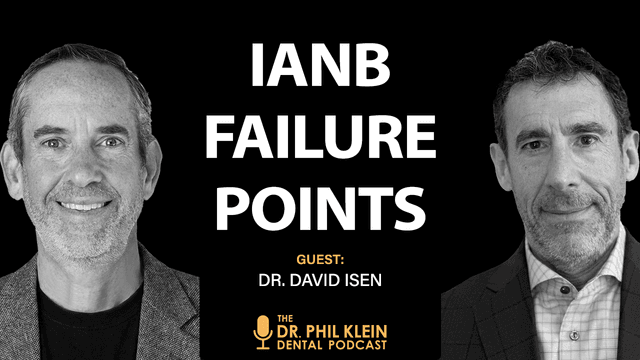
This episode features Dr. David Isen, who maintains a private practice in Toronto, Canada, running a Sleep for Dentistry clinic specializing in anesthesia-based care. Dr. Isen has delivered over 400 presentations worldwide on medical emergencies in healthcare settings, local anesthesia for dentistry, and sedation techniques. He has authored numerous articles, peer-reviewed papers for dental journals, and served as a consultant for dental and pharmaceutical companies, bringing decades of expertise in pain management and patient sedation.
The conversation traces the fascinating evolution of dental anesthesia, from 4,000-year-old Babylonian clay tablets describing tree resin pain relief to modern local anesthetic innovations. Dr. Isen explains how current anesthetic techniques work, why articaine offers superior tissue penetration compared to lidocaine, and how combining nitrous oxide with effective local anesthetics creates an optimal patient experience. The discussion also explores sedation dentistry protocols and emerging technologies that promise to transform pain control in dental practice.
Episode Highlights:
Articaine's hybrid ester-amide structure allows superior nerve membrane penetration compared to lidocaine, with its 4% concentration providing 72 milligrams of drug per 1.8ml cartridge and faster metabolic breakdown enabling safer re-dosing protocols. The thiophene ring structure enhances lipid solubility, prolonging anesthesia duration through better tissue protein binding.
Epinephrine in local anesthetics actually reduces systemic toxicity by keeping the anesthetic localized longer, while plain solutions like mepivacaine and prilocaine pose higher cardiovascular risks due to rapid systemic absorption. Most dental patients can safely receive epinephrine-containing anesthetics, as intraoperative pain causes more endogenous epinephrine release than the vasoconstrictor provides.
Nitrous oxide remains significantly underutilized, with only 60% of dentists administering it despite its excellent safety profile and rapid onset within 20-30 seconds. Proper titration can reach concentrations up to 70% nitrous oxide while maintaining minimum 30% oxygen, with modern delivery systems featuring failsafe mechanisms and scavenging systems for optimal safety.
IV sedation offers superior control over oral sedation because of its titratable nature, while oral benzodiazepines create guessing scenarios that cannot be easily reversed if overdosed or supplemented if underdosed during the same appointment. Conservative dosing with triazolam at 0.375-0.5mg can be effectively combined with IV midazolam for enhanced patient comfort.
Emerging long-acting local anesthetics like liposomal bupivacaine provide 72-hour anesthesia for surgical sites, potentially eliminating opioid requirements post-operatively, while intranasal tetracaine applications promise pulpal anesthesia from second premolar to central incisor without injections, though cost considerations at $250 per vial may limit initial adoption.
Perfect for: General dentists seeking to improve pain management protocols, dental residents learning anesthetic pharmacology, oral surgeons exploring advanced sedation techniques, and practice owners considering sedation dentistry integration.
Discover how modern anesthetic innovations can transform your patient experience while maintaining the highest safety standards.
Transcript
Read Full Transcript
This transcript was automatically generated and may contain errors or inaccuracies. It is provided for reference and accessibility purposes and may not represent the exact words spoken.
In fact, epinephrine makes a local anesthetic less toxic because it keeps it away from the cardiovascular system for a longer period of time. So the plane solutions like mepivacaine plane and prilocaine plane, they're readily available to the cardiovascular system when we inject those. And so they happen to have a little bit of a higher risk from a toxicity perspective.
Welcome to the Phil Klein Dental Podcast. Pain management has been a cornerstone of dental care for millennia, starting as far back as the ancient Babylonians who turned to nature's remedies like tree resin to soothe oral discomfort. These early beginnings laid the foundation for centuries of experimentation and innovation in the quest to make dentistry as comfortable as possible.
The 19th century introduced revolutionary methods with the use of ether, chloroform, and nitrous oxide, bringing newfound relief to patients. Then, in the early 1900s, the development of injectable local anesthetics changed the landscape of dentistry, enabling practitioners to perform intricate procedures with precision and ease. This, of course, has led the way to modern local anesthetics, which we'll talk about today, like arcticane.
In this episode, we'll also highlight how one general dentist relies on mild to moderate sedation to make dental care more accessible and less intimidating to countless patients that otherwise would not visit a dentist. Finally, we'll look toward the future, discussing emerging innovations that are shaping the next chapter of pain control in dentistry. Our guest is Dr. David Isen, who maintains a private practice in Toronto, Canada, running a Sleep for Dentistry clinic.
Dr. Isenhas presented almost 500 lectures across North America and around the world on topics related to local anesthesia and medical emergencies. He has acted as a consultant for dental companies regarding product development and his peer-reviewed papers for dental journals. Dr. Isen, it's a pleasure to have you on the show. Thank you, Phil. It's a pleasure to be on the show.
Pain control has certainly evolved quite a bit in healthcare over the past century. And I've always loved history. Personally, I love hearing stories about history. I like reading history. And hopefully most of our listeners enjoy listening to a bit of history as well. So to begin this episode, tell us about their early attempts in dentistry to alleviate pain. Something that's really fascinating for me as well. I'm a history buff.
When I started putting together my local anesthetic lectures, I thought it's important for me to understand where all of this comes from. And so I started searching up different things online and at different medical museums, collecting information about different societies and cultures and the things that they use to alleviate not only oral pain, but medical pain as well. And the earliest reference I could find to...
a society or a culture trying to help with oral pain was from 4,000 years ago, believe it or not. The Babylonians, there's a clay tablet that's available at a museum that talks about alleviating oral pain with tree resins. And of course, you know, in those early days, people had to use what the land provided them. So that's sort of an example of one really early reference to
people using what the land gave them to help them with pain. Do you have any idea what kind of formulation that tree resin came in when they delivered it to the oral cavity? I believe they mixed it just with water. I don't think they added anything else to it. The resin, I assume, allowed it to stick. And maybe they heated it up. My guess is they heated it up with boiling water and used that to apply to...
different wounds that people were coming to them with. You're talking about 4,000 years ago. That's a long time ago. Let's fast forward to the mid 1700s. Things started to develop quickly since then. There were some major discoveries in the mid to late 1700s that got carried over to the 1800s. And then the mid 1800s, something happened that was big and so forth. So tell us about that. Yeah. So after people were able to start manufacturing things,
The first evidence of people trying to alleviate not only oral pain, but medical pain was actually with nitrous oxide. So there was this English chemist named Joseph Priestley, who in 1774 first isolated oxygen. Now, he had no idea what the oxygen was, but he isolated it using a mixture of decompensated mercuric.
oxide or something like that. And then he wrote about it. And then he also isolated nitrous oxide, again, not knowing what it was, by mixing iron, filing sulfur, and boiling water. So these two gases were first isolated in the mid-1770s, again, not knowing what they were, until this guy comes along named Davey in the mid-1770s.
where he works at a vapor hospital, and his job was to figure out what different vapors did to the body. So he would inhale all of these different things and write about them. One of the things that he inhaled, again, not knowing what it was, was nitrous oxide. They called it deflogicated air or something like that. But he inhaled it and wrote about it and said, you know, this kind of makes me woozy, and maybe this could be used for medical pain.
exactly what you're saying is what happened. But I think that chemist himself or through another person did like a sideshow and advertised it as laughing gas because what he experienced when he tested this vapor, he started to laugh and he felt lightheaded and he was quite enjoying it. So correct me if I'm wrong, but then, and I may be stealing the story, but Horace Wells went to that sideshow, that little exhibition, and he was a dentist.
And then what happened after that? Are you familiar with what I'm talking about? Yeah. Yeah. So I think exactly what I was going to get into. So this doctor, medical doctor named Gardner Colton. Now, this is now in America. The Davey was an English chemist, but, you know, word spread. And so this this medical doctor, Gardner Colton, started going around to different places, mostly in the northeast.
like Hartford and Boston, and doing these shows with nitrous oxide. And so he would go to a hall, people would gather, and subjects would breathe in the gas and run around and do crazy things. And at one of these particular shows in Hartford, Connecticut in 1844, Horace Wells was in the audience.
And he saw this fellow, you know, inhale the nitrous oxide. This is 100% nitrous oxide. It's not mixed with oxygen at this point. So this guy inhales the nitrous oxide, starts jumping around doing crazy things, bashes his leg on the table and doesn't even recognize that he's done this. And Horace said, whoa, I mean, this is incredible. I got to get this stuff into my practice.
At the end of the demonstration, he goes down to Dr. Colton and says, look, you know, tomorrow, come to my office, let's set this up, and I'm going to inhale your gas, and my partner is going to extract one of my teeth, and let's see what happens. So they do this experiment, and sure enough, Horace's partner extracts his tooth while he's under the influence of 100% nitrous oxide. Horace has no...
no recollection of the procedure, none at all. And he says to himself after this, you know, this is incredible. It is now my life mission to convince everybody in dentistry that you got to use this drug. Now, you mean to tell me that Dr. Wells, a dentist, had his own tooth extracted to test this gas out? That's right, by his partner. Wow.
That's an interesting partnership between the two dentists and a very interesting guy. I mean, I don't know too many dentists that would offer that for the sake of science, but one dedicated clinician and dentist. By the way, you mentioned Hartford, Connecticut. There is a athenium there, Wadsworth athenium.
I think I'm pronouncing that right. And that's like a museum that has a portrait of Horace Wells and some sort of exhibit there. So if you're ever in Hartford, you can check it out for those dental historians who are so interested in the history of our profession. He's known as the discoverer of anesthesia, this guy Horace Wells, who happened to just go to this exhibition and said, hey, if this guy could bash his leg against the stage and not feel it, my patients are going to be...
a lot happier when I start pulling their teeth. So interesting way for that to evolve. Tell us about nitrous oxide. Now, you know, they were using 100% nitrous back in the day, at least in the beginning stage, as you just mentioned. Now we're using in the office, what, 20 to 30% nitrous? Well, the proper way to use it is to slowly titrate it. So 20 to 30% might be good for some people, but a lot of patients need a much,
Higher concentration. Yeah. Okay. So it could go up to what, 40 to 50? It could go to 70. Oh, really that high? Okay. And the reason for that is you need at least 30% oxygen because that's what's in the ambient air approximately. So, you know, the reason why nitrous oxide used to be dangerous is because upon inhaling 100%, people would become hypoxic. Right. And, you know, now we...
have oxygen mixed with it to make it safe. Yeah. In my endo practice, I never went over 40%. I was just telling the patient, yeah, this is about as much as we can give you. I don't know. I just felt 40%. I guess it was anecdotal, but I just felt more comfortable not going up to 70%. I'm sure doctors are doing that regularly with no problem. It's pretty safe. They have pretty safe mechanisms now with the delivery system.
Yeah, there's failsafe delivery and continuous flow. Continuous flow, the gases are expunged to the outside air. And so they're very safe machines. Yeah, the flow meters are very advanced now. They're calibrated to ensure the right kind of mixture. And then they have the emergency shutoff controls and the scavenging systems. It's been evolving over the years.
Only about 60% of dentists administer nitrous oxide during these procedures. And you'd think that based on the safety and everything else, almost every patient should have it. What's your thoughts on that? Where are we with that? Yeah, I think it's very underused. And I come from the side of seeing so many people who are anxious, who are referred to me by dentists who aren't able to manage their anxiety.
And I think using nitrous oxide in one's practice would definitely help, you know, that 15 to 20% of the population who are anxious enough that they just can't sit through a dental visit. What do you attribute to dentists not using it as readily? Like a little bit more than half the dentists are using it, the other half are not. Why would that be? I think dentists are generally slow to change. We get into our habits.
And maybe sometimes we don't really understand people who are anxious and phobic. I think there's a setup that's required. It takes time to induce the effect, especially the first time a patient has it. We can't just sort of turn it on to a certain level and hope that it's going to work. So there's time involved. And also there's time for the drug to dissipate. So we have to still...
uh, you know, wait five or 10 minutes for the patient to exhale the drug and then come out of the sedation. Right. So there's time involved and set up and cost as well. Yeah. But when you think about the benefits, the rapid onset of this, it's like 20 to 30 seconds, they're feeling it. And then the recovery is rather quick. So they could listen to the post-op instructions and remember them.
So it seems like the advantages of nitrous far outweigh any of the inconveniences that you just talked about. But like you said, dentists, once they get set in their ways, it was funny because you said they're slow to change. 1850, 1840, they were using nitrous. So how many more centuries is that going to take for them to get the idea? What's interesting historically about nitrous oxide, Dr. Isen, is that it wasn't smooth sailing for a while. The actual...
It actually ran into some roadblocks and was kind of repudiated by many dentists. Tell us what happened there. Nitrous oxide actually became unpopular because although Horace Wells tried to convince everybody that it was the panacea for medicine, a lot of his shows, he went around now doing these shows in public places and different dental offices. A lot of the shows didn't work and patients were yelling during the procedures.
he had a hard time convincing the public and medicine that it was a good drug to use. And so then ether, which was around, was being used by medical doctors and dentists as well. And this other dentist who was one of Horace Wells' other partner, not the guy who extracted his tooth, another one of Horace's partner, was very adept at using ether. And in fact, he was the dentist who did the famous surgery.
in the ether dome at Massachusetts General Hospital in 1844, I think it was. So, you know, ether was becoming much more popular because nitrous oxide, people didn't believe in it so much. And what about chloroform? Chloroform and ether were around the same time, sort of the mid-1800s. Did patients die from chloroform at the dental office?
Yeah, there was this chloroform issue with the cardiovascular system where people would have severe cardiac irregularity, irregular heartbeats, and people would die of sudden cardiac arrest. And that was due to the chloroform? Yes. And what about the ether? What was the negative of ether where that phased out? I mean, ether also had deaths because, again, they just didn't know.
how to use it safely. So they were causing general anesthesia. This is a patient who's not intubated. And so they're doing these surgical procedures as quickly as they can. And so people are dying from the operations, from the overdose of the anesthetics, whether it was ether or chloroform. But it was just sort of cowboy anesthesia, you know, doing the same thing to a lot of different people for a lot of different reasons. Yeah, yeah.
They didn't have any real scientific basis for measuring dosage and so forth like that. So let's talk about injectable anesthetics. All of a sudden, at the turn of the century, you know, I guess the early 1900s.
We started with injectable anesthetic. Tell us about that and how that evolved. Yeah, so just before injectables, topical anesthetics were recognized. So a German scientist, an ophthalmologist actually, read about cocaine. And there's a famous experiment where he puts topical cocaine on the eye of a frog, and he's able to do surgery without the frog.
moving his eye and he decides to try cocaine on himself uh in his own his own eye and he's able to you know blow air on his eye and his eye doesn't feel the stimulation so this uh german ophthalmologist he was austrian his name was carl kaller he writes about it uh and then these two american surgeons read about
collars, cocaine, anesthesia, local anesthesia, and they start mixing cocaine with boiling water and injecting it into their medical patients for all kinds of different surgeries, including oral surgery. So there's a famous story about a dentist, sorry, a doctor named Hall, who, one of these surgeons, does the first inferior alveolar nerve block in 1884.
with cocaine dissolved in boiling water so cocaine was the first legitimate at the time local anesthetic that dentistry had to offer that's right and it it provided pretty good numbness but there were huge huge social problems uh you know so many doctors including paul and caller and all of these people who were testing it became addicted
Finally, this guy came along and said we need a topical or injectable anesthetic that doesn't have an addictive quality to it. And so in 1905, he invents procaine or Novocaine. Novocaine is just like cocaine without the addictive quality. So now dentists and medical doctors have this injectable anesthetic that doesn't cause any mental side effects.
and is much safer. And this was really our first good injectable anesthetic. And being a full ester-based anesthetic, there were some issues. Tell us about that. The issue really was ester injectable anesthetics have a very long onset and a very short duration. So they were getting very short anesthesia. And that's when these two Swedish guys came along.
and invented the first amide local anesthetic, which had a much faster onset, a longer duration. And that was so successful, they called it xylocaine actually, that the use of nitrous oxide, which was still around, almost stopped. Because now they have this wonder drug, lidocaine, xylocaine was a wonder drug in the 1940s. It was huge for dentistry. So lidocaine was invented in 1943. It's still being used regularly.
And I assume it hasn't changed a bit. Still called xylocaine, as a matter of fact. Still called xylocaine. It's the same drug. The lidocaine that we have available to us now with the epinephrine in it is exactly the same as what it was in 1942. So let's talk about articaine for a minute. Articaine apparently adheres to the tissue proteins better than lidocaine, especially inside the nerve membrane.
This is a huge advantage because it's more lipid soluble than lidocaine. So once it gets past the nerve membrane, it lingers for a longer period of time, prolonging the anesthesia because of its ability to adhere to the tissue protein. So you're the expert, Dr. Isen. So where am I going wrong? Right. No, yeah, you got it. So in 1969, again, in Germany, two chemists.
invented a new local anesthetic. Back then it was called carticane. And they wanted to invent something that was partially ester-based because the ester-based local anesthetics do actually cross the lipid membrane of the nerve better. So they invented this hybrid, they called it local anesthetic, carticane back then called articane now.
And the reason it's a hybrid local anesthetic, part ester, part amide, is because like the other ester local anesthetics, arcticane is metabolized in the blood. So it has a pretty fast metabolic breakdown that we realize the advantage of being able to inject more drugs sooner with arcticane because of its fast metabolism. And the other advantage of the hybrid.
style of local anesthetic is that with the extra ester link on the molecule and something called the thiophene ring, so not a benzene ring, the molecule is able to cross the nerve membrane more effectively. So from what I know, Dr. Isen, the clinician has options to purchase articane from different manufacturers. However, all articanes are not the same. Tell us about that.
Yeah, so there are a number of different manufacturers that sell Articane. The people actually who are sponsoring this podcast sell an excellent version of Articane, and their version is called Oroblock. It's very similar with respect to having both 1 in 100,000 and 1 in 200,000 epinephrine. But where it differs is that in the manufacturing process,
It's the only product that is actually aseptically produced. So other local anesthetics have a process called terminal sterilization. So they're heated at the end.
more irregularities in the cartridge. And what that allows for, actually, their product has a longer shelf life. So their OuroBlock has a two-year shelf life compared to a year and a half for the other Articanes. And if you would, Dr. Isen, address the fact that Articane is 4%, whereas typical Lidocane is 2%. The percentage of local anesthetic happens to be 4% for Articane. Of course, for Lidocane, it's 2%.
And the importance of that number is it helps us distinguish how much drug we can give to someone. So, you know, everybody has a maximum dose for arcticine. It happens to be seven milligrams per kilogram. And so knowing that the solution is 4%, with a little bit of math, we can calculate that a 4% solution when it has a volume of 1.8 mils, which is what the cartridge size is.
A cartridge of articaine has 72 milligrams of drug. So knowing that now and knowing that the toxic dose is seven milligrams per kilogram, we weigh our patient and we can figure out how many cartridges or mils we can give to a patient. And talk about the epinephrine that's added to the actual anesthetic. In fact, epinephrine makes a local anesthetic less toxic.
because it keeps it away from the cardiovascular system for a longer period of time. So the plane solutions like mepivacaine plane and prilocaine plane, they're readily available to the cardiovascular system when we inject those. And so they happen to have a little bit of a higher risk from a toxicity perspective. And then when we think about our cardiovascular patients,
It's safe to use a little bit of epinephrine on most people. Very few patients who are healthy enough to walk into a dental practice are so sick that they can't have a little bit of epinephrine. But a little bit of epinephrine maybe will give you your one and a half hours of anesthesia, and therefore you're not causing pain for the patient. And intraoperative pain is going to be worse because of the endogenous epinephrine, which is worse.
then a little bit of epinephrine in the local anesthetic cartridge. So you're running a sleep for dentistry clinic. That's what you call it in Toronto, sleep for dentistry clinic. How do you handle the patients as far as the formulary of what you give them to make them comfortable and put them in a sleep mode? So we use a lot of nitrous oxide and also we rely on oral benzodiazepines, which we give.
sometimes half an hour to 45 minutes before the appointment. And then for the people who are very nervous, we'll hook up an IV and rely on intravenous midazolam, or it's also known as Vercent. And eliciting people to a mild or moderate sedation level helps those people a great deal. It's interesting, Dr. Eisen, because many dentists feel that using IV in the office is really out of their realm.
and they don't feel comfortable with it. Now, of course, you need additional training for sure, but dentists that think they could use oral sedation as a safer, more conservative way might be getting into trouble because if you overprescribe, it's virtually impossible to reverse overprescribing oral sedation. And if you don't give enough and you don't hit the mark, you can't just give the patient more at that visit. Talk to us about that if you would.
That's why if you over sedate somebody with an oral drug, again, you can't titrate it, so you're guessing. And if you do over sedate somebody, it's very, very difficult to reverse. Whenever we have to reverse an over sedation, the most important thing is airway, making sure that the person is getting enough oxygen and calling EMS for a paramedic.
uh reversal agent doesn't work very quickly so you don't use oral sedation too much in your practice oh we use it quite a bit but isn't it safer to stick to iv well we use it in conjunction with iv so you know some of our patients are so nervous they can't walk in the room comfortably so you know we give them you know 0.375 or 0.5 milligrams of triazolam halcyon which is a it's a short-acting oral benzodiazepine
And then we'll combine that sometimes with intravenous midazolam as well. Do you sometimes only use oral sedation without IV? Yes. Often people are comfortable enough. If their level of anxiety is more mild, often an oral drug will be enough. But then you're kind of guessing with the oral sedation. But I guess you're doing it conservatively.
Always. Yeah, always doing it with a very low dose. And we have to be prepared to say, all right, we tried to give you this first dose. It didn't work today. And so we're going to rebook you in a week or two and try again with a little bit more because you can't really give a second dose of an oral benzodiazepine. Does most of your practice include sedated patients, i.e. sleep for dentistry?
oral nitrous oxide or IV sedation. And then the other ones just are comfortable enough to have just local anesthesia. So you being a general dentist in Canada permits you to do sedation dentistry in your practice. And I assume there's some monitoring as well from the government. Yeah, I'm a general dentist and I've done some CE and I've got approval from my licensing body to do
moderate IV sedation. Our practice gets monitored on an annual basis. You know, where I practice in Ontario is very, very strict. And, you know, we don't keep doing these things lightly. We have to follow the rules and be very careful and have these annual inspections by our licensing body. And so, you know, I'm not a dental anesthesiologist. I'm not allowed to do general anesthesia.
So I'm not allowed to use propofol. I'm not allowed to take a patient beyond a level of mild or moderate sedation. I have partners here who can do that level of sedation should a patient need it, but that's not in my wheelhouse. Right. So before we close with our last question, which I'll ask in a second, I do want to ask you this. Do you recommend that dentists get trained on mild to moderate?
sedation in their practice? I think that having some level of knowledge to help anxious people is very important. I think nitrous oxide is easy to learn and works for most anxious people. It also probably requires in most states the fewest rules and hoops and whistles that dentists have to adhere to.
Once you start doing oral drugs, that's a little different. And sometimes the rules in some places are a little bit more strict because it adds a level of risk. And then when you combine oral and nitrous oxide, again, there's a whole other level of education and training required. And different states have different rules for dental offices to make sure dentists.
are properly trained to administer those methods of anesthesia. So based on our conversation, Dr. Isen, it seems to me nitrous oxide, along with a good local anesthetic like arcticane, for example, like Oroblock, what you described earlier, is really a winning combination. It's effective. It will make the patient comfortable. It's safe. It'll give the clinician peace of mind. And that's without going into IV sedation. Is that...
a general recommendation you would make to a dentist who's looking for something that's extremely effective and safe? I would say nitrous oxide arguably is the safest drug in medicine. There's no allergy. It's titratable. Most people like it. Some people don't like the confining feeling of the mask, but past that, yes, I agree. It's probably the best and safest way to help.
anxious people, along with a good local anesthetic injection with a local anesthetic light oral block, making sure that person is numb. All right, there you go. Last question, Dr. Eisen, before we wrap it up, what do you see the future to be like? What are the major advancements yet to come in the area of dental local anesthetics? So there's some very interesting ways I think local anesthesia is going to advance in the next few years.
The first thing that I'll mention is a long-acting local
anesthetic, it actually lasts for 72 hours. It's called X-PIRL or liposomal pupithecaine. This local anesthetic is being used by surgeons after a knee operation or a toe operation. They'll inject this local anesthetic in the site, the surgical site, and people are numb for three days. And so now,
The beauty is they don't require opiates for pain control. So it's a huge advantage for reducing opiate prescriptions and obviously addiction. Now, there are some oral surgeons who are starting to use this after surgical removal of wisdom teeth. They're using this long-acting local anesthetic and they're finding that patients don't need opioids for pain control.
And even, you know, a drug, a good NSAID Tylenol regimen is enough for most of those people. So that's one really interesting thing that's going to be more available in dentistry. Yeah, the downside of that, Dr. Eisen, I can just think about is, you know, a patient chewing on their tongue. They have to, you know, they're not going to be sipping through a straw for three days. So when they start chewing, if the mandibular nerve is involved, now half their tongue is out for three days. You know, I mean.
That's one downside, right? Sure. But the early days with this drug is that it's not supposed to be used with a block. You're not supposed to use it with an inferior ovule or nerve block. It's supposed to be used as an infiltration drug around where the surgical site is. So, I mean, I don't know, you know, there's no testing, very, very little testing in dentistry. But the hope is that wouldn't happen, that we wouldn't have somebody with a numb lip and tongue for three days. It would only be the surgical area.
that was numb for three days. Right. But you don't get infiltration in a thick mandible though. True. But is most of the pain from the bone or the soft tissue? Right. I think that maybe the soft tissue is the primary. I'm not an oral surgeon, but. Yeah. It depends on the surgery. I mean, if you're doing osteosurgery and you need to get the mandible numb, you just use something else. You use arcticane, use Oroblock. But if you're doing a local surgery with some soft tissue that could cause a lot of discomfort.
And it eliminates those harder painkillers that you want to keep that patient off for whatever reason. I definitely see a use for that. What other future things do you see coming down the road? So we have an intranasal application of a local anesthetic. It happens to be tetracane. It's approved by the FDA. Not available in the marketplace, unfortunately. But this would be an intranasal application of tetracane.
which would give pulpal anesthesia from the second premolar to the central incisor on the side of the nostril that it was squirted into. So it's really effective, and there's some good studies to show that it works as effectively as an infiltration with a local anesthetic, like laticane or arcticane. The cost of that could be quite prohibitive, at least in the beginning when it's first commercially launched.
I would imagine it'll be, so speaking of cost in these new products, this long-acting bupivacaine, one of the downsides is one vial is $250. So that one might be cost prohibitive, at least at the beginning, like this intranasal anesthesia. The other really interesting thing that I see in the future is local anesthetics with buffering agents inside of them.
You know, we have these buffering tools. One is called Onset and one is called the Nutra. And these are buffering tools that infuse sodium bicarbonate into either their proprietary syringe or the local anesthetic cartridge. And that is useful for areas of infection or fast-acting local anesthesia.
So buffering and anesthetic is something I think will be more commonplace soon as well. Right. Because if you have an infection, the pH is going to be very low. So this buffering solution raises the pH so that the anesthetic can work. Exactly. Really cool stuff. We went from 4,000 years ago using some sort of tree. What was the tree? Tree resin. Tree resin. Tree resin. 4,000 years ago. Then we moved up to the 1700s where this guy was breathing this gas in because he was a vapor tester.
And then we moved to a exhibition where some dentist said, hey, this guy could break his arm on the stage and not feel it. My partner will pull my tooth and let me try it. And that's where we got nitrous oxide. And then we have dentists that are still slow, as you say, to change behavior. From 1840, they still need to be convinced. So, I mean, listen, that's a typical dentist. That's my audience. So I got to be nice to my audience and hygienists and staff. We're all there.
Anyway, you've been great, Dr. Isen. Thank you so much for being our guest. And we'll be talking to you in the near future. And I know you continue to do webinars for us and stay warm in Canada, Toronto, beautiful place to live. And again, we really appreciate your time. We know how busy you are. Thank you so much. Thank you.
Clinical Keywords
David IsenDr. Phil Kleindental podcastdental educationlocal anesthesiaarticaineOroblocklidocaineepinephrinenitrous oxideIV sedationoral sedationmidazolamtriazolambupivacainetetracainedental anesthesiasedation dentistrypain managementliposomal bupivacaineintranasal anesthesiabuffering agentssodium bicarbonateOnsetNutradental phobiaanxiety management