Baylor College of Dentistry · University of Texas Health Science Center San Antonio
Read full bio
Dr. Milman received his dental degree from Baylor College of Dentistry in Dallas, Texas. He completed his Periodontal residency at the University of Texas Health Science Center in San Antonio. He was a researcher in periodontal microbiology and was a full time periodontist in his private practice in Round Rock and Austin, Texas for 36 years.
Do over-the-counter mouthwashes actually prevent periodontal disease, or are patients just wasting their money? Are there any products that can truly make a difference in the fight against gum disease?
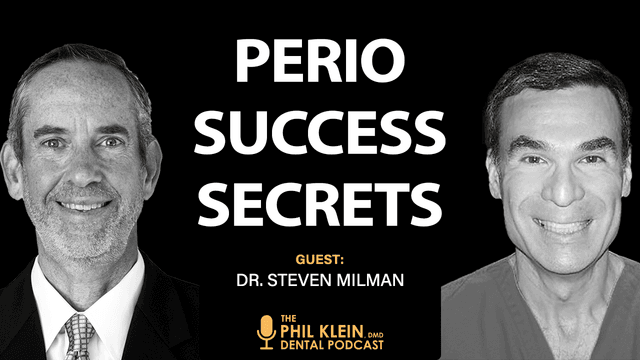
Dr. Steven Milman brings 36 years of periodontal expertise to this discussion. He earned his dental degree from Baylor College of Dentistry in Dallas, Texas, and completed his periodontal residency at the University of Texas Health Science Center in San Antonio. As a researcher in periodontal microbiology and full-time periodontist practicing in Round Rock and Austin, Texas, Dr. Milman offers unfiltered insights based on decades of clinical experience treating periodontal disease.
This episode cuts through marketing claims to reveal what actually works for periodontal therapy. Dr. Milman examines the efficacy of popular over-the-counter products versus prescription alternatives, discusses the critical concept of substantivity in antimicrobial agents, and shares his clinical protocols for subgingival irrigation. The conversation addresses both supragingival and subgingival treatment approaches, providing evidence-based guidance for practitioners seeking effective adjunctive therapies.
Episode Highlights:
Only chlorhexidine among available mouthwashes possesses substantivity, allowing it to adhere to oral tissues and slowly release over 12 hours for genuine gingivitis prevention. Most over-the-counter products dissipate quickly due to saliva flow and lack this critical property, making them largely ineffective despite the $16 billion annual market.
Subgingival irrigation faces significant delivery challenges, with research showing that irrigants only penetrate 50-60% of pocket depth at best due to physics limitations and gingival crevicular fluid flow. The bottom portion of periodontal pockets remains largely untreated regardless of the antimicrobial agent used.
Betadine irrigation using a side-ported endodontic syringe provides an economical alternative to expensive controlled-release antibiotics like minocycline microspheres. The protocol involves scaling and root planing followed by pocket irrigation, with costs measured in pennies rather than hundreds of dollars per treatment.
Molecular iodine represents an advancement over traditional povidone iodine solutions by isolating the most bactericidal component. This concentrated form provides immediate bacterial kill on contact rather than requiring metabolic processes, making it theoretically superior to bacteriostatic alternatives.
Mechanical plaque removal through brushing and flossing remains unmatched by any chemical adjunct, with no over-the-counter product proving superior to proper oral hygiene techniques. The most cost-effective approach involves investing mouthwash money into additional professional cleanings.
Perfect for: General dentists and dental hygienists seeking evidence-based guidance on periodontal adjunctive therapies, periodontists looking for cost-effective treatment protocols, and any clinician who wants honest evaluation of antimicrobial products beyond marketing claims.
Discover which products are worth recommending and which are simply enriching stockholders rather than improving patient outcomes.
Transcript
Read Full Transcript
This transcript was automatically generated and may contain errors or inaccuracies. It is provided for reference and accessibility purposes and may not represent the exact words spoken.
Relatively new, there's a product that is molecular iodine. So it's just one form of iodine thought to be the most bactericidal. In that bottle of betadine, molecular iodine's in there and it's the superstar. And now we've taken it out of that mix and we put in a separate bottle. Now you only have the superstar. Welcome to the Phil Klein Dental Podcast.
Are typical mouthwash products effective, and are they worth recommending to our patients? Are there any products out there, for that matter, that can actually make a significant difference in our fight against period disease? Our guest, Dr. Steven Milman, will address these questions and more. Dr. Milman received his dental degree from Baylor College of Dentistry in Dallas, Texas. He completed his periodontal residency at the University of Texas Health Science Center in San Antonio.
He was a researcher in periodontal microbiology and was a full-time periodontist in his private practice in Round Rock in Austin, Texas for 36 years. We'll be right back with Dr. Milman in a minute, but first, for the optimal bond between zirconia and your resin cement, check out Bisco's Z' Plus.
Rated best in class by thousands of top clinicians, Z-Prime Plus, featuring MDP, creates a strong, reliable bond to zirconia, metal, and alumina substrates. And nothing could be simpler. It comes in a single bottle, and it's 100% compatible with both light-cured and dual-cured resin-luting cements. It's time you get the most out of your zirconia restorations. To learn more about Z-Prime Plus and the entire Bisco adhesive product line, visit bisco.com.
Dr. Milman,, it's a pleasure to have you on the show. Thanks, Phil. Glad to be here. So this is interesting because, you know, a lot of companies market a lot of products and sometimes we're so busy we don't know what works and what doesn't and there's a lot of research behind it. You don't know who's being paid to do the research. So it's really important and I think relevant to all of us to hear from a periodontist about products that are supposed to benefit periodontal conditions in the mouth.
which ones work and which ones don't. So maybe we can start with super gingival products. What's out there? What do you think is worth purchasing and using in the practice? I'm going to start with making a general dental comparison. There's a product called Crest Optic White, a whole line of products, and they claim that if you use this for four days, your teeth will be whiter.
A lot of general dentists do a lot of whitening in your office and have products that are substantially stronger than Crestoptic White. Should people stop going to you to do that if Crestoptic White whitens their teeth in four days? Many, many over-the-counter products make a lot of claims and don't provide the bang for the buck that they claim.
What about Perio? Let's talk about the retail side. The Walmarts and the CVSs, are their mouthwashers effective in preventing gingivitis? As far as whether they work or not, the American Dental Association only certifies Listerine as useful and only useful in preventing gingivitis. Products with acetylperidinium chloride in them may...
reduce gingivitis. These products say they reduce gingivitis, but they largely cannot say they reduce plaque because they largely don't. So they may modify the biofilm enough that it doesn't cause as much gingivitis, but plaque doesn't come off unless you use something mechanical, such as a toothbrush. The only really useful
product against gingivitis is something like Peridex or Periogard. It's prescription. It's chlorhexidine. And there's a huge difference to it because it has a property called substantivity. Nothing else in the supermarket has substantivity. In other words, you rinse with even Listerine. It dissipates. You've got saliva that washes it away. You eat food. With these things that you want to make your breath,
fresher. Do you use them one time and your breath is fresh for a very long time? They dissipate quickly because they wash away. Substantivity means they don't wash away. Chlorhexidine sticks to oral tissue throughout the mouth and slow releases over 12 hours. Because of that 12 hours, if you use it twice a day, it does work to prevent gingivitis. Any side effects with chlorhexidine? Chlorhexidine tends to make a black stain.
on the tongue, on the gum line in some people. Some periodontists say that if it didn't stain, I'd have all my patients on chlorhexidine every day because it does work. That staining is a big problem. It also blunts taste in some people, which is pretty unpleasant. So you've got a product that works that has significant downsides. Typical mouthwashes. Are you saying that non-chlorhexidine mouthwashes are really just...
A waste of time and money? I think they're a waste of time and money. I think if you want to use a mouthwash, a good one might be using hypochlorite. In other words, Clorox. Phil, have you used sodium hypochlorite to clean out root canals? Yeah, but I wouldn't be rinsing with it. Right. But if you dilute it enough, which the dilution is one teaspoon to 12 ounces, it's safe.
to rinse at that level. And it probably will kill more bacteria than any of these things that are on the supermarket shelf. But what about the substantivity of that? Not good, but I'd hold it out there to be equal to anything in Walgreens. I still feel a little bit hesitant about rinsing with Clorox just because it could be swallowed even in the diluted form. How about salt water? That won't be as deadly.
Well, salt actually has antibacterial effects. Your point is that it's not necessarily you're promoting rinsing with sodium hypochloride diluted, although you may be. No, no, I'm not. I'm saying that if you feel like you have to do something. Why go out and buy a bottle of something for $9 when you can make gallons? Let's expand on what I'm saying. The American Dental Association is saying. Right.
Another way of thinking about this is there is $16 billion a year of those products sold. And there's still a lot of periodontal disease. If these products that get newer, better, have more pizzazz every day actually worked, why didn't the gum disease go away? So we haven't seen any improvement in treating gum disease with these products, these at-home products that are sold over the counter.
in this form that you're talking about, low substantivity characteristics like a mouthwash, a non-chlorohexanine mouthwash. In your opinion, they haven't really done anything for the health of the patient regarding their perio health. No, not the health of the patient, but the checkbook of the stockholders, yes. Yeah. Okay. Well, that's good to know. So we're still talking about supergingival products. Any other supergingival products other than chlorohexanine, which is prescription only, any other product?
would be useful in your mind for a patient to use where they could purchase it over the counter? The problem becomes you're comparing it to brushing and flossing or if there's a little bit of recession, brushing and using an interproximal brush. No one can prove that their product is better than brushing and flossing because brushing and flossing works. So you're not adding anything. Right. So if you do want to rinse, rinse with whatever you want, whatever tastes good. Bubbles the right way.
I can't really disagree with you because I've been, as we talked offline, I've been flossing for 40 years. I started doing it in dental school and I have no bone loss. I don't go to the dentist near as much as I'm typically supposed to. That's really upsetting. Yeah, right. I know. A lot of dentists don't though. They stay out of that. And I've never used mouthwash. Never.
I always thought it had alcohol in it, which bothered me. So in your mind as a periodontist and somebody that's practiced almost 40 years, they haven't come up with a mouthwash that's even close to the effectiveness of brushing and flossing, basically. No, I got a better idea. Each time you buy the mouthwash, throw five bucks in a can and go to the dentist and get your teeth cleaned one more time a year. Invest the money. Dollar cost average. Reinvest it at the dental office. Yeah, right. There you go.
All right. Okay, so that's it for supergingival. Just before we leave that, ozone's gotten a lot of talk lately about an antibacterial. And this is also, if you actually want to evaluate these products, look at their research and see if their claim is that some of them claim they kill 99% of bacteria.
you're going to find out that they did that in a petri dish in a laboratory. That didn't happen in a patient's mouth. How was that applied, ozone? As far as the ozone goes, there are gels, water additives. Where it came from is we were looking for ways to mitigate COVID-19.
And ozone does kill viruses. So it started out as an antiviral, anti-COVID-19 rinse. It does do that. So pre-rinsing before a dental appointment, if you're trying to avoid COVID-19, that's a good use. Right. But again, you're almost implying with a lot of these products that...
We don't want people to floss. We don't want them to brush their teeth adequately because they're lazy and they won't do it. So that's how I'm rinsed with this stuff to not make it necessary. We'll be right back with Dr. Melman. But first, as a dental healthcare professional, you might already know that 3M Healthcare is now Solventum. And one of its next generation products is 3M ClinPro Clear Fluoride Treatment, available in a new rosin-free water-based formula.
With soluble fluoride ions immediately available to deposit on the tooth, ClinPro Clear Fluoride treatment needs only 15 minutes of contact time.
Plus, with less waiting time to eat or drink after application, it's even easier for your patients to say yes. Its uniquely designed LPOP delivery system ensures a smooth and professional application process. In clinical studies, hygienists found it fast and easy to apply, and patients rated their experience an impressive 98 out of 100. So if you're looking for effective fluoride uptake in a rosin-free, water-based formula,
Try 3M ClinPro Clear Fluoride Treatment from Solventum. To learn more, visit solventum.com. Let's talk about subgingival products. And what I want you to talk about actually is what you used in your practice over the years. Okay, you said you practiced 36 years. Let's go back a long time when you first started. Were you using something sub-G?
differently than you were using when you retired? Did you find something that really worked and you switched over to it? Or have we made progress in this area? Tell us about that and tell us which products work. It's good that you put a timetable on it because the research done way back when, 36 years ago, they took a dye and used it in an irrigator and put it into a periodontal pocket of a patient that there was reason.
to extract that tooth. And they extracted the tooth and look what happened to the dye. And what they found is the dye doesn't migrate very much. So you can't effectively squirt stuff under the gum. It also doesn't bottom out at the bottom of the pocket. The physics has it
splash down to maybe 50 to 60 percent at best, but it doesn't hit the bottom of the pocket. So from a delivery system point of view, we don't have a way to coat the entire pocket, whatever stuff, the magic bullet. We don't have a way to deliver it to kill the bacteria, which in and of itself is a problem.
Secondly, there is gingival cravicular fluid that comes out of pockets, which essentially is a water flow going from the bottom of the pocket to the top. So you put something in there and it's going to wash it back out the top. That's what it does. So you're talking about not only are we challenged with the right material being the ingredients of that material that actually do the job.
but also the logistics of getting the material to where you want it to go and stay there for a period of time where it can do its job. So those are the two challenges. True. So if you want to make global statements about subgingival products, the placement technique is very difficult to impossible. So you're only going to get a marginally positive effect no matter what you do with these. Now, didn't they come out with a rest in where these little tiny beads were designed
down into the pocket and stay there? As a periodontist, and I think many periodontists, it's not used much in the practice. The way I used it was in trouble spots. So very rarely used it up front during scaling and root planing. Let's say the patient's on maintenance and then all of a sudden we got a single site or two sites that are bleeding, six millimeter pockets that are bleeding. Those single sites I would consider
putting a rest in it. Almost it's better than nothing. But using it globally to treat periodontal disease, I wouldn't do. The research on it that they claim is so wonderful is minimal attachment gain on the order of 0.25 millimeters, which is not clinically significant. And the research only goes out about nine months. If you go out 12 months,
arresting plus scaling and replaning and scaling and replaning alone have the same results. But you still use it occasionally in local areas? Yeah, it was in the office, but we wouldn't go through it very fast. Other than that, as far as sub-G medicaments or products that we're talking about in this podcast episode, what else is in your quiver? So at some point I spoke to...
a microbiologist named Jorgen Slotz, which was the hall of famer in periodontal microbiology. And we were talking about something else, but at the end he said, you know, start irrigating with betadine. Take my word for it. This stuff works. So I've done a lot of pocket irrigation with betadine, which is an iodine mix. The thinking being, first of all, it's cheap.
Betadine itself you can get over the counter at the drugstore. Second of all, it's harmless because iodine is used in surgical scrubs, all sorts of disinfectants. And thirdly, it's bactericidal. Bactericidal means it kills on contact. It touches bacteria, they die. Whereas arrestin is bacteriostatic. It needs to be metabolized.
works through the blocking of the bacterial RNA, allowing proteins to express. So just conceptually on that regard, I would rather have something that kills on contact that...
has to go through some process to kill. And that's something you were using in the past when you first started practicing or you continue using Betadyne all the way through? When I started practicing through probably, I don't know, 15 years or so, very few people were doing any kind of pocket irrigation. So when did you start the Betadyne irrigation? Could be 20 years ago. And you delivered that through?
Through an ultrasonic scaler? We used a side-ported endosyringe. Oh, side-ported endosyringe. Okay, so you didn't use any kind of sonic delivery? No. Conceptually, we either scaled in root planing with anesthetic, or if it was during a maintenance, we root planed without anesthetic, and then took the side-ported syringe, and wherever there was a pocket, we squirted some in. What did you find as a result of that? I don't have statistics to tell you.
You're using a product that costs very little, and you can do many sites for pennies, whereas with something like a Reston, you can do many sites for $800. So if you also think of the ability for things to move around the pocket, if you have a Reston, if you want to do a whole pocket, you've got to probably pump four of them into one tooth because you've got to paint the whole thing. With the Betadine, you just keep squirting.
go all the way around like a periodontal probe and squirt it in there. Okay, so you leave that liquid in there in the pocket and release the patient. Yes, with the knowledge that it's going to flush back out of there. Right, but the whole game plan here is that it's a constant fight, right? It's the host versus the bacteria. Right. And so if you do this scaling and root planing and betadine treatment on a regular basis, you're maintaining... I'd put it in the category of that's the best we're capable of.
Right. But it works though, because your patients, some of them were in pretty bad shape. You stabilize them where they did not lose their teeth, which is the game plan, right? To a very large level of success. Did you use betadine all the way through the end of your practice? Yes. Is that molecular iodine that's in there? No. Betadine is a mix of various iodine compounds. What's relatively new is there's a product that is molecular iodine. So it's just one form.
of iodine thought to be the most bactericidal. In that bottle of betadine, molecular iodine's in there and it's the superstar. And now we've taken it out of that mix and we put in a separate bottle. Now you only got the superstar. Again, if that contacts bacteria, it will kill them.
But that's different than povidone iodine. That's something- Povidone iodine or betadine are the same thing. They're a mix. Okay. So povidone iodine, if you bought that on Amazon, for instance, for six bucks for like 12 ounces- And that's largely what we did because the molecular iodine wasn't available. But you're saying the molecular iodine is better? Better. You've taken the best out of the bottle of betadine, stuck it in a different bottle. Now you're only putting the best stuff down. Oh, nice. Yeah.
Something interesting that, you know, I didn't try this. I probably should on my dogs, but the company sells to vets quite a bit. And they find that if you put three drops of this stuff in dog water, the dogs don't get gingivitis. All right, Dr. Milman, another good podcast episode. So we heard it from the periodontist himself. Thank you, Dr. Milman. We appreciate your insight and we look forward to having you on future episodes. Thank you, Phil.
If you're enjoying this podcast and have an Instagram account, please follow us, Phil Klein Podcast. Every week we'll be adding high quality relevant content. And to support this program, please leave a review on your favorite podcast platform. It really does make a difference. Thank you so much for listening. See you next time.
Clinical Keywords
Dr. Steven Milmanperiodontal diseasemouthwash effectivenesschlorhexidinesubstantivitybetadine irrigationmolecular iodinepovidone iodinesubgingival irrigationarrestinminocycline microspheresperiodontal microbiologygingivitis preventionpocket irrigationside-ported endodontic syringebactericidal agentsbacteriostatic agentsgingival crevicular fluidDr. Phil Kleindental podcastdental educationperiodonticsantimicrobial therapyover-the-counter products