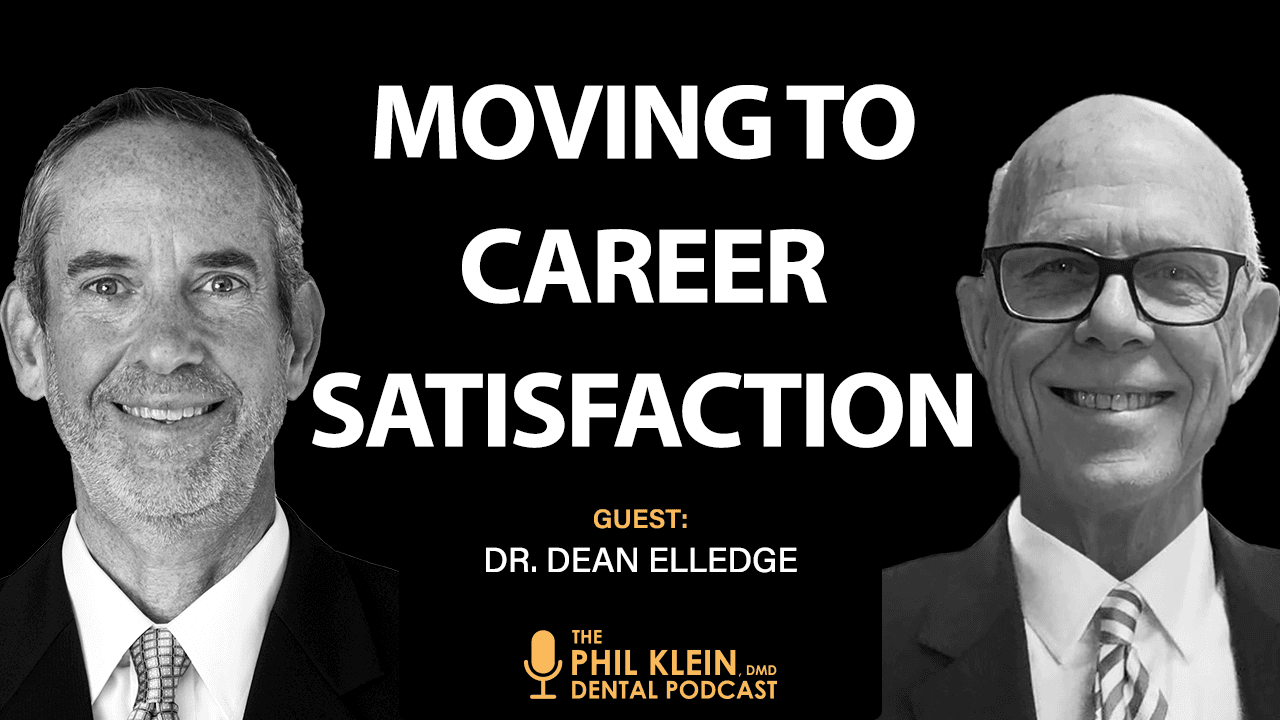
Dr. Dean Elledge, a seasoned dentist based in Kansas City, found himself at a crossroads in his career. While many might have settled into routine, Dr. Elledge wanted something more—something that would reignite his excitement every morning. His dream? To become the director of a residency program. However, there was no such opportunity available near his home in Kansas City. But when he learned about an opening for the position at Wichita State University, nearly 200 miles away from his home, he didn’t let distance deter him. His decision to chase his dream has not only transformed his career but also given him a renewed sense of purpose. Yes, sacrifices may be required, but when the payoff is fulfillment and purpose, the journey is well worth it.
Transcript
Read Full Transcript
This transcript was automatically generated and may contain errors or inaccuracies. It is provided for reference and accessibility purposes and may not represent the exact words spoken.
You're listening to the Phil Klein Dental Podcast
In this episode, we have a guest whose journey is a testament to the power of passion,
perseverance, and purpose. Dr. Dean Elledge, a seasoned dentist based in Kansas City, found himself
at a crossroads in his career. While many might have settled into routine, Dr.
Elledge wanted something more, something that would reignite his excitement every morning he woke
up. He knew that what truly motivated him was mentoring young dentists fresh out of school, guiding
them alongside experienced colleagues and specialists. His dream? To become the director of a
residency program. However, there was no such opportunity available near his home in Kansas City.
But when he learned about an opening for the position at Wichita State University, nearly 200 miles
away, he didn't let distance deter him. He applied, was accepted, and today...
He proudly serves as the director of the Advanced Education in General Dentistry program at Wichita
State University, and he's been the director for 11 years. His decision to chase his dream has not
only transformed his career, but also given him a renewed sense of purpose. In this episode,
we'll talk to Dr. Elledge about his journey, why he loves what he does, how he manages the 180
-mile gap between home and work, and the lessons he's learned along the way. His story is a
powerful reminder that self-imposed limitations should never stand in the way of our aspirations.
Yes, sacrifices may be required, but when the payoff is fulfillment and purpose,
the journey is well worth it. Dr. Elledge, it's a pleasure to have you on the show. Hey, Phil.
So this is an interesting conversation we're going to have because it shows something that most
people would typically find not feasible can actually work. And that is being three hours away from
your home. But you can actually pull it off based on how you manage your time and manage your
commute. But before we get into the details of the program that you're now a director of, what were
you doing before you made that move? You were at UMKC Dental School. What was that like?
Well, my transition, I did rather a similar thing in a bigger city called Kansas City,
a city of over one million population with a dental school, with 20 other prosthodontists like
myself in that location, a lot of restorative dentists, and a lot of experts already there.
When you branch out, you will find that there's opportunity. you'll find your cheese in another
location because you will be the expert. For my instance, when I came to Wichita,
in a short time, I was the Wichita District Dentist of the Year. And then two years later,
I'm the State of Kansas Dentist of the Year. Now, I was the same person for 20 years in Kansas
City, but I came to where there was new cheese, you might say. Okay, so what elevated you?
to these accolades you're the same person as you mentioned yeah you just moved down the road 200
miles from yeah 180 180 miles okay 180 miles and now you're all over all of a sudden a superstar is
that because you're a big fish in a smaller pond uh big no i'm just a fish in the pond i'm the only
fish in the pond i'm the only training program in kansas i'm the only multi-specialty center in
the state of kansas i'm rather unknown i am I am the Mayo Clinic of the Midwest,
you might say, but it's Kansas. There are no dental schools in Kansas. There's no training centers
for residencies in Kansas. All the multi-specialists who want to teach are at my program.
If you want to teach, you're at my program. So you were working at UMKC Dental School,
University of Missouri, Kansas City, in the clinic as a faculty member, practicing faculty member,
and then... reached a point where a crossroads where you said, I need to make a change.
Tell us why you wanted to make this change. Well, here I was 50 some years old.
And like many of you out there in the audience, you say, is this really what my life is going to
be? Is this really, have I fulfilled my aspirations? Have I given 100% to myself and to my career
and to my family of who I want to be? So I went back to school at age. 53,
I did an advanced standing AEGD, which allowed me to pick up a surgical skill set.
And that also allowed me to get my certificate in advanced education general dentistry.
And now I can teach it. Where'd you do that education? University of Missouri,
Kansas City. That was the advanced education general dentistry program. And each program is rather
unique. These are American dental associated programs. called the Council of Accreditation.
And each program can be a little bit different depending, there's probably about 100 programs like
mine throughout the United States, but each one is a little bit different. They can change as
people come in and out. So a person needs to sort of inspect what's local in their state. You know,
would you want to go in as maybe a doc and maybe give a lecture, teach a half a day? You know,
you might be looking to maybe pull one of those young people out into your practice. Okay, so this
program that you completed, was that a one-year program? Yes, I was a teacher of that same
program. So yeah, it was a one-year program. When were you the teacher?
I was the teacher before I was teaching in the program. But due to American Dental Association
requirements, you can never be a director until you get your certificate. So I was a prosthodontist
doing the prosthodontic, especially within this eight resident advanced education program.
But I could never be the director, even though I'd been there 20 years. You can't be the director
until you have a degree, the same degree that you're giving to the. To your understudies,
you might say. I see. Okay. So you did get your certification from that advanced education in
general dentistry. You then were eligible to be the director. Correct. Okay.
Correct. But then you moved your career to Wichita,
Wichita State. Was that something because you felt like, okay, I'm going to become a director at
Wichita State. It doesn't even have a dental school, but I want to start a... going to start an
advanced education in general dentistry program there. And you did start that. Is that right? Well,
I did not start it. It was started before me, but that person had left to go be a dean at another
dental school. So he had a career advancement for himself. So that left a void. And it was just
timing. It was just sort of meant to be. But that was always my aspiration. If Wichita did not
open, I would have looked in other parts of the country. Maybe I would have. picked up my family
and moved, but this is sort of my dream. So your goal was to be a director of a residency program.
That's what you wanted to do. That's phenomenal. So when you left Kansas City, you didn't have to
worry about selling a practice because you worked in the dental school clinic and you just
basically left as an employee. But when you're seeing patients in Wichita, if there's an issue with
those patients and you're not around because you've gone back to your home in Kansas City, how is
that handled? So my role, my patient base is all out of Wichita,
and my young doctors manage the patient base. So I'm always available.
I have a team on site always available. We have doctors on call for the weekend.
I'm in Kansas City. Hey, we've got a patient in pain on Saturday. morning i got an eye that's
swollen well one of my docs one of my part-time private practice docs will open his practice up
bring him in on a saturday and get eyes on the case you decided you didn't want to live in wichita
although you're working there what how many days a week in the residency program okay okay i will
be there monday tuesday wednesday thursday all right and you manage that without any problem being
180 miles away tell us about tell us how you do that Correct. Well,
you have to have structure. Everyone has a, you have structure, everyone covers.
We always have two doctors in the clinic, for instance. There's always a specialist there every day
in the clinic. We have perio, the implant periodontist is with us Mondays and Fridays. Endo faculty
is there Thursday afternoon. I've got two general dentists that pick up a day a week.
I got two oral surgeons that helped me out. So I got an oral. So Dr. Elledge, you're a full-time
employee of Wichita State, but the other dentists that are helping you out that you just mentioned
are not. They come in part-time. Payment-wise, I'm a university employee, and I'm the only full
-time doc, but I've got about, like I've mentioned, about eight other docs that give me a half a
day, a day of things that they contribute from their specialty. These are private practicing docs.
that love to teach. They want to give a half a day. Maybe someone's thinking, hey, I want to get to
know the young docs. Maybe that young doc will come take over my practice. These sort of
relationships are developing. So how many residents are there? Five.
I take five a year. So you take five residents a year, and they're in this clinic.
And who owns the clinic? Okay, the clinic is owned by Wichita State. However...
The theme, since there's no dental school in Kansas, the theme, we were given a grant,
a gift. We, I mean, the Wichita State University was given a grant from the Delta Dental Group,
the insurance group, and they gave a gift to build this building. We have a beautiful standalone $5
million clinic. And this gift, it was a lead gift with matching through,
for instance, the... The emergency room docs in Wichita gave us a nice chunk of money because they
wanted us to help them with dental emergencies. They got tired of unnecessary extractions coming
into the office, you know, into the emergency room, burning their loads.
So this was all funded by donations, you're saying? Yes. Yeah. Yeah.
Why? Yeah. Why did Delta Dental give $5 million to build your clinic? They didn't give five.
A couple million. Say a couple. I don't know the exact couple. Well, that's still even two million.
Why did they do that? Because they wanted to help the community. They wanted to bring rural.
They wanted to bring dentists to rural Kansas. To rural Kansas. Okay. Most of Kansas and
underserved Kansas. So, yeah. So what's interesting to our audience, hopefully, in this
conversation is that. there is opportunity in remote areas in the country,
which are probably very beautiful. I mean, is Wichita a beautiful place to be?
I think most people would say it is sort of like a little house in the prairie,
you might say. The beauty is in the grasslands, the rolling hills.
The beauty is in the people. It is in the best people. I'm going to say the best people in Kansas,
the best people in Wichita. i got there's no competition if i get in trouble you know for instance
i had a little implantology case sort of bite me but the local specialist helped me out on a on a
on the case and and he doesn't have any spite against me i guess exactly would you see what i'm
saying yes it's traditional america where everybody helps people used to help build their log
cabins When someone was sick, they would cook food and bring food over to someone's house. And
we've lost a lot of that, of course, in our society, in our civilization right now. No question
about it. So it's really a lifestyle where you feel like you're really part of something.
And it's the people. So, you know, when we decided to have this conversation, you reached out to me
because I've known you. I knew you way, way back. And I couldn't really think of a...
know, a theme here. Like, why am I doing this podcast episode? How is the audience going to be
interested in hearing about this? But, you know, we did do a podcast episode with another doctor on
practicing in remote areas. And that is becoming a trend not only for dentists,
but generally speaking, people are lured away from the city and attracted to rural life because
they do want to enjoy some of the things that still exist in this country.
And the cities have really dramatically deteriorated. So you love it.
You're going to continue to do it. So where do you see yourself going forward?
You're how old now? I am 67. Okay, you're 67. And how long you've been running this residency
program? I've been doing this for 10. I'm on my 11th year. Okay, so I guess as long as you could
drive. As long as I can drive. And you have a good vehicle, and you certainly don't have a lot of
traffic, hopefully, you're going to keep doing this, right? Absolutely. I've got one faculty who's
an oral surgeon in Kansas City, like myself, and he loves teaching in the program so much. I have
an oral surgeon that will drive down. He's my backup. If I have too much oral surgery in the month,
I call up. Dr. Elledge, I got too much oral surgery this week. Can you come down and give me a day of
oral surgery? I'm backed up. He'll drive down out of Kansas City. Why? Because he loves it. He
loves to give back. He loves talking to the young docs. And he's almost 80 years old.
Wow. Tell us about the technology that you have at that facility.
What should it... resident expect to learn regarding the newest technology because that's okay
where everything's going right now so if you don't have the equipment and the technology they're
not going to get what they should out of a residency program so what do you have over there okay
give it here's an example very i'll be quick i had two residents a husband and wife joined me last
year every piece of technology we trained them on they purchased in other words a sprint ray
printer a a mill a cirac mill we do one day crowns Last night,
I needed to, I have a surgery on Monday. We have an implant surgery on Monday. We need a guide.
It's immediate extraction. I ordered it late. It's going to take four days to get it out of the
lab. Well, we're going to print it ourselves. My resident's going to print it today herself. So
what I'm saying is we print our own guides. We put our own bruxes and guards. We scan.
We mill. So you have all the latest technology. You have advanced digital workflow there.
So they're learning workflow and the instructors, the dentists and the specialists,
the GPs and the specialists that are teachers there, do they get paid or is it voluntary? No,
no, they get paid. They get paid. Where does that money come from? From the fees generated from the
work? Yes and no. My salary does not go against the program.
I'm funded about 90% by the state of Kansas. I have a... guess you might say I have a government
job. I'm funded by the state of Kansas through the Wichita State University as a professor. So my
salary mostly comes out of state funds. My residents are paid a stipend.
It's not a lot of money, not paid enough. They're paid about $40,000 a year to be a student under
the mentors. And that's paid by Bia Christie Hospital. So it's a small...
stipend. And then, so that covers that part. And then the money we generate, then that pays the
part-time faculty and the staff and the assistants. And we are a standalone clinic.
I'm not attached to a hospital. I'm in the neighborhood. What was the hospital name that pays the
residents? It's called Via Christie Ascension. Okay. And that hospital is a direct connection to
your clinic if there's any dental work needed. or dental expertise? No, no.
We're rather separate. We're physically separated by miles, so that doesn't really work that way.
We're completely separate from the hospital. So why do they support the residents? Because they
wanted to help the community. In other words, they wanted to help.
There's such a need for dentistry. They sort of gift us the money without any sort of strings
attached to run it. Like I've mentioned briefly, The physician community wants dental support
because there's too much dentistry by the ER doctors going into the hospital. And we're
functioning. We're getting the teeth out as one function so that the patient's not calling there on
a Saturday or Sunday a swollen face and there's no dentist to take care of it. Yeah.
So as far as the logistics of where you are during the week, I assume you spend Monday, Tuesday,
Wednesday, and Thursday in Wichita and then Friday, Saturday, and Sunday at home.
in kansas city is that how you're doing it if you don't mind getting up early in the morning again
you can sleep four nights in your own bed with your family and your spouse and you can do three
nights at your remote location get you a little do what i did get you a little rental there's
beautiful rentals not a lot of money in rural kansas um and i get you a car and do some miles so
and then you find out you love it then buy you a little place and stay yeah so you you mentioned
that Having two different locations, one dedicated to work and the other one being your home,
which is Kansas City. You thought that was kind of like a Zen-like experience when you return
home. Tell us quickly about that and then we'll wrap up. Well, you're going to separate your life.
In other words, the Zen is the drive. Some people podcast. I just,
my mind drift for each way, down and back. I stop and do a little exercise,
walk halfway in the Flint Hills, beautiful Flint Hills. I got a little route. I walked for 10
minutes halfway. I look at the snow, look at the ducks, look at the ponds. So it is separation of
work and home. When I come home, I got a phone that I can take calls. I can tell my young ducks,
hey, if they got an issue, how to direct it. I got on-site private practitioners that'll help me
out if I'm in a bind and our patients are seen. And the residents are mentored and they learn how
to triage. All dentists have to learn to triage. Yeah. So let me ask you this.
So you found an opportunity to be a director. You found a new purpose in your career.
So this is really about an opportunity for a dentist who's kind of maybe in a rut, who's doing the
same thing all the time, who really likes people and likes to teach, but there's not much
opportunity perhaps close to where they live. But that dentist should still be open-minded.
about the opportunities that could be a couple of hundred miles away and find a way to make that
work like you have. You know, either leave on Sunday night or leave early on Sunday morning, on
Monday morning, and you'll have two locations. But meanwhile, you'll fulfill the purpose that you
really want to explore, which is more teaching interaction with young dentists and,
of course, the camaraderie of working with all the other doctors. So there's a lot in it for you.
And you think that the actual experience for the resident is very valuable too. Tell us about what
you think the resident gets out of an environment like this. Okay. They get a lifetime mentor or
two. They get to be with people who love what they're doing. I love what I'm doing. My part-time
practitioners love what they're doing. It'll rub off on you of how they think about patients, how
they do their work, how they get their passion. My passion comes from my 81-year-old oral
surgeon. I have one periodontist that's 78 and they love what they do.
I have other younger doctors that they come in and they'll give a half a day and they say, hey, I
love this because they don't know, they're not appreciated when you're out by yourself, but you
bring a young kid under your shoulder and you say, wow, I know my stuff. And there's sort of a
synergy that happens. It's certainly clear, Dr. Elledge, there's a special place in your heart for
Wichita, Kansas. And I can see why. And I think it must be a very special place for many people
that live there and for the residents that spend a year there and learn a lot of dentistry and then
go on their way or maybe even stay as a associate for a dentist, like you mentioned, in Wichita or
the surrounding area. But it's an opportunity for anybody to explore. And it might be quite
different than your typical residency program in a major dental school, university environment. So
if you want to get in touch with Dr. Elledge, his email is dean, D-E-A-N dot Elledge.
E-L-L-E-D-G-E at wichita.edu. You can also Google him,
type in Wichita State University Elledge, and you'll find information on the Advanced Education in
General Dentistry program. So as we wrap up this podcast, Dr. Elledge, any closing thoughts for our
audience? When you get out of dental school, you really don't know what you are passionate. You
don't really know what your love is. And because you haven't done enough, you haven't done, maybe
it's root canal work. Maybe it's surgicals. Maybe it's... Maybe it's implantology.
Maybe it's crown and bridge. It's a great opportunity working with really nice people that are
there because they actually care. Truly, personally care. It's not a business for them.
They're doing it as they're giving back to the profession. They're giving back to the community.
So, all right. Well, thank you very much, Dr. Elledge. Thank you, Phil. Safe travels as you go back
and forth between both locations because I know the weather can get rough in the winter. And we'll
touch base soon. Have a great day. Take care. Okay. Thank you.