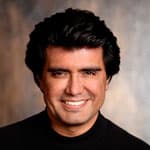
Dr. Ruiz has been named as one of the "Top Clinicians in CE" 2006-2011 by Dentistry Today. Director of the Los Angeles Institute of Esthetic Dentistry and past course director of the "University of Southern California's Esthetic Dentistry Continuum" from 2004-2009. Associate Instructor at Dr. Gordon Christensen PCC in Utah. In full time private practice in the Studio District of Los Angeles for 20 years.
Dental podcast: Welcome to DentalTalk. I'm Dr. Phil Klein. Today we'll be discussing tooth replacement using minimally invasive adhesive bridges. Our guest is Dr. Jose-Luis Ruiz, who has been named as one of the “Top Clinicians in CE” between 2006-2011 by Dentistry Today. He is the director of the Los Angeles Institute of Esthetic Dentistry and past course director of the “University of Southern California’s Esthetic Dentistry Continuum” from 2004-2009. He has been in full time private practice in the Studio District of Los Angeles for 20 years.
Transcript
Read Full Transcript
This transcript was automatically generated and may contain errors or inaccuracies. It is provided for reference and accessibility purposes and may not represent the exact words spoken.
You're listening to The Phil Klein Dental Podcast
Welcome to Dental Talk. I'm Dr. Phil Klein. Today we'll be discussing tooth replacement using
minimally invasive adhesive bridges. Our guest is Dr. Jose Luis Ruiz, who has been named as one of
the top clinicians in CE between 2006 to 2011 by Dentistry Today.
He is the director of the Los Angeles Institute for Aesthetic Dentistry and past course director of
the University of Southern California Aesthetic Dentistry Continuum from 2004 to 2009.
He has been in full-time private practice in the Studio District of Los Angeles for 20 years.
Before we get started, I would like to mention that Dr. Ruiz's webinar titled Tooth Replacement
Using Minimally Invasive Adhesive Bridges is now available as an on-demand webinar on VivaLearning
.com. Simply type in the search field Ruiz, R-U-I-Z, and you'll see it.
Highly recommend this webinar to the entire dental team. Dr. Ruiz, it's a pleasure to have you on
Dental Talk. Phil, it is my pleasure. Thank you for inviting me. Yeah, it's an honor for me. I see
you for years on the covers of magazines and so forth, articles, and you've done an amazing job
contributing to clinical education, continuing education to the dental profession over the years.
So we're very happy to have you on our show. Your philosophy on clinical practice focuses on
minimally invasive dentistry, which is great. I'm all for that. Why is that so important when it
comes to a replacement of a missing or unsavable tooth? Well, I think minimally invasive in
medicine is indispensable, you know? I mean, if you think about if you're going to go to get any
type of surgical procedure in medicine. you want minimally invasive you don't want an open heart
surgery you don't want to have a an open knee surgery you know my dad had one of those when he was
a you know 30 years ago plus and and he was he couldn't walk for a week so the collateral damage of
aggressive uh surgeries is very extreme dentistry is no different you know dentistry um If we cut a
tooth too much, we know that we traumatize the nerve and we put margins in the middle of the gum.
We traumatize the gums irreversibly. That's a super gingival minimally invasive dentistry,
which is something that I've been advocating for many, many years. And adhesive materials,
high-quality adhesive materials, you know, is very, very important.
And that's why I'm... you know i i appreciate um vocal support on this podcast and i uh you know i
love many many of the products because they they have products to help the minimally invasive
adhesive then it's like future bond plus uh universal so lots and lots of products that i can tell
you that i that could not live without and and by the way i mean whether it's a filling or or uh or
an indirect restoration like a veneer or a tooth replacement minimally invasive is crucial.
Yeah. So we're going to get into, particularly on this topic, minimally invasive dentistry as it
relates to tooth replacement. And you have some interesting things to talk about regarding bonded
bridges. So we'll get into that shortly. But before we get into that, would you consider implants a
minimally invasive option when replacing a tooth? That's such a good question. I mean... mean, it's
a surgery, right? It's a surgical procedure where we cut the gum and we make a hole in the bone.
But in many cases, an implant is a very minimally invasive procedure.
You know, when you have a patient with enough bone, healthy tissues,
placing an implant instead of other options like bridges or even...
removable bridge it is a superior you know a superior option and minimally invasive because you
know anybody that is experienced doing placing implants I place more over 2,000 implants when you
have a good situation it is it's a procedure that takes 15 minutes the patient feels no pain and
and their recuperation is minimum and and while the the great results are a little delayed But the
results are phenomenal, right? So in some cases, an implant can be minimally invasive.
On the other hand, sometimes implants are incredibly invasive and hurtful for the patient.
And that's the thing that we have to remember. I mean, sometimes in order to give a patient a molar
implant, we have to open the sinuses and put bone in the sinuses.
And, you know, that can have some consequences in addition to the fact that it's super painful and
uncomfortable for the patient, right? Or bone augmentations. And the success rate of those is
dramatically less than when you have a good bone. So sometimes implants are extremely invasive.
And so it's important for the clinician to not just assume the implants are one thing or another.
It can be both, and it can be both to the extreme. Yeah, and of course, if you have a tooth that's
diseased and you can save that tooth with endodontic treatment, that's probably the first thing
you're going to want to do before extracting it. That's a choice, right? Yeah, you're right. Yeah,
so I'm just talking through my endodontic mind because I did that for quite a while in Philadelphia
back in the day. So let's talk about replacing a tooth without an implant and talk about another
option that we have, which is a bonded. bridge, let's say number 19 is missing,
or we can talk about anterior first or both. Tell us about bonded bridges. Do they really work long
term? Is that a real solution or is that something that you would use for a patient that may have
economic hurdles to work through at that time? They may be unemployed or whatever.
Tell us what your feeling is about bonded bridges. Phenomenal question. Phenomenal question. I
mean, bonded bridges, just like implants, can be all of the above. right uh we we do have a long
history of failing bonded bridges and maryland's and things that we tried and that have not worked
so well not that they don't work at all but they they don't work predictably well every time um and
and and we as a profession kind of because of those failures we kind of like put them aside and we
think about them as only a temporary solution type of thing and um but I have to say that there has
been people that out there have been working on these techniques and have really created an
understanding of how to make it successful. So one of those is Dr. Matthias Kern from Germany.
He's been researching and kind of changing the paradigm on bonded anterior bridges.
He has a book and published extensively on on cantilever anterior bonded zirconia bridges.
So we're talking about one retainer pad, and the success of that is phenomenal.
His research shows 100% that we're really at 10 years.
Wow. I mean, that's going to be more successful than an implant,
right?
You know, that has to make us think. I mean, this is something, you know. Of course,
you know, Cantilever Ontario Bridge has a limited use.
So I personally have, with my 25 years of extensive adhesive dentistry experience,
myself, together with Dr. Bertolotti, we have created a whole... a set of bonded bridge
opportunities that we can use in multiple situations. So it becomes an option that is for every
situation. There are, of course, some exceptions, obviously, but we can use it in anterior,
we can use it in the back, we can use it in, for example, I have a design that we can use for when
we're doing a set of veneers and we have a missing tooth, we can use a veneer preparation as a
retainer pad. Of course, posterior we can do with a variety of retainer designs,
inlays, onlays, even just kind of like a mesial veneer minimum preparation.
So, yeah, this can be quite impressive and quite successful.
So as far as posterior bonded bridges, again, the occlusion plays a role here.
What are some of the... components that come into your decision making when working with posterior
bonded bridges very very good question as well i mean no doubt that the primary concern the primary
reason of failure of implants is occlusion and the primary reason of failure of anything else that
we do in restorative dentistry is occlusion so so uh managing it is crucial no question about it um
but properly manage you know with the with the power that we have of adhesive dentistry and really
adhesive dentistry for as much as every dentist in the country will say i've been using adhesives
for for 30 years or 20 years or 10 years uh we are not using them to even half of what they can do
and the trust that exists out there on adhesives is very very little you know i have no problem
bonding a restoration on a tooth that is flat to the gum and inspect durability because I trust
adhesion. You know, I've been associated with Dr. Ray Bertolotti, who is a pioneer of adhesive
dentistry. And the reason why he's a pioneer of adhesive dentistry is because he was a NASA
engineer on ceramics and adhesives before he was a dentist. So he understands that it takes
hundreds of pounds of force to separate a properly bonded piece of porcelain to a tooth.
You know, I don't know you personally, but as I said, I've seen you in dentistry all over the place
for many, many years, decades, and you've shown some really extravagant work. And it sounds like to
me that as you got more and more involved with adhesive dentistry, you pushed the limit and you
said, okay, what else could I do with this? And you continued to come up with innovative ways of
using adhesive dentistry to replace teeth, things that no one ever thought of. So you're really
someone who understands. what the capabilities are and also what the limitations are at the same
time. And I think with your level of expertise, you have the clinical knowledge to push the
envelope with adhesion. But the regular dentist that goes to work every day, that does everything,
dentures and whatever, is that dentist, do they need to take additional CE courses to push the
limit? Or should they be more comfortable with their level of expertise to do the basic? bonding
techniques for restorative class 2 composites, for instance? Very good question, and thank you for
the comment. For sure, for sure. We all stand in the shoulders of giants, of people that have
advanced the knowledge of adhesives, as I mentioned, Dr. Ray Bertolotti, and many,
many others. I believe that adhesive dentistry can make restorative dentistry for every single
dentist much, much, much easier and better and healthier. And it is worth it to take,
you know, training on this because once we use it, dentistry becomes easier and faster and better
for the patient. So, yes, I mean, the answer to your question is yes, it does require training,
understanding, and it requires a change of paradigm. And it also requires companies like Volco and
their great adhesive products to continue to advance the profession. they have they do have some
phenomenal materials admire the fusion the bottom line is that we live in a time that is very
exciting i'm i'm very i'm i'm more excited about dentistry today than i was when i finished when i
finished dental school i feel it's very very exciting we can do so many amazing things and fun
things and but also supported by evoco we have a webinar uh coming in the near future and i
strongly encourage you i mean of course That will be visual. We will be able to show you photos of
cases done and preparation techniques. And that will be something that will be worth taking a look
at because that will be a little more in-depth of how we do this bonded bridges.
And also I'll be speaking at the ADA. I'm one of the keynote speakers at the ADA meeting in
Orlando. And one of my courses will be in bonded bridges. Right. In closing. Do you recommend young
dentists, and even dentists that have been out there for 10 years and so forth, 15 years, I don't
want to hold it against anybody who's been practicing longer. Do you recommend that they push the
envelope and experiment to some extent as they do their clinical dentistry and develop their career
with adhesive materials like the ones Voco you're talking about? Absolutely. I think that they,
I recommend not to experiment so much as much as take advantage of the people that already
developed techniques. They are very, very predictable. There is no,
it's not experimental. I mean, this stuff, this stuff works and we have tons of research behind it.
So get the training and yes, start using it because it will really change the industry for the
better and for the funner. Yeah, experimental was more of a poetic word,
but I didn't mean it as if it's not that it's tried and true. It's just, yeah, I know it's been
proven and it works. But in the hands of someone that hasn't done the typical traditional bonding
techniques and they're trying to do the things that you've been doing for years, which has been
very creative, I think it's good for dentists to be open-minded about what the capabilities are
based on the fact that you've proven that this can work. using the right techniques.
And some of it is technique sensitive and they have to be wary of that. It's not going to all fall
into place the first day. Totally agree with you, Phil. Totally agree with you.
Every single thing you said. Yeah, perfect. Well, Dr. Ruiz, I really appreciate your input. Again,
thanks for taking the time from your busy day to meet with us. And we are very excited about all
the work you do with us as far as webinars. Thank you very much, Dr. Ruiz. My pleasure. Thank you
so much. And have a great rest of your day.