Restorative Dentist · University of the Pacific, Arthur A. Dugoni School of Dentistry
University of the Pacific, Arthur A. Dugoni School of Dentistry · Tufts University School of Dental Medicine · Bioclear Alumni Network · Seattle Study Club
Read full bio
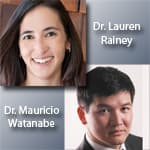
Dr. Lauren Yasuda Rainey is a proud alumna of the University of the Pacific, Arthur A. Dugoni School of Dentistry. After receiving her dental degree, she completed a General Practice Residency at Tufts University School of Dental Medicine. Her focus at Tufts was on advanced restorative techniques, including the use of surgical microscopes for restorative care, treating patients with complex medical needs and strengthening her skills by teaching in the undergraduate dental clinics.
After residency training, Dr. Rainey began teaching at the Dugoni School of Dentistry in the Department of Reconstructive Dental Sciences and the Department of Dental Practice. She was involved in both lectures and hands-on coursework in teledentistry, pre-clinical restorative curriculum, and local anesthesia administration. Dr. Rainey continues to teach direct composite restorative programs including black triangle closures, predictable class II techniques and is an advocate for using composite resin for crown alternatives wherever possible. She has taught dentists in the US and Canada, both in-person and in virtual hands-on formats. Dr. Rainey was recently featured by the Seattle Study Club in their Expert Tips series.
Dr. Rainey maintains a private practice in Berkeley, California where she developed and launched her own in-office membership program in 2018. She is active in mentorship and community building with her involvement with the Wellesley Club of Northern California, the Bioclear Alumni Network, and currently sits on the board of the Alumni Association at the Dugoni School of Dentistry. In her free time, you can find her outdoors in the Bay Area, mentoring young women interested in the health professions or whipping up a cake.
He graduated dentistry at the University of Araçatuba - UNESP, Brazil and has a Master's Degree in Prosthodontics.
He is specialised in Periodontics and Buco-Maxillofacial Surgery and Traumatology.
Currently he has his own practice in Brazil, and he is teaching courses of cosmetic dentistry in Brazil and South America.
How can you deliver a beautiful full coverage crown in under 30 minutes while removing minimal tooth structure? What if you could restore large carious lesions with subgingival decay using a conservative approach that preserves natural tooth architecture?
This episode features Dr. Lauren Rainey, a restorative dentistry educator and private practitioner from the University of the Pacific, Arthur A. Dugoni School of Dentistry, who completed her General Practice Residency at Tufts University School of Dental Medicine with advanced training in surgical microscopy and complex restorative care. She currently teaches direct composite techniques and crown alternatives while maintaining a private practice in Berkeley, California. Joining her is Dr. Mauricio Watanabe, a prosthodontist from Brazil with specialization in periodontics and oral surgery, who has developed innovative semi-direct restoration techniques taught throughout South America.
This conversation explores the semi-direct restoration technique - a revolutionary approach that combines direct composite for deep margin elevation with indirect fabrication of composite crowns outside the mouth. This method allows clinicians to restore severely compromised teeth with minimal preparation while maintaining complete control over aesthetics and occlusion. The technique is particularly valuable for teeth with large carious lesions extending below the gum line, where traditional approaches would require extensive tooth reduction.
Episode Highlights:
The semi-direct technique involves removing decay, elevating deep subgingival margins with direct composite, preparing minimal tooth structure, and fabricating a composite crown on a silicone model that sets in five minutes. The entire procedure can be completed chairside in approximately 30 minutes including impression time.
Deep margin elevation uses direct composite to bring subgingival decay margins above the gum line, creating accessible restoration margins that are easier to visualize, scan, and maintain long-term. This eliminates the challenges of working with margins hidden below tissue level.
High-filler content composites like nano-filled materials provide the mechanical properties necessary for full coverage restorations, offering excellent wear resistance and longevity when proper occlusal adjustment is performed. Cases with over 20 years of clinical success demonstrate the durability of this approach.
The technique requires using the same composite system throughout - both for deep margin elevation and crown fabrication - to ensure material compatibility and optimal bonding between direct and semi-direct components. Staying within one product line prevents potential adhesive failures.
Aesthetic results can be achieved using just two shades in many cases - typically a dentin shade for the body and an enamel shade for the surface layer. The conservative preparation and composite properties often make restoration margins nearly imperceptible clinically.
Perfect for: General dentists seeking conservative alternatives to traditional crowns, restorative specialists interested in single-visit solutions, and practitioners wanting to preserve maximum tooth structure while delivering full coverage restorations.
Discover how this technique could transform your approach to large posterior restorations and give your patients stronger, more conservative treatment options.
Transcript
Read Full Transcript
This transcript was automatically generated and may contain errors or inaccuracies. It is provided for reference and accessibility purposes and may not represent the exact words spoken.
For a molar, using a stone model, we need to have two appointments. But when we are using the silicon model, we can do it with the patient on a chair. Generally, I need some 20 minutes to fabricate it, and we can cementate the reservation. 20 minutes plus the model's setting time, five minutes and impression.
Welcome to the Phil Klein Dental Podcast. Today's episode should be interesting for those of us who value conservative tooth preparation, artistic control, and delivering a beautiful crown in a single visit. We're talking about what has been recently called a semi-direct restoration. This approach is ideal for teeth with large carious lesions, especially when part of that lesion extends deep below the gum line.
So here's the crux of this procedure. We remove all the decay, we raise the restorative margin above the gum line using direct composite resin, fill in any undercuts, and then prep the tooth for a thin composite crown, removing very little tooth structure in the process. Our goal is to fabricate an aesthetic composite crown that can be bonded onto the tooth prep, which will result in a long-lasting, strong restoration. According to our guest, Dr. Mauricio Watanabe,
By using a highly filled nano composite to fabricate the crown, the same material we'll be using for our deep margin elevation and filling in our undercuts, our semi-direct full coverage restoration should provide long-term predictable success. And Dr. Watanabe has years of cases and research to support his opinion. And the best part of his procedure is that we're fabricating the composite crown outside the mouth. That means total access.
total control, and all the time we need to create beautiful aesthetics. Even better, the whole procedure can be done in under 30 minutes when you're pouring your impression with a fast-setting silicone material, which we'll talk about on this episode. So if you're looking to practice conservative dentistry and preserve as much natural tooth structure as possible and still deliver a full coverage crown that looks beautiful, you might find the semi-direct restoration an excellent option.
for many of your large carious lesion cases. Our guests are Dr. Lauren Rainey and Dr. Mauricio Watanabe, both of whom are expert clinicians and well-respected key opinion leaders in the area of restorative dentistry. Before we bring in our guest, I do want to say that if you're enjoying these episodes and want to support the show, please follow us on Apple Podcasts or Spotify. You'll be the first to know about our new releases, and our entire production team will really appreciate it.
Thank you, Dr. Rainey. Thank you, Dr. Watanabe, for joining us today. We appreciate you being on the show. Happy to be here. Thanks for having us. Hi. So let me begin with you, Dr. Watanabe. You have a very interesting approach to restoring large cavities that come into your practice. These are teeth that are fairly broken down, and you use what you call a semi-direct technique.
the combination of direct restorative dentistry with indirect restorative dentistry. And you do it in one visit, you do a chairside, no lab. So you're here to confuse us because we all know what direct restorative dentistry is and we know what indirect is. And usually indirect requires a laboratory or chairside milling. And it's difficult to do indirect in one visit unless you have a chairside setup. But you do it in one visit and you don't have a chairside setup. You do it through this method that is quite unique. Tell us about it.
Hi, Phil. In fact, we are taking impression and building the restoration on a model. We just don't need an external laboratory to do it. We can do it by ourselves. So this is the approach that I think I should call it indirect composite restoration.
it's the directory source material use it indirectly and and we have another approach that is the semi-direct restoration that we obtain a silicon model instead of a stone model and when we are obtaining a silicon model we can the silicon set in five minutes so we can
uh place the restoration in the same appointment that i would call it semi-direct restoration and do you use that Dr Rainey yourself in your practice no i this was all new to me and i started reading about this and that's how i got interested in wanting to know dr wasmabe was he was doing this other approach which is not as far as i know taught
here in North America. I mean, I did go to school a little while ago, but I was on the faculty for a number of years after that. And this is not something that is discussed even a little bit. So Dr. Watanabe, tell us the clinical steps in this semi-direct technique. And also, why don't you just use direct restorative materials and restore the tooth that way? Okay. First, I would remove the old restoration node.
or remove the decay and just prepare the tooth with a immediate dental sieben okay so it's etch the enamel apply uh the adhesive a self-etched adhesive or a universal adhesive and after that i would fill the areas that we have some problems with the uh
you're referring to removing any undercuts that would give us a problem with draw yeah yeah and so we fill it with the composite and we also can elevate the deep margins when we we have some some situation like that like in class two uh we place a rubber rubber down we isolate it we place the matrix
and fill it with the composite. But this filling is not to finish the restoration, it's just to elevate the deep margin. Okay? And just to clarify, Dr. Watanabe, to our audience, a deep margin elevation, that usually involves removing the decay deep down in a class 2 box. It's really subgingival, very hard to visualize a margin down there. It's certainly difficult to scan it or take an impression. So you remove the decay.
very carefully isolate it, bring up the margin with direct composite through adhesive and direct composite, bring it up super gingival. And of course, the objective here, I assume, is to create a new restorative margin where it's easy to see and easy to restore and easy to maintain. Okay. And once you're done with that deep margin elevation, what's the next step? After that, I remove the matrix and prepare.
And this preparation is just to make the cavity expulsive. And we can take the impression or even scan, use the scanner to obtain the model. And when we take the impression and use the silicone to obtain the model, we call it semi-direct restoration because we can finish now in the same appointment.
If you use the stone, we isolate it with the wax and build up the restoration. The same composite to use for direct restoration.
So Dr. Watanabe, how long does it take using a stone model versus using a silicone model to do this semi-direct restoration chair side? What's the time frame? Okay. For a molar, using a stone model that we need one hour to obtain it, we need to have two appointments. And between these two appointments, we fabricate the restoration.
but when we are using the silicon model we can do it with the patients on a chair generally i need some 20 minutes to fabricate it and we can cement the reservation 20 minutes plus the models setting time five minutes and impression uh 30 minutes to fabricate the restoration
So you're fabricating using the same direct composite that you do for the deep margin elevation. You're using that on the silicone model, and that's what allows you to do it so quickly because the silicone model sets up in five minutes. What kind of silicone are you using? One thing that is really important is that we use a specific silicone to obtain the model, okay? Voco has a product called dye silicone.
that is appropriate to obtain this kind of model to use the semi-direct technique. Are you doing this kind of procedure, Dr. Rainey, based on what you've learned from Dr. Watanabe regarding this semi-direct technique? I've never tried it, but I've watched lots of videos and I've read his articles and now I get to talk to him. Maybe one day I'll get brave. Yeah, we thought you were going to be like...
start giving testimonials on this technique and how many success stories you have. But his work is absolutely stunning and beautiful. So if you get an opportunity, please look up Dr. Watanabe's work. It is just his photographs are beautiful. Where did you start hearing about Dr. Watanabe? What brought you into his world? You know, considering he works in Brazil, I know it's a global world now. Did you just start reading his papers and seeing his photos?
yeah it came i actually started reading it was an article about composite polishing and his name came up there and then it kind of showed up somewhere else and then i was like oh this is he really knows his composite stuff i should start like seeking this out and then we were at the same we were at a meeting last year together in the same place at the same time and that was pretty incredible to have a bunch of um it was an international
meeting put on by Voco. And it was just a great opportunity to see what some amazing clinicians all around the world are doing. So what do you see, Dr. Rainey, as Dr. Watanabe's technique was just described? What do you see the biggest advantage clinically to a dentist who really loves to do direct restorative? How do you see this whole thing benefiting you and your practice? It comes back to the longevity of the tooth. If we can be using the right materials, and again, with composites, there is very,
There are very few times there's minimal thickness of amount of composite you can use over to a structure as opposed to using the more traditional indirect.
materials where there is a minimum thickness needed for lab fabricated restorations. If there was a way for me to be able to do this with the right team and make it financially sustainable, I absolutely would get some of that dye silicone and start doing this benchtop direct composites because I know for me, that's probably what I would want in my own mouth.
And that's certainly a strong testimonial coming from a very experienced dentist. And I do want to mention to our audience that Dr. Rainey and Dr. Watanabe did a really good webinar on this technique. At least part of the webinar addressed it. And that's worth watching for sure if you're interested in doing this.
And that can be found on VivaLearning.com. Just type in Rainey, R-A-I-N-E-Y. The title of the webinar, Pushing the Envelope, Direct and Indirect Posterior Solutions with Composite. So apparently, Dr. Watanabe, you feel this technique, this semi-direct technique, helps you by taking the fabrication of the composite out of the mouth. Nowadays, I use this technique in many situations.
Even when we are establishing the occlusal vertical dimension, we can use the direct and indirect techniques because we have many situations like molars generally with a larger cavity where you prefer to use an indirect approach. But we also use the direct approach because...
um it's not easy to handle the indirect restoration when it is a little space to to work on it that's why i think composite resin would be we can work with it with both techniques depending on the situation i would prefer one another
Just curious, Dr. Watanabe, do you think having a countryside environment where you're the only office within a certain area and you wanted to get these patients finished with full coverage in one visit motivated you to look for another solution where you develop this technique, which gives them the full crown coverage that they need for these large restorations without going to a lab? Phil, in fact...
We have many excellent laboratories here, and this is not why I started using it. The main reason is because the conservative way that we prep this teeth is much more appropriate to our philosophy of conservative dentistry.
that's why i started working with this larger restoration in the past i have some works with more than 10 years and even even 20 years of follow-up and we'll have many situations that when i did it in the past in fact i was in doubt that that was the best
thing to do in that situation. But nowadays, I think, in fact, I know that it was the best way to restore that tip. Yeah, no, the conservative aspect to it is a big thing. And what do you attribute the strength of the composite to that you're doing this procedure with, where it can be rather thin, right, and still be very strong and last a long time in this indirect approach? When you use...
a composite resin with excellent mechanical properties. Because wear is one of our problems. I spend a lot of time adjusting the occlusion and if I use an inappropriate composite to do it, I will lose it shortly. And that's why I would prefer composites with a higher filler content. Okay? Higher filler content, less resin.
in proportion to the filler material. And what about the aesthetics that you're getting? The aesthetic, I can obtain a good aesthetic using just two shades. In some situations, it's even difficult for us to observe the limits of the cavity when we use the right shades to do it. Generally, A3, A4 for the dentine and A1 for the enamel.
It's interesting because there's a huge movement towards us.
single shade composite these days. And I know it's not really a shade, it's really how you perceive it to be next to the tooth that it's being restored against. It's like the physical properties of the material are kind of fooling the brain to think that the shade is matching. I don't know, Dr. Rainey, do you use some of that as well? The universal shades? Yeah. I'm finding that those are working pretty well. And especially in the posterior, the distal number two, the reality is that I'm probably the only one looking at it.
But the science, again, in both these bulk fills and in these universal shade composites is really very cool. Typically, they go in a little bit translucent to allow curing lights to allow full polymerization. So they need to be translucent enough that light's going to pass through them. And as soon as that polymerization occurs...
you see that start to change and they become a lot more opaque. So I've been pretty happy with some of these universal shade in the posterior region, for sure. Anterior, not so much, but definitely in the posterior. So to follow up, Dr. Watanabe, on the actual composite that you use for the semi-direct procedure, do you have a favorite go-to that you could recommend? I use Grandioso. Grandioso is high filler content composite resin. I can also use...
The grandioso have a flow to elevate the deep margins. And when we have a patient with a bruxism, I think it's very important to use the composite with a higher resistance, like this one that I use. Grandioso, you're saying? Grandioso, yes.
And I do want to point out, Dr. Watanabe, to our listeners, based on your recommendation earlier in another episode, that it's very important to stay within the same product for this semi-direct procedure. So if you're doing the deep margin elevation using Grandioso Heavy Flow, then you build up the tooth on the model, whether it's stone or silicone, whatever you're using.
with Grandioso. So you stay within the same system. If you're using another product, you do the same thing. Whatever composite you're using on that margin elevation, you use the same composite when you sculpt it up on the model and then cure it and bring it into the mouth. And that helps with compatibility. Yes, yes. And one of the very important things we're learning from this discussion is that dentists need to be open-minded about
procedures and not be fixed on the idea that composite is not strong enough for full coverage. We have to go ceramic. We have to reduce the tooth more. And then, of course, we sacrifice very important tooth structure that could lead to a fracture. So we need to be open-minded. And I think the conservative approach that Dr. Watanabe is pursuing with amazing aesthetics and one visit is really something amazing and praiseworthy. So as we wrap up this podcast,
I do want to ask Dr. Rainey, how much experience do you have with really large blown out teeth where you've gone even for financial limitations or whatever reasons the patients don't want to have crowns like we discussed earlier and you're going with direct restoratives? What have you seen in some of these cases where before these materials were so advanced, you would say, no way, this is not going to work. It's going to break in a year. What are you seeing?
Well, I didn't really believe it until I started doing it until I started seeing, you know, work of other colleagues that had these five, 10 year retrospectives and you go, well, maybe.
maybe there is an opportunity here. So you're right on the open-mindedness, right? Science is constantly evolving and changing and the manufacturers do a great job on the dental side, thinking of what the problems that we face clinically day-to-day and coming up with solutions for that. So since 2018, 2019, now I know that there are options for my patients and it comes down to, we can either go crown or we can do something different. And then that opens up the conversation.
If they're willing to have it. Any last thoughts from our guests? I'm just so excited that dentistry has given me the opportunity to meet people like both of you. Never in a million years did I ever think we'd be having a, you know, North South America podcast conversation across multiple state lines. Yeah, no, that's the beauty of technology. There's no question about it. The stuff that they're doing in Brazil, they've always seemed to be very advanced in Brazil. They push the envelope. They have.
unbelievable results in their aesthetic dentistry aesthetics are just yeah it's really unparalleled hats off to you doctor uh you're doing something in brazil that's a little bit different than we are in america america is more you know our culture i'm not to belittle the american culture but um the attention to details may not be there all the time there are many listeners on the show that are that are probably disagreeing with me but there are
some dentists that, you know, would like to find the fastest and easiest way to do something. And, um, that supersedes sometimes maybe the safest and minimal, most minimal way to do it. Um, but I think, like I said earlier, we have to be open-minded, learn new things. And as we wrap it up, just a reminder to our audience on viva learning.com, check out the webinar by Dr. Rainey and Dr. Watanabe, pushing the envelope.
direct and indirect posterior solutions with composite. Excellent, excellent presentation. If you're interested in conservative dentistry and doing a new procedure like this, check it out. You can search Rainey, R-A-I-N-E-Y, and you'll find it. Dr. Rainey, Dr. Watanabe, thank you so much for joining us. We really appreciate you being on the show. Well, thank you for having us. Thank you.