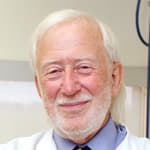
Dr. Malamed is a Diplomate of the American Dental Board of Anesthesiology as well a continuing education lecturer on anesthesia, sedation, and emergency medicine. He has authored more than 170 scientific papers and three textbooks that are used around the world.
Dental podcast: Welcome to DentalTalk. I'm Dr. Phil Klein. Today we'll be discussing how to prepare your dental office and staff to recognize medical emergency situations, and learn to efficiently and effectively manage them. Our guest is Dr. Stanley Malamed, a dentist anesthesiologist and emeritus professor of dentistry at the Herman Ostrow School of Dentistry of U.S.C., formerly the University of Southern California School of Dentistry.
Transcript
Read Full Transcript
This transcript was automatically generated and may contain errors or inaccuracies. It is provided for reference and accessibility purposes and may not represent the exact words spoken.
You're listening to The Dr. Phil Klein Dental Podcast
Welcome to Dental Talk. I'm Dr. Phil Klein. Today we'll be discussing how to prepare your dental
office and staff to recognize medical emergency situations and learn to efficiently and effectively
manage them. Our guest is Dr. Stanley Malamed, a dentist anesthesiologist and emeritus professor of
dentistry at the Herman Ostro School of Dentistry of USC, formerly the University of Southern
California School of Dentistry. Before we get started, I would like to mention that Dr. Malamed’s
webinar titled Basics of Emergency Medicine for Dental Facilities is now available as an on-demand
webinar on VivaLearning.com. Simply type in the search field Malamud, M-A-L-A-M-E-D,
and you'll see it. It's an excellent webinar for the entire dental team. Dr. Malamed, it's a
pleasure to have you on Dental Talk. Phil, nice to be back. We want to hear what you have to say
about a lot of these issues regarding medical emergencies in the dental office, but to begin, What
is the likelihood of a medical emergency even happening in a dental practice? Well, the likelihood
of a medical emergency from numerous studies basically say that if you practice dentistry on a full
-time basis, you can expect to have one medical emergency occurring in your office every two to
four years. Every two years, if we count fainting, fainting,
syncope is by far the most common medical emergency in any study published anywhere in the world.
dental office emergencies. And if we take syncope fainting out of the equation, one emergency every
four years. That's even more than I thought. I would think that, well, again, it depends on how
busy a dental practice is and how many patients are coming through the door. But this is a general
average, obviously, you're quoting that study. So let's talk about preparation.
What are the steps that a dental practice needs to take so that they could recognize and treat a
medical emergency when it happens in their practice? Good question. And there are four basic steps
or four basic steps for preparation. Number one is basic life support. I'll go back over these in a
moment, but basic life support. Number two is having some kind of a basic emergency team in your
dental office. Number three is knowing whom to call and when to call for emergency assistance.
And number four is having in the office emergency drugs and equipment. So we start out with basic
life support, CPR. And most states require the dentist,
the hygienist. Some states require the assistant to be trained or have a currently valid CPR card
in order to maintain your licensure. I would go a step further. and i would say that you the doctor
should make it mandatory that every person who works in your dental office be trained in cpr and
the way i look at this is that it says what if i the doctor were the victim of a medical a serious
medical emergency and the only person in my office was my receptionist who in every state is not
required to be trained in basic life support so make it mandatory number two even though the cards
are usually valid for two years your ability to perform CPR or basic life support deteriorates
rapidly if you don't do it and we don't so I would recommend also doing it every year and one last
thing I would say in that first part is have the course in your office because you're training your
office staff to treat a medical emergency in your dental office environment, as opposed to going to
a big dental meeting, the Hinman meeting, Chicago Midwinter meeting, California meeting, and going
into an auditorium with 100 other people and getting your card. You want to do it in your
environment. So that would be the very first step is basic life support for everybody. Number two
is to develop a team. Now, very simply, we're talking about if it hits the fan.
people have to know what to do. So the way I look at this, I have a bare-bones three-member team.
Member number one of the team, keeping in mind that all people in the office are trained in basic
life support. So member number one of the team is the first person on the scene. This could be the
doctor if the doctor's patient is in the chair having an emergency. It could be the dental
hygienist if a hygienist patient has an emergency, or it could be the receptionist if somebody in
the reception area collapses. That person, stays with the victim, administers whatever steps of
basic life support are necessary, and calls for help. Now, we're not calling 911 yet. We're just
activating a team. Help, I need help in the reception room, member number one.
Member number two, when they hear this call for help, before they go to the scene of the emergency,
gets the stuff. And the stuff is going to be the emergency drug kit, the oxygen cylinder,
and the automated external defibrillator, the AED. Okay, number number three is sort of the rest of
the staff. When the doctor arrives on the scene, he or she becomes the leader of the team,
and they can direct people to do certain tasks. If we want to call 911,
John, make the phone call for 911, and then come back and tell me you did it. If we were in a five
-story medical dental building, we want somebody married to go down to the lobby of the building,
wait for the ambulance to arrive on the scene, escort them up to the office. So everybody is going
to be assigned a task to do. That's the emergency team right there.
So the third part of my preparation is making that phone call for help. And in the United States,
it's 911. When? You call for help. You're the doctor.
You're the one in charge. It's a feeling in your gut that I don't like what's going on.
I think every doctor who's going to listen to this podcast had a patient faint. And I would venture
to guess that 99% of them did not call 911 because it was an 18, 19-year-old macho dude getting
an injection who fainted. I once had a doctor that said the Chicago Midwinter meeting many years
ago. And I asked, has anybody ever in this audience ever called 911 when a patient fainted?
And the doctor raised his hand. And I said, why? And he said, because the patient was 80 years old.
Given the fact that 80-year-olds can faint, but they're 80, there's nothing wrong with that.
So again, it's a feeling that you don't like what's going on or you don't know what's going on, you
make the phone call. Say 911 in the United States. Now, one thing that's really important is
response time. Response time for ambulances in the United States.
And in an urban area, uh this was the entire country taken as a whole uh in an urban area response
time at the ambulance was about seven minutes in a suburban area it was six minutes and in a rural
area it was 13 minutes and in 25 of the rural cases where they called 911 the response time
exceeded 19 minutes so you got to keep in mind that you the doctor are going to be with that person
you're the one who's responsible for the life of that person until help shows up on the scene and
that's why you need to be prepared so that leads me now to the fourth part of this and that is
emergency drugs and equipment it is an absolute legal requirement that you have in your dental
office emergency drugs and equipment uh if a doctor has is doing certain types of sedation whether
it's uh we'll talk about general anesthesia which is not sedation, intravenous sedation,
oral sedation, giving medications, and triazolam, Halcyon is a very popular drug.
The state in which you practice, you need to have a permit to administer sedation,
and the state has a list of emergency drugs that you have to have. Given the fact that most
dentists do not use sedation, they use local anesthesia.
There are eight drugs that I have been advocating as a bare-bones basic emergency kit that every
dental office should have. And just to read off the list for you, we don't have the time to go into
them right now, but the single most important drug in emergency medicine is epinephrine, an
autoinjector. We need an antihistamine by injection, a drug like diphenhydramine,
which is Benadryl. Then we have six other drugs that are non-injectable. We have a bronchodilator,
which is the asthma medication. We have nitroglycerin, little tablets for angina.
We have sugar, either it's a medical form of sugar or orange juice or non-diet soft drink for low
blood sugar, hypoglycemia. We have aspirin, preferably powdered or chewable for a suspected
myocardial infarction. We have oxygen, the second most important drug in emergency medicine.
and in the last year actually about two years ago we added naloxone narcan and we added it not
because which is of course the narcotic antagonist put narcan into the emergency kit not because
dentists are using narcotics but because their patients are i could talk about 10 or 15 actual
instances where patients came into a dental office high as a kite on narcotics or collapsed in the
bathroom in the dental office. And naloxone, it's a nasal spray. It's a drug that saves life.
So those are the basic eight right there. Then we have two pieces of equipment that are truly
important. One is the face mask. Because as healthcare providers, we still, when it comes to doing
CPR, basic life support, we are still required to ventilate. If you are a lay person and you take a
CPR course, they do what is called compression-only CPR. There's no ventilating done. But as
healthcare providers, we still need to ventilate that patient. And the thought of putting my mouth
on a patient's mouth at any point in time during any dental procedure is repugnant to anybody.
A face mask, which sells for maybe $10, is something that you can have in the office.
But the most important thing in way of equipment. by far the most and i've been advocating this now
going back to the 1980s is the automated external defibrillator the aed um some states require it
but if you're smart if you are smart you're going to buy two of them you're going to buy two for
your dental office one is going to wind up in your office and the other one is going to wind up in
your house you're buying it for your life uh over half of all uh 70 i'm sorry 70 percent of what
are called out-of-hospital cardiac arrests occur in the home of the victim.
Most cardiac arrests occur between 7 a.m. in the morning and 11 a.m. in the morning.
Where are you? You're at home or in the office. Using the AED, that requires some training as well.
AED is idiot-proof. Okay, idiot-proof. No, you can, anybody, a layperson could go right now
onto... Sam's Club, Walmart, you can go to Costco. You can buy an AED.
Anybody can. And the reason is there is no training required. These devices,
I use the word idiot proof, and they are, in the sense that all you have to do is turn the machine
on. And it doesn't matter which one you buy. People always ask me, what's the best AED?
And I say, in all honesty, pick your favorite color. They come in every color,
but they all work exactly the same way. you turn the machine on it tells you where to apply the
electrodes and there are diagrams on the electrode where you place them they go on the chest but
there's a diagram once it is on the machine is going to talk to you and it's going to say to you
analyzing rhythm do not touch patient don't touch the patient if a shock is advised and the
accuracy of these machines is over 99 99 accurate in in determining whether a heart rhythm is
shockable or not over 99 accurate the machine will say shock advised it'll say charging it'll say
do not touch patient it'll say press the button and you've just delivered a shock now if the
patient has a heart rhythm that is not shockable the machine is going to say to you no shock
advised continue cpr again what if what if you And this may sound kind of weird.
The machine says no shock advised. But you decide, I'm going to press the button anyway.
It won't deliver a shock. You cannot deliver a shock unless the rhythm in that patient is
appropriate. It's called a shockable rhythm. 99% success accuracy. So there's no training.
Seriously, there's no training. One more thing, though. So when you first get this device in the
office, of course, open it up. Open it up, look at it, read the instructions, but there's no
training that really needs to be done. It'll come with a DVD or a video.
You can go online and watch it. But there's really no training in how to use the device because you
cannot use it improperly. But you have to know that the patient just fainted or the patient's
having a myocardial infarction of some kind, right? Okay, so it's either an acronym or an
algorithm, but it's five letters. the letters p c a b and d this actually is the algorithm for cpr
but this is the algorithm we use for any and every medical emergency so let me just go through
these five steps with you the very first step in the managing of all medical emergencies is to
position the victim appropriately if they are conscious example of conscious would be a person with
asthma a person with an angina episode a person with a myocardial infarction in a conscious person
the position of choice is whatever they want most patients who have asthmatic attacks most patients
with chest pain they're going to sit up that they feel more comfortable but whatever they want if a
person is unconscious And our definition of this is a lack of response to sensory stimulation.
So every person listening to the program has had a CPR course and is lying there.
The very first thing you did was shake and shout. Lack of response to sensory stimulation means
you're unconscious. Now, since the most common reason a human being becomes unconscious is their
brain is not getting an adequate amount of oxygen, the position of choice for any unconscious
person is supine. Supine is horizontal, where the feet elevated slightly.
And the dental chair is perfect for that. If the back of the chair, the chest part of the chair is
parallel to the floor, there is a slight elevation in the legs. So the dental chair is perfect for
that positioning. The second step is to assess circulation.
Okay, now, if the victim is conscious, the asthmatic, a person... has low blood sugar,
a person who's having angina, you don't have to check circulation. Because they're conscious,
okay? You don't have to check airway. Dr. Klein, I'm having an anginal attack. Okay,
you've just assessed circulation, airway, and breathing because speech is breathing. So in a
conscious person, the next three steps, C, A, and B, as soon as the patient says anything to you,
you've assessed C, A, and B. But in the unconscious patient, then we have to assess,
physically assess. So the first thing we do in the unconscious patient who is now lying in a supine
position is check the carotid artery. We check the carotid artery with our index and middle finger
for not more than 10 seconds. If there is a pulse, then we don't do anything else.
We don't do chest compression. And if there is no pulse, we then start doing chest compression.
Okay, the next steps, airway and breathing. Again, back to the conscious patient,
no. No need to do it because we know just the fact that they're talking, airway and breathing.
They may not be perfect, but they're okay. Unconscious patient, head tilt,
chin lift. Probably the most important step in medical emergency in dentistry because,
thank God, cardiac arrest is very, very rare. It happens, but it's rare. But fainting is the most
common medical emergency. And when a patient faints, when a patient is unconscious,
Their muscles relax. The tongue falls back in the airway. And the most common cause of airway
obstruction in a human being is the tongue. So that step,
head tilt, chin lift, you put your hand in the forehead, you lift the chin, the tongue is attached
to the mandible, and the airway in almost all situations will now be open. Okay?
Then we get down to the last step. And the last step is definitive care. Okay?
Definitive care. D, definitive care, has three sub-Ds. D for diagnosis,
D for drugs, and D for defibrillation. So if you can make a diagnosis and if you have the
appropriate drugs, administer them. If you make a diagnosis and a diagnosis is cardiac arrest,
we have a defibrillator. If we can't make a diagnosis, then we make that phone call for 911.
So that's short and sweet. That's the way we prepare. We don't want medical emergencies to happen,
unfortunately. Look, we are treating people. We're doing invasive procedures and people are scared
of going to the dentist. So bottom line is stuff happens. So we need to be prepared to handle it.
So you went through all these steps. How long do you think is reasonable?
What reasonable amount of time should pass before? the doctor decides we need to call 911.
What are we talking about as far as time going through these steps if you're a decently trained
practice? Here are the two examples. Asthma and angina. Doc, I'm having an asthmatic attack.
Or Doc, I'm having an angina attack. Those two patients will tell you if they need an ambulance.
Because a patient with angina is going to say to you, Doc, This is not angina. You better call an
ambulance. And with an asthmatic, they're going to have their inhaler, their rescue drug. And after
they take it once or twice, they're going to say to you, Doc, it's not working. Call an ambulance.
Now, if it's first time chest pain, if it's bronchospasm for the first time,
you make that phone call immediately. OK, now with an unconscious patient, let's go back to the
most common one is fainting. I mentioned Mr. Macho, who's 18 years old, getting an injection.
He loses consciousness. You lay him down in the supine position, feet elevated slightly. You will
regain consciousness from a faint within 10 seconds. Simple, within 10 seconds.
How much longer are you going to wait? If it's 15 or 20 seconds and the patient is not getting any
better, while you're still maintaining an airway, you're telling somebody else to make that phone
call. Okay, so what happens? You make the phone call. And a second later, the patient regains
consciousness. Good. You don't cancel the phone call. The paramedics arrive in the office. They'll
assess the patient, say, doc, you did a good job. One other thing, seizures. OK,
seizures. If a patient is epileptic and comes into your dental office and has a seizure,
in most cases, a person with epilepsy has lost their driver's license because.
Driving a car, having a seizure, of course, is not very conducive to longevity. So there's somebody
in the reception area who drove that patient in, friend, relative, husband, wife. Bring them in.
And they have seen this patient have seizures before. And they'll say to you,
Doc, it's just another one of the seizures. No need to call an ambulance. Or they may come in and
say, Doc, you better call an ambulance right now. Now, regardless of which one of those two it is,
let's say the other person says no need for an ambulance. It's your choice. If you, the doctor,
are uncomfortable, you've never seen a real seizure before in your entire life, make that phone
call. Okay? So that's, I mean, the bottom line I said earlier, it's a feeling in your gut that
either you know what's going on and don't like it, or you don't know what's going on. Make that
phone call. Nobody is ever going to fault you for calling an ambulance to the office. Nobody ever
will. Right. So we talked about the drugs and the equipment that's recommended for these dental
offices. Tell us about... risks of expired drugs they're no longer working and what are some of the
solutions that you recommend for an office to look into i know health first is involved with that
as well exactly well a couple of things um before i talk about emergency drug kits uh what does the
expiration date on a drug mean what it means is the let's look at a local anesthetic called
lidocaine okay the most used local anesthetic in the world it's a two percent solution it expired
last month What that actually means is the drug has lost about 10% of its effectiveness.
It hasn't become a poison. It's not toxic. It's simply 1.8% lidocaine.
What I'm saying and what is legal are two different things here. A drug can be used past expiration
date. It shouldn't be. But if all you have available is that recently expired drug,
it can be used.
One way around this is an emergency kit. And I've always said,
make your own, make your own. If you make your own emergency kit, you know what you put in.
You probably did a little research. And I think you buy this Tupperware container,
you can use it. But most dentists... They want the easy way out.
And Health First, by the way, what do you want to call this disclosure? I am a consultant to Health
First Corporation. But they make emergency kits. They have very basic kits.
The eight drugs that I talked about earlier are in that basic emergency kit. But what's nice about
what they will do for you is they have you on a computer. They know the expiration date of each of
the drugs you have in your kit. They will send you. a fresh drug just before the one you have
expires. So again, it costs money, but it makes life a lot easier for you.
So I would recommend looking into that. Yeah. When it comes down to something as serious as a
medical emergency, I don't think that the extra costs involved with making sure your drugs are
fresh is a big issue. In your experience working with general practitioners,
what percentage of offices do you think are fully prepared? for a medical emergency in the way that
you're recommending and then you know don't be afraid to be blunt oh no i'm not i'm not afraid okay
oral surgeon 99.9%. Okay. General dentists,
25%. 25. Yeah, I wouldn't even say half. I mean, look,
I give a lot of CE courses. I'm back on the road again, thank God for that. And the medical
emergency course is the most popular course. It brings in the entire office staff. And it's
unfortunate, but I really and truly believe that most dentists... When it happens,
when it hits the fan, they're not very comfortable. Okay, so 75%,
they are basically going to pick up the phone and call 911 then? Like I said, in every survey,
including the one that I did, over half of the emergencies are fainting. Again, it's that teenager,
early 20s, macho guy. Females can faint, but it's the macho dude,
especially now when we have more female doctors and we have female hygienists giving injections.
There's no way a macho guy is going to tell anybody he's afraid of getting a shot. So they
internalize their fear, and that's what leads to fainting. Okay, so what is happening in these
dental practices that are the 75% approximately that are not following these recommendations the
way you describe them? What's the result of this? Happily, the result is very rarely death.
Very rarely. I mean, many of the emergencies, such as seizures, they stop all by themselves.
The patient who has a history of angina medicates themselves. The patient with asthma medicates
themselves. They diagnose these and medicate themselves. And these are very common medical
emergencies. So in spite of us, let me put it like that, in spite of our lack of being fully
prepared, the result usually turns out to be positive. I mean,
that's sort of a weird way to put that, but I honestly and truly believe that most dental offices
are not adequately prepared. If you look at the four things I talked about, I don't think they're
fully prepared. You are saying that it's very rare for a medical emergency to result in a death of
a patient, period. Very rarely. Very rarely. Do you have that percentage? No. You don't?
I mean, look, I've been now teaching almost 50 years. 1973,
July will be 50 years. And with one emergency, let's talk about local anesthetic overdose.
I've been involved over 50 years with 27 deaths, 27 deaths or serious brain damage.
And that's an emergency, of course, that is absolutely preventable. Give injections properly,
don't give too much. Other than that, I mean, in fact, I'm right now in the process of rewriting
the new edition, eighth edition of my book on medical emergencies. And when I go back into
literature to find case reports, there are very few. There are very, very few,
which is, you know, thank God for that. We're talking about worldwide. You know, and the other
thing about if somebody dies in a dental office, it makes the news. It's on TV. It's in the
newspaper. Again, happily, even though these things happen on occasion,
in fact, that's why they make the news. Right. They're so rare. So the bottom line is it pays to be
prepared. All these things you recommended are just phenomenal as far as protocol to make sure that
the team is not totally caught off guard. If something like this happens in the office and they're
under control, they don't scare the people in the waiting room. It looks like the team knows what
they're doing and it gives a lot of confidence. And that's it. If you know what to do when you have
assigned tasks, you don't have people running around not knowing what to do. You don't want panic.
That's the one thing you do not want in this situation. Yeah. Interesting. Well, thank you very
much, Dr. Malamed. Again, a great podcast full of incredible information, information that can be
used by every dental office, specialty and GP. I'm sure we're going to get thousands of people that
listen to this podcast. We really appreciate your input and hope to see you on another one soon.
Thank you very much, Chuck Mellon. Same here. Thank you, Phil.