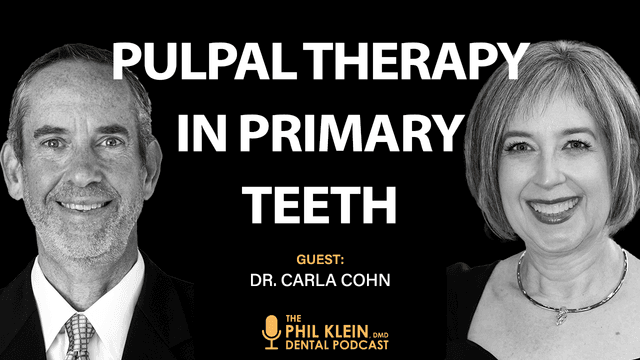
Dr. Cohn graduated from the University of Manitoba in 1991. She then went on to complete a post-graduate internship in Paediatric Dentistry. In addition to private practice, she is a clinical instructor, part-time, in Paediatric Dentistry at the University of Manitoba. Dr. Cohn is a partner at a private surgical clinic. She is a member of the following organizations: Manitoba Dental Association, Canadian Dental Association, Manitoba Dental Alumni Association, Winnipeg Dental Society, Women's Dental Group, American Academy of Paediatric Dentistry, Catapult Elite, and the Dean's Advisory Board. Dr. Cohn lectures internationally on prevention and Paediatric Dentistry for the general dentist.
When working on a primary tooth, how do we decide between indirect or direct pulp cap therapy? What about a pulpotomy or even an extraction? And if we can save the tooth, what are the best materials to use over a vital pulp? To tell us all about it is Dr. Carla Cohn. She has a ton of experience in this as she is a GP who only treats children.
Transcript
Read Full Transcript
This transcript was automatically generated and may contain errors or inaccuracies. It is provided for reference and accessibility purposes and may not represent the exact words spoken.
You're listening to the Phil Klein Dental Podcast
So we're working on a primary tooth and we think we have an exposure, but we're really not sure. We
know we're close. What's the best way to proceed? Do we do an indirect or direct pulp cap?
Do we do a pulpotomy or possibly an extraction? Lots of options and it's good to know what our odds
are and what's the best way to proceed to get the best results. To tell us all about how to treat
the vital pulp of a primary tooth is Dr. Carla Cohn. She has a ton of experience in this as she is
a GP who only treats children. So we welcome Dr. Cohn from Winnipeg,
Canada. Dr. Cohn, it's a pleasure to have you on the show. Thank you very much. It's a pleasure to
be here. Thank you for having me. So to begin, tell us what vital pulp therapy is and how does it
fit into the clinical treatment of children in your practice? Yeah. Oh, absolutely.
Well, vital pulp therapy is exactly what it sounds like. It's treating the pulpal complex of a
vital tooth. And we have a few different ways that we can do that.
So that in a very brief nutshell is what vital pulp therapy is.
So how has that evolved over the years? There's new materials out there, which you're going to be
talking about on this podcast. But what do you do before? What was the old fashioned way of doing
these things? Yeah, so it has changed immensely over the last...
few years, but over the last few decades, you know, we were treating pulpal complexes with calcium
hydroxide. We were doing pulpotomies with formacresol and then later on with ferric sulfate.
So our medicaments have changed. The chemistry has evolved and we are able to be able to treat now
these vital pulp therapies much more effectively and much more efficiently and much more
predictably. than we were with the materials of years gone by. Yeah, and for this podcast, I just
want to make it clear to our audience that Dr. Cohn primarily treats children almost 100%,
if not 100%. She's a GP, but she has tremendous experience in treating pediatric patients.
So what we're going to be talking about with vital pulp therapy is really related to the pediatric
patient. So what is the single most important factor for success? vital pulp therapy for you and
your practice? The single most important factor is correct diagnosis. If we can't treat,
we can't diagnose properly, we can't treat it properly. We need to be able to diagnose whether a
tooth is in fact a vital tooth and that One piece is the most important part of the equation to
know whether or not we're going to be able to have a successful treatment. And then, of course, the
second most important part is whether we're using the right medicaments and right technique.
Yeah, and I agree with you 100% because as an endodontist myself, diagnosis was the most critical
part of everything we do. I would get referrals from GPs and they would send the case over with
the... at least from their perspective that there was a certain disease process going on and it
turns out in many cases the diagnosis was not totally correct and it really did affect the way
things were going with that patient. And I always tried to keep an open mind to what the GP
suggested. But at the same time, I wanted to come in with a fresh look at the tooth and go through
all the steps of diagnosis so I can do it the way we were trained, which typically would take us to
a very high rate of success as far as diagnosing it correctly. So what are the things you look at
as far as diagnosis? So you have a patient coming in, there's pretty bad decay there. And what do
you do when that patient sits down to help you diagnose pulpal disease? The very first thing that
we do is we ask questions and get a proper history. So seeing kids.
You're not going to get a really reliable history from a three-year-old, so we're relying on the
parent to give us a correct history. And we are talking mostly about symptoms and when that tooth
is hurting. When that tooth is hurting is going to give me the biggest indication of whether or not
a tooth has a reversible pulpitis and is going to be able to respond to vital pulp therapy.
or not that child has pain that is nocturnal versus pain that is induced pain,
whether that pain is going to be a prolonged pain or whether it's going to be of short duration,
whether it's relieved by analgesics or not. Those are just some of the things that we look at when
we're taking our history in order to determine the vitality of that pulpal complex,
whether or not we have the infection from the... or the assault from the caries that has extended
into the radicular pulp complex, or whether we can assume that it's most likely contained within
the coronal pulp. Let's assume that you've come to the diagnosis of vital, so the pulp is
relatively healthy, right? It could be painful, but it's reversible, and you've come to that
conclusion. What do you do then at that point? The other pieces of the puzzle that we put together,
of course, is the clinical situation. We're going to take a look at that tooth. We're going to look
at things like the color of the tooth, the mobility of that tooth. We're going to look at
radiographically and see what the pulp chamber looks like, what the radicular pulp looks like,
if there's any resorption, internal, external, to see if we, in fact, have a tooth that's even
salvageable. decay that has created such an assault on that tooth that there may or may not be
anything worth saving. And then, of course, we also look to see if the tooth is going to be
exfoliating anytime in the near future. Why are we going ahead and putting a lot of treatment and
time and expense into a tooth that is a primary tooth? If it's going to exfoliate within a matter
of months, you know, forget it. We're on our way. Now, when you look at that tooth and you decide
the tooth is vital, and you're fairly convinced that it's reversible pulpitis, although we're never
sure, you have two options there. Well, there's two, not options, there's two scenarios let's talk
about. One is when you do caries excavation, the pulp is exposed. The other is it's not exposed.
You have dentin over that primary tooth, over that primary pulp, so that you're not into the
chamber. What do you do in these two cases? So we have options with vital pulp therapy,
whether we're going to be doing an indirect pulp therapy, a direct pulp therapy, or a pulpotomy.
Those are our three options for vital pulp therapy. And the highest success rate that we're going
to have is if we can do an indirect pulp therapy.
fairly confident that this is a reversible pulpitis and the caries hasn't invaded the pulp.
I don't have a mechanical exposure. I don't have a carious exposure. I'm going to have my best odds
of recovery with an indirect pulp therapy. Now, if I'm not so sure.
And I've gone through all of the checks and balances and seeing that, yeah,
this is looking like we're going to be able to have a reversible, but I'm really skeptical about
the health of the pulp chamber or the symptoms aren't quite adding up because it's, you know, it's
not quite a science and art and all of that nuances. So in those kinds of scenarios.
If I'm close and I'm seeing that I'm close to exposure, I'll go ahead and do the pulpotomy knowing
that my chances of success are lower that way. But at least I can go in and I can physically look
at the pulp because looking at that pulp in the coronal pulp is going to give me a lot of
information too. Just visually, not microscopically, just visually seeing what that pulp looks
like. Yeah. And when you're talking about what the pulp looks like, we're also talking about the
hemorrhagic activity going on in that pulp. And that hemorrhagic.
aspect, you know, obviously, or maybe not so obviously to those that might be listening is,
but if we can't stop the pulp from bleeding, if we can't achieve hemostasis, that's a hyperemic
pulp. We're, you know, that tooth is in trouble. Let's call it that. And part of the reason that
our newer materials are more successful in giving us higher efficiency and efficacy is because we
need to stop that pulp from bleeding without a hemostatic agent.
And so we don't have any of that false, you know, I've stopped the bleeding with ferric sulfate.
Oh, so it's a good pulp. I'm putting pressure on it. If I can't stop the... pulp from bleeding with
pressure, it's a hyperimic pulp, and then I know that I can't successfully treat it with a vital
pulp therapy. So in those cases where you cannot stop the bleeding, what's the next step? Then I
would go into a pulpectomy, which is time-consuming, laborious, and questionable as to whether or
not it's worth it, or remove the tooth. So in the process of removing decay on a primary tooth to
avoid pulpal exposure, do you leave some afactidentin or do you take it down to squeaky clean
surface? Yeah. So, you know, I mean, those are like the, that's the million dollar question is when
do you stop cutting? The other million-dollar question is when do you start cutting? Those are our
two problems in dentistry. When do we start and when do we stop? So we want to leave behind not
infected dentin. There's no chance of any type of regeneration with infected dentin.
But if we can get in and we can leave behind affected dentin that is not mushy,
relatively healthy-looking, and then we can go in and treat it with a medicament that's going to
drop calcium into it. area, act with an alkaline pH and help to promote the healing of that tooth.
So in those cases, we're going to choose a medicament to place on there as our indirect pulp cap.
But if we had that crystal ball and we could look ahead and see, am I far enough?
Am I too far? One of the beautiful things too about the materials that we have today is that I can
use TheraCal LC as an indirect pulp therapy. But if I do have an exposure or I have an exposure and
I can't see that exposure, then that TheraCal LC is going to work also as a direct pulp cap.
So that's my security blanket of choice is to go in and take that TheraCal LC,
use it in an indirect situation or in that situation where it's like,
Am I in there? Do I have that pinpoint exposure that I can't see? The TheraCalLC is going to cover
both of those bases. Yeah. And the fact that it has that calcium release, which stimulates
hydroxyapatite, helps us get that secondary dentin bridge, which won't occur if it's excessively
hemorrhagic. But if you can't see the exposure, then we are assuming that it's not hemorrhagic.
Otherwise, you'd see it. So in those cases where even if you have a direct pulp exposure, you're
saying, In pediatric teeth, in primary teeth, this particular product that you use, TheraCal LC,
works rather well. Yes, absolutely. What about the situation where now you've determined you need
to go through the roof of the pulp chamber, excavate the pulp tissue out, and now you're not
getting any more bleeding. You've got it under control and you've got a pulp chamber that's pretty
much cleaned out. What's your next step? So if I've got things cleaned out and hemostasis is
achieved, then I still need a medicament for those radicular pulp stumps. And so my...
of choice, my material of choice is going to be the TheraCal PT. So the same family as that
TheraCal LC, but TheraCal PT is a double-barreled syringe. It's a dual-cure material.
So I know that I can put it to a depth that I need to put it to and have an accurate...
cure, a reliable cure, but I can also light cure it so that I can carry on with the procedure as
soon as it's placed. And because it's syringable, I can only use as much as I need,
as opposed to some of the other materials that have lots of waste to them.
It's easy to use and it's... in the same sort of paradigm as what a general dentist would be using,
a syringable material. You put it in, you like, you're done. And if you're in a general office and
you're doing one pulpotomy once a week or once every two weeks, this material is going to be ideal
for you to be able to use it, put it away until the next time that you use it. What's the thickness
on the direct pulp cap versus the... the pulpotomy, putting it over the radicular orifices.
Yeah, so there's literature out there that's saying that if we're doing a pulpotomy, we want to
have a few millimeters depth of the material. If I've just got an indirect pulp therapy or I've got
a direct pulp cap and I'm using TheraCal LC, I only want a thin layer. I want like a millimeter or
so of that material. And that's where, not to muddy the water, but that's where their third
material of this family comes in, which is TheraBase. If I need something thicker, or I need
something that's more strength for a base as an indirect pulp layer,
then that's going to be the TheraBase because it's got properties that are stronger. So the
TheraBase acts as a protectant. It's kind of like a liner. It's a liner, basically. Yeah,
which is the same mechanism that the TheraCal LC can do.
kind of simplify things. But the TheraBase has the mechanical properties. The TheraCal LC has the
chemistry for me to get in there and put it on a direct pulp cap if necessary.
Yeah. So these materials are useful in that they insulate the pulp. They protect and insulate the
pulp. They also have a significant calcium release. How are they with moisture tolerance?
The moisture tolerance of the TheraCal PT is excellent because we're putting it onto an area where
even though we've got hemostasis achieved, there's still going to be seepage of the blood. So it's
very capable of being a moisture tolerant material. And in fact, the TheraCal LC,
for those of our audience that have used it in the past, sometimes you find that it flakes off.
Well, if you're finding that it's flaking off, what you're probably... that you've actually
desiccated the tooth too much. So it needs to have a little bit of moisture in there for it to
actually stay in place. So these are really good materials for all of the correct properties of our
tooth. So how has the change in materials for you, Dr. Cohn, as a GP that treats kids,
how has that changed your methodology? Are you doing things pretty much the same? except you're
using a superior material that's getting you good results or have you changed any other type of
process in treating these patients? So really the only change that has happened with these
materials, besides the fact that we've got better results and better materials, is that your way
that you're achieving the hemostasis is better. That's then giving you a reliable insight into the
vitality of that tooth. So rather than going in with the ferric sulfate or the form of creasol and
rubbing it on the pulp and stopping our bleeding, we're relying on the pressure.
So it takes probably about a minute longer. But if you can't achieve hemostasis within that minute,
you've got to go back to the drawing board. Maybe you've not removed enough of your coronal pulp
material. Maybe there's still a little bit into the radicular pulp stumps.
In the end, these materials have changed the technique in that hemostasis and made for a more
reliable diagnosis. So what is your typical success rate when you do stop the bleeding in a
patient, for instance, that has another two years left with those primary teeth? Let's just say two
years. When using these materials, what are you getting out as far as clinical outcome? Yeah. So I
can't give you I don't have my statistics, but I can tell you what the success rate of.
indirect pulp therapy, direct pulp therapy and pulpotomy is. So if you have an indirect pulp
therapy, assuming that you've got proper diagnosis, et cetera, et cetera, good materials,
you've got a 94.4% success rate. If you've got a direct pulp cap,
it's an 88.8% success rate. And if you've got a pulpotomy, you've got an 82.6% success rate.
So, and those are from a 2017. article in the Pediatric Dentistry Journal.
There are tons of other articles out there that I've read that are giving success rates of pulpal
therapy with ferric sulfate of like 60%. Then there's some that are really high.
It really depends how that study is done. And just because it's written doesn't mean that it's
written well. It's gospel, yeah. Regarding Form of Career Soul, to wrap up this podcast, is anybody
using that in pediatric dentistry anymore? Or is that just something that's gone by the wayside?
You know, sadly, it is still being used by some people in some places. It's still being taught in
some schools. And, you know, we've known since, it was 2011 when...
FDA came out and put formacresol on its list of known carcinogens. So,
you know, it's 2023 right now. It's been a dozen years. It's time to change the paradigm on what it
is we're using and why, you know, and whether or not formacresol was getting into bloodstream
because there was a whole... host of articles and studies that were done after that announcement
came out saying no no no it's not getting into the the kids bloodstreams whether or not these
materials are far superior they they let you work faster they let you work easier they let you work
more effectively and i don't want to go in and retreat a patient i i want that patient to have a
successful treatment the first time I see them. I never want to see a patient a second time for the
same tooth. Right. And what about postoperative sensitivity? The patient comes in in pain. It's
decided that it's reversible pulpitis. You go through these procedures as you described with
TheraCal PT or TheraCal LC. Are you getting the results you're looking for as far as making the
patient comfortable after these procedures using these materials? Yeah, absolutely. There's a high
success rate. And nobody gets it right 100% of the time. But this is going to give you the best
chance at success. Right diagnosis, right treatment, and right materials.
Sounds good. Thank you very much, Dr. Cohn, for your insight in this. And again, thank you for all
your contributions on VivaLearning.com, both on the webinar side and on the podcast side. I hope
you don't have too cold of a winter in Canada, but I have no control over that here. And stay well
and healthy. Thank you so much. Thank you so much. It's a pleasure. If you're enjoying this
podcast, please leave a review or follow us on your favorite podcast platform. It's a great way to
support our program and spread the word to others. Thanks so much for listening. See you in the
next episode.