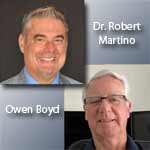
Dr. Martino owns and operates a 7-office group practice in West Virginia. He is well versed in disinfection technologies and the health risks associated wtih biofilms in the dental practice, not only from dealing with these issues in his own practices, but also as the CEO and co-founder of OraCare. Aside from his professional endeavors, Dr. Martino is the founder of Freedom Day USA, a national thank you event for veterans that has provides free dental service to members of the military and their families.
Owen Boyd is the CTO of Toppen Health and the original founder and former CEO of SolmeteX, that developed an amalgam separator as well as an arsenic removal technology. He is an adamant researcher and has studied water treatment technologies and their link to environmental impact as well as impact on the human microbiome. He is considered an expert on mercury, arsenic, and disinfection technologies and their uses and holds patents on remedial technologies. He speak and writes water and health related topics. He is an EPA Innovator Award winner, a National Academy of Sciences Silver Prize Recipient and a National Academy of Engineers Award Recipient.
Dental podcast: Welcome to DentalTalk. I'm Dr. Phil Klein. Today we'll be discussing dental waterline safety. Dental unit waterlines are the ideal place for dangerous biofilm growth. If this growth goes untreated it will make patients sick and leave your office liable. So the question is: Is your office vulnerable to this risk?
Transcript
Read Full Transcript
This transcript was automatically generated and may contain errors or inaccuracies. It is provided for reference and accessibility purposes and may not represent the exact words spoken.
Welcome to the Dr. Phil Klein Dental Podcast. I'm Dr. Phil Klein. Today we'll be discussing dental waterline safety. Dental unit waterlines are the ideal place for dangerous biofilm growth. We all know that.
If this growth continues to go untreated, it will make patients sick and leave your office liable.
So the question is, is your office vulnerable to this risk? Our guests are Dr. Robert Martino and
Owen Boyd. Dr. Martino owns and operates a seven-office group practice in West Virginia.
He is well-versed in disinfection technologies and the health risks associated with biofilms in
the dental practice, not only from dealing with these issues in his own practices, but also as the
CEO and co-founder of OraCare. Owen Boyd is Chief Technology Officer for Toppin Dental.
He is considered an expert on mercury, arsenic, and disinfection technologies and their uses and
holds patents on remedial technologies. He studies, speaks, and writes about water and healthcare
-related topics. So it's a pleasure to have both of you on the show. Hey, thank you, Phil, for
having us. Phil, pleasure to be here. Yeah, we're happy to have you. Before we get started, I'd
like the audience to know that Dr. Martino and Owen have a CE webinar, The Storm is Coming, and it's because of your water. waterline safety, current lawsuits, and new technology. So I hope you all tune into that. As always, there's no charge for these webinars on Viva Learning. It’s up as a searchable archive. So we welcome you to that. So let's begin with you, Dr. Martino. How did you get involved with water treatment? Well, I have seven dental offices. And anytime you have it,
you look for things that... can affect your whole office and or your whole organization and and i
you know just was doing some research and heard about all these patients that were getting sick
from dental line water and i had you know never heard of that you know i'm like you know i've you
know been practicing for 20 some years and you know we always thought you know well we have to the
bottled water we use uh you know distilled water and we think okay well we're we're safe and and
that's just not true and you know and and i think owen can go in and tell you why that's not true
but as as again as a dentist we don't know a lot about dental water so i you know i started doing
research and of course the first thing i did as i talked to you know my dental rep and and and
she's she's like yeah you should be using this this this stuff and and and basically it was like
put chemicals in our water and i'm like doesn't water have chemicals in it already you know and so
i i tried that for a couple years and you know my water would i was testing it and it wouldn't pass
and and and it was costing me a lot of money i have 70 some operatories and So it was costing me
upwards of $15,000, $18,000 a year. So I was doing some research and I found this company,
Toppin, and they have a completely different technology where they don't use chemicals.
They use what's called nanofiltration, really small. And again, Owen can talk to you a little bit
about that. But the great thing for me is, you know, it kept my water clean because it didn't let
bacteria and viruses in the line. and it saved me over $10,000 a year.
Yeah, the fact that you have seven offices, so from the standpoint of patient safety,
there's no question you wanted to optimize your system, but financially, based on the bills you
were getting with the current systems you were using, you were looking for something better,
especially more cost-effective, I should say. Let me address Owen for a second. And again,
Owen, I introduced as chief technology officer, and I don't mean that in the standpoint he's
running websites. He's actually someone who really understands the technology of water,
probably as well or better than anybody in the country. In fact, many years ago, he talked to me
offline and he was working on artificial intelligence. So we have to assume that Owen is quite a
bright guy and he could tell us about the dangers of biofilm. We all know biofilm builds up in
these water lines. We've seen pictures of it. So Owen, how does it get there in the first place?
Well, biofilm is just a process of bacteria sticking to... water lines,
plumbing, copper piping, where it will divide and multiply.
It likes to multiply. It's what bacteria has been doing since the planet was born.
Biofilm essentially is bacteria's method of protecting its children and then expanding its presence
in your water. So it has what are called stages of adhesion to water lines.
So you go into, you know, what's an initial attachment, you know, because a bacteria has an outer
wall that's kind of sticky. It'll stick to the surface of a wall. And in ideal conditions,
which unfortunately dental, you know, water lines provide to bacteria, it'll start to divide and
multiply. And then it creates a, it's a polymeric shield, an exopolymeric shield that sits over the
bacteria to protect it from chemicals. I mean, it's quite clever. This is why bacteria still
remains a problem in water lines globally. I mean, it's why you get boil orders constantly.
Right. So even with the motion of the water, the movement of the water through these lines and
chemicals that are being applied into these lines by dentists all over the world, you're saying
that this protective shield can protect the dangers of this bacteria.
And what are the dangers to the actual patient? Well, you know, to a human being,
you're loaded with gram-negative and gram-positive bacteria that have to remain in balance
constantly. And when, you know, when that sort of microbiome, this is, you know, you have an oral
biome and a gut biome. Those things, we've learned how important they are to overall human health.
If bacteria gets into wounds or gets inside the oral cavity.
It starts to do what it does in piping. It's going to start dividing and multiplying,
creating biofilms, putting your body out of balance, causing all kinds of diseases and illnesses.
Yeah, that sounds like you want to avoid that. Dr. Martino, as a dentist, what is your biggest
concern about the dangers in the offices that you own as far as the water? My patients would get
sick from something that I do. You know, hey. These patients are our friends,
our families. I want to make sure I provide them something that's safe. Isn't that what we're
supposed to be doing? And so it really scares me. And, you know, and then, you know, you worry
about lawsuits. You know, I know in California, there's a big lawsuit. 200 kids got sick and
there's one in Georgia, you know, and you just, you know, you worry about that. But I think the
bottom line is. You want to make sure that what you're doing to a patient is helping them and not
hurting them. And I think that's what I fear. So what did you do to assure yourself that you're in
a safe zone right now? So, you know, the great thing is I didn't know what to do.
But Toppin, they have a water program. So they assign me a water expert.
They have a program. They send me free shock.
offices and shock the lines and and then you know that happens every they keep me up to date
because you know listen there's a lot of things going on in office my number one thing isn't water
uh but it is for them and so they kind of hold our hand along the way and and i think so it you
know and then we test our water and and i feel i feel a lot safer now yeah so owen tell us about
the current methods that dentists are using the office where they're you know, they feel confident
that they're doing something correctly to make sure the water that's going through those lines are
clean and safe to the patient. And what does Top and Dental do that's different? Well, the main
difference is, you know, dentists are trying to accomplish what water treatment plants do to treat
water. And that's to add a chemical, whether it's chlorine,
you know, silver, you know, iodine, you can add all kinds of things to water.
Because those chemicals, they're typically oxidants that will kill bacteria and kill virus.
The only issue that causes failure is before you add a chemical to any water source,
if you don't know the other things that are in the water, the chemical can do two things.
One, not be concentrated enough to kill the bacteria because it's reacted with other organisms in
the water like tannins, tannic acid. Iron, copper, lead, zinc,
you know, creates oxide forms of those. So now there's nothing left over to kill the bacteria.
That's a serious issue because bacteria like Legionella, which has a very high expansion rate,
a single colony forming unit untreated left for a day can grow from one colony forming unit to over
100 million colony forming units in a single day. So the other thing you get is unwanted.
reactions, you know, so you can create things like disinfection byproducts,
chlorinated dioxins, furans, and these are all carcinogens. So you really should know what you're
doing and have a very good chemical knowledge of the input water, how much to dose so you get the
effect that you want, whether you need further treatment before you move on. What does your company
offer to the dentist if they were to get involved with? Top and Dental. I know Dr. Martino
mentioned he's got a lot on his mind, and as much as he wants the water safe, that's not his
priority with his everyday routine. So he relies on your company to handle that. So what would our
audience be interested in learning about Top and Dental that could help them achieve consistently
clean water and safe water for their patients? Well, the first thing is, you know, we don't add
chemicals. You know, we filter the bacteria and virus out.
I'm not going to explain the technology because it's a little complicated, but we do it in a very
cost-effective, inexpensive way. And then we maintain contact with the dental offices to ensure
that the systems are performing. We also, by not adding chemicals, I don't have to worry about all
these disinfection byproducts. I don't have to worry about my dose rate.
I mean, I can literally remove bacteria out of rivers and streams with this same technology that
I'm treating municipal water. So it's very effective. We are also taking the food groups out.
One of the things that you get with chemical treatment is you kill a bacterial cell. The inside of
the cell disperses in the water because you typically tear apart the outside wall. Those are
nutrients. So other bacteria eat those up and grow and form biofilms. So what you want to do is
filter out the bacteria, the virus, and the food groups. Don't tear the bacterial walls apart.
Where does this filter go in the system? Well, sort of the good news is depending on what your
dental office looks like, we have systems that can go into a chair-side water bottle.
It can go in just a standard single water line going to a single chair, although we really filter
the whole office. because it makes sense to have all your water clean, not just a single chair or a
dental unit water line. Get everything clean. Is that how it operates on your side, Dr. Martino?
Yes, and that's what saved me time and money. It's where the water comes in, that's where the
filtration starts. So all my water coming into my office is now bacteria and virus-free.
How long have you been using this system, Dr. Martino? I've been using it for about eight months
now. Before, I wasn't shocking enough. uh i wasn't and again that's what i'm i'm talking about with
popping is they they send me the shock they say hey now's the time to shock so so before i would
never know and and and so they shock and then we test the water and you know if anything happens i
got i got an expert on the line and and but i think the great thing is you know we now we now
protect the whole office instead of just the you know just in the water bottles and one thing that
i think a lot of people get excited about we don't have to use distilled water anymore you don't
have to use distilled water anymore in your office oh and but he's still shocking it so you're
still using chemicals okay so the uh the shocking um you know is a treat and then rinse rinse the
uh the solution out of the lines Although we use a chemical, we use a chemical, it's actually the
same chemical that your body produces to kill pathogens. So the idea that being safe for your body
makes it pretty safe in a dental unit waterline. The dental unit waterline is about the most ideal
environment for bacterial growth. Even though you filter, you can take 10 billion cells,
colony forming units, out of the water. If one slips by and there's food in the water,
sufficient for it enough to grow, it will grow. So this is just preventative. It's also,
Phil, it's following the guidelines that the ADA, the CDC, the FDA is kind of telling us,
you know, hey, you should shop every quarter. Right. Again, Owen explained to me one time,
he said, listen, if we started from your water lines, we just built your office, you probably
wouldn't have to shop. But he said, you know, There's always stuff in your lines. He said, there's
also this thing about suck back, you know, like you might have some suck back, like if it's in the
patient's mouth. He said, that's what you're shocking for. And like he explained to me, the
chemical that you use is really, really safe, but does a really good job of killing the bacteria.
Yeah, this has been very helpful, guys. We really appreciate your input. I guess if our audience
wants more information, they can look up Toppen Dental, T-O-P-P-E-N.
dental. You can Google that and do some research and find out more information from the company
itself. And thank you again to you both, for your insights. Thank you, Phil.
Keywords
dentaldentistCellerantInfection ControlPublic Health