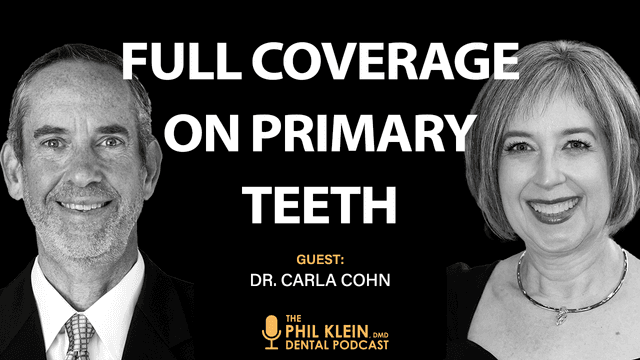
Dr. Cohn graduated from the University of Manitoba in 1991. She then went on to complete a post-graduate internship in Paediatric Dentistry. In addition to private practice, she is a clinical instructor, part-time, in Paediatric Dentistry at the University of Manitoba. Dr. Cohn is a partner at a private surgical clinic. She is a member of the following organizations: Manitoba Dental Association, Canadian Dental Association, Manitoba Dental Alumni Association, Winnipeg Dental Society, Women's Dental Group, American Academy of Paediatric Dentistry, Catapult Elite, and the Dean's Advisory Board. Dr. Cohn lectures internationally on prevention and Paediatric Dentistry for the general dentist.
Dental podcast: Welcome to DentalTalk. I'm Dr. Phil Klein. As the years go by, nothing makes a dentist happier than restorations that have stood the test of time. Longevity of dental treatment firmly establishes quality, reliability, durability, and function. In the case of our pediatric patients we're looking to place dental restorations quickly, that will last for a long time. Our guest is Dr. Carla Cohn, a general dentist devoted solely to the practice of dentistry for children. She maintains private practice in Winnipeg, Canada.
Transcript
Read Full Transcript
This transcript was automatically generated and may contain errors or inaccuracies. It is provided for reference and accessibility purposes and may not represent the exact words spoken.
Welcome to The Dr. Phil Klein Dental Podcast. I'm Dr. Phil Kline. As the years go by, nothing makes a dentist happier
than restorations that have stood the test of time. Longevity of dental treatment firmly
establishes quality, reliability, durability, and function. In the case of our pediatric patients,
we're looking to place dental restorations quickly that will last a long time. Our guest is Dr.
Carla Cohn, a general dentist devoted solely to the practice of dentistry for children. She's going
to tell us more about this. She maintains a private practice in Winnipeg, Canada, and has published
several articles and presented hundreds of webinars and live courses. Dr. Cohn enjoys teaching all
aspects of children's dentistry to the GP and has done so both nationally and internationally.
Dr. Cohn, it's a pleasure to have you on Dental Talk. Thank you very much, Bill. It's a pleasure to
be here. and we're certainly happy to have you back. To begin, let me ask you this question. What
restorative material is the most common for your intracoronal restorations, and what considerations
must be given when using it? Sure. So the most common really is composite resin,
and that's across all of North America. And that's also my most commonly used restorative material
for intracoronal restorations. So, and that applies to children, right? We're talking about...
Oh, yes. We are talking solely about... treating children here in this and all of my podcasts.
Although, you know, I'm glad you said that because this material that we use for intracurinal
restoration is not just the most common in North America for kids. We have a big love affair with
composite resin restorations in North America for all of our patients. We're very comfortable with
it. And it's immediately aesthetic outcomes. It's a very satisfying.
and thorough material that we can work with, something that is going to give us predictable
results. Most commonly, although I do use lots of other different materials for restorative,
for intracronal, the most common one that I pick up is a composite resin.
We need to though give consideration when we are using composite.
resin particularly when we're treating children because of that hydrophobicity of that material so
proper isolation and preparation and proper placement are really really important specifically
using it on children when we have a not always so predictable patient we have a reliable and
predictable material but it has to be kept dry and also to know that not all composite resins are
created equal so i don't know if you know you might be a little bit like me or our listeners like
you like me but i'm not so good at reading the instructions and we we tend to get uh material and
think that we know best it's really important though to read about what you're using to know what
the proper are of that particular material or medicament. And in order to achieve ideal outcomes,
you have to know what it is that you're using. Right. So you've been treating children as a general
practitioner, right? You're not a pediatric dentist, which is interesting. And you teach a lot of
GPs about children's dentistry. So in the past, and many of our listeners might be thinking this,
is that glass ionomer was the product of choice. you want to get the patient as a child in and out
as fast as you can you yeah less technique sensitive less yeah uh tolerant or more tolerant i
should say to moisture which is a big factor when you have a patient biting your finger and not
tolerating rubber down you come from a little bit of a different approach here with the composite
resin approach but you've certainly had decades of experience in this so tell us why you're very
confident with composite resin yeah or you still use glass onomer Each of these materials both have
their strengths and their weaknesses, and glass ionomers are a great material for all of the
reasons that you mentioned, and resin-modified glass ionomers in that umbrella as well.
So they're a fantastic, fast, reliable material, but they don't have the same strength as composite
resins. They don't have the same aesthetics as composite resins, and they don't have that...
in terms of not washing out or color stability. So I do use both on a regular basis,
but by and far, the most common material that we use is composite resin.
And also keep in mind, and I digress just a little bit, when we're seeing our kids as patients in
our practice, Most of the time, our kids are cool and calm,
and we can do what we need to do and isolate and all of these other things that make for a
successful restorative procedure. You know, it's probably 80% of the kids that we see that are
going to be cool cucumbers, and then 20% of the kids that are going to be a little more
challenging, if you want to call it that. For the majority of kids that we use, we can use an
ideal, aesthetic, strong. long-lasting material when you say children give us the range of age
that you're talking about so i'll see anywhere i i mean i'll see anywhere from like zero up but
when we talk about doing restorative treatment typically restorative treatment will start around
the age of two years of age and then go on up. Typically,
when you have kids in private practice, in a general family practice,
most general practitioners tend to feel fairly comfortable around the age of five years.
That's usually the... the time when a dentist would feel confident in proceeding with treatment in
their general practice rather than referring that child out to a pediatric. practice.
But if you think about it, and I digress again, if you see a five-year-old and you're doing a
molar restorative, that tooth needs to last that kid seven years. Now in the adult world,
that's not a long time, but in a child, that is a long time to have a restoration last,
particularly if it's an MO or a DO. What qualities make an ideal composite resin material in your
mind? Specifically when we're placing composite resin. restorations in kids,
one of the main things that I look at is fill content. And the fill content correlates to wear and
to shrinkage, which are both hugely important when we're seeing kids. High fill content means low
wear, low shrinkage and a long lasting restoration. you know i've been a speaker for about a dozen
years now one of the very first manufacturers that i worked with was voco and back then i was super
keen to read their scientific material and i remember reading their literature like cover to cover
on what was their new grandioso back then really that one has become my one of my favorite go-to
reliable materials it's fast to work with it gives patients long-lasting results it stood the test
of time it's 10 years old now that material and in addition to that original grandioso back 10
years ago voco now has an expanded grandioso line that has a bulk fill which is a grandioso extra
and a grandioso light flow i think i've got a podcast that I've done or will do, I can't even
remember, on the light flow itself. So they really are, for pediatric restorative dentistry,
they must have materials. Now, when you say the fill is really important for strength, what about
for handling and flowability? Isn't it when you increase the fill, there's a sacrifice there,
or is that not the case with this material? It does tend to make for a stiffer material when we're
trying to extrude it. But one of my favorite tools to use is the caps warmer.
And the one that I use is also made by Voco. And so you put your syringe,
I use the little compules in the composite gun or the composite dispenser, I guess we don't want to
call it a gun. And I put it in there and it makes the material very flowable and much.
nicer to work with so when we extrude it it's got this creamy consistency to it and I can have a
more pleasurable experience using a highly filled material with that caps warmer.
If you would describe your placement technique of choice for a typical posterior composite resin
restoration. Sure so I'm just going to summarize kind of real quick there's like lots to talk about
with this. particular technique but the snowplow technique is basically based off of technique from
a combination of what Dr. Clark and Dr. Belvedere did with their restorative material placements
and so I'll do a selective etched technique and then adhesive and then I follow it with a layer of
flowable composite resin and I don't cure that I then put on the packable composite and it allows
the flowable to extrude to the gingival margin and the occlusal and to fill in all of those little
nooks and crannies and make for a voidless restoration. Then I'll cure it and I'll top the entire
thing off with a flowable again that then will act as sealant type of a material.
And again, just to totally seal everything, get all of those nooks and crannies covered.
so when you use the flowable you're not curing it and then you're placing grandioso extra on top
yeah so now when i'm doing them i'm using the grandioso extra as a bulk fill but even before the
Grandioso Extra was a product, I would use the Grandioso as a bulk fill.
Because remember, we've got primary dentition and we don't have very deep restorations.
I do have another technique. I don't think time would permit us talking about it that I'll do.
If I do have a deeper restoration, I'll then put in a layer of base that I'll cure,
but by and large. almost all primary dentition, the first, second primary molar that I'm restoring
with these, I do typical MODO on an A and B, for example,
I'll use that snowplow technique and use it as a bulk fill. And there's different evidence out
there. I've got a few things under my belt in my list of evidence-based literature that talk about
doing bulk fill without an actual bulk fill material. still having really good success you know
that we don't need to have to do all of these little incremental placements and when we're seeing
kids we don't have time right we just we need to be quick and efficient so on the flowable does
that have to be the same system as the composite resin that's going on top do you recommend staying
with the same company I do. I stay with the same company because in my mind,
the chemistry is the same. Now I'll do a Grandioso Light Flow with the Grandioso Extra on top of
it, just because I really love that handling of that Grandioso Light Flow.
And the Grandioso Extra gives me such a nice, highly filled... long lasting material in my
restoration. So those are my two that I'm using quite commonly in the last couple of years.
The light flow hasn't been around for very long. The beautiful thing about it.
It's a great material, but the dispense of it through a very fine cannula in that syringe just
allows for such precision placement. You use less material. There's less waste. You get it where
it's supposed to go. It's really a nice, nice material to work with. Is there any risk in that
technique where the flowable doesn't polymerize? Because since you're not curing it before you add
the composite resin on top, is there a possibility that the cure won't go all the way down?
that something dentists might be a little bit nervous about? Yeah. And, you know, it depends upon
the depth of that restoration, right? How far, you know, you can only cure so far, right? And for
that reason, if we're in a situation where it's deeper... and I'm not certain that it's going to
cure, it's going to polymerase, then I'll use a base layer. But typically,
in a primary tooth, in a primary molar, if I'm too deep to cure through,
to get to that base of the material, I'm putting a crown on that tooth anyway. I'm not too big of a
restoration. How has your longest standing composite resin stood the test of time? yeah so you know
what the grandioso has held up really really beautifully time has given us a wide range of dental
materials as companies continue to innovate and respond to those demands of of us as dentists in
the field as well as our patients needs and in terms of composites many of these innovations really
revolve around making placement faster for dentists make restorations more long-lasting for
patients and in both these cases a common is time. Voco's materials manufacturers always taken the
concept of time seriously and whether it's the speed that we can work with or the length of time a
restoration lasts, Grandioso is no exception. The fact that it's last 10 years in a competitive
marketplace, we have so many different composite resins available to us. It's a testament that it's
a fixture in time for practitioners and our patients. It's been a really great benefit for my
practice and my patients. and we see what it's done in the last 10 years and I am confident 10
years from now it will still be talking about it as a great material. Dr. Cohn,
it's been great. We really appreciate everything. And I think it's a wonderful service with all
your work that you do teaching GPs on how to optimize their treatment for children. And in addition
to all the CE that you're doing lately over the years, the library is building nicely and it's
really helping our listeners. So we appreciate that. And thank you very much. Thank you so much.
And thanks for all that you do. We couldn't do it without you. Thank you. You have a great night.
Thank you. You as well.