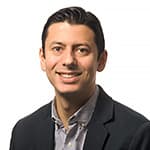
Dr. Julián Conejo, D.D.S., M.Sc, is the Clinical CAD/CAM Director at the Department of Preventive and Restorative Sciences, University of Pennsylvania School of Dental Medicine, Philadelphia PA, USA. He conducts research and has multiple publications in peer-reviewed scientific journals on CAD/CAM technology, prosthodontics and implant dentistry. Dr. Conejo has been the recipient of several awards in his field, to include the ICP Research Fellowship in Dental Restorative Materials in 2016 and has lectured in over 35 countries.
Dental podcast: Welcome to DentalTalk. I'm Dr. Phil Klein. Today we'll be discussing the importance of and protocol for perfecting Esthetic Mock-Ups in your practice. Our guest is Dr. Julián Conejo, Clinical CAD/CAM Director at the Department of Preventive and Restorative Sciences, University of Pennsylvania School of Dental Medicine. He conducts research and has multiple publications in peer-reviewed scientific journals on CAD/CAM technology, prosthodontics and implant dentistry. Dr. Conejo has been the recipient of several awards in his field, including in 2016, the ICP Research Fellowship in Dental Restorative Materials.
Transcript
Read Full Transcript
This transcript was automatically generated and may contain errors or inaccuracies. It is provided for reference and accessibility purposes and may not represent the exact words spoken.
You're listening to the Dr. Phil Klein Dental Podcast from Viva Learning.com.
Welcome to the show. I'm Dr. Phil Klein. Today, we'll be discussing the importance of and
protocol for perfecting aesthetic mock-ups in your practice. Our guest is Dr.
Julian Conejo, Clinical CAD-CAM Director at the Department of Preventive and Restorative Sciences,
University of Pennsylvania School of Dental Medicine, my alma mater, as a matter of fact. He
conducts research. and has multiple publications in peer-reviewed scientific journals on CAD-CAM
technology, prosthodontics, and implant dentistry. Dr. Conejo has been the recipient of several
awards in his field, including in 2016, the ICP Research Fellowship of Dental Restorative
Materials. Dr. Conejo, it's a pleasure to have you on Dental Talk. Hello, Phil, and thanks for the
invitation. It's a pleasure for me also. Yeah. And I was recently at University of Pennsylvania
Dental School where I went to dental school and also endo grad school. And it's just an amazing
facility. I mean, it's beautiful compared to what I worked in. It's like I worked in the stone age
of dentistry. I think I caught the last part of the main clinic and other facilities that were
there before they literally redid everything. And they probably redone it. twice since then so it's
beautiful school to work at and congratulations for being the director of of your department of
preventive and restorative sciences to begin this podcast let me ask a simple question uh what is
the importance of an aesthetic mock-up in prosthodontics yeah well so um nowadays i think that
we've been merging to a lot of digital technologies for treatment planning from extra-aural
photos, face scans combined with intra-aural scans to get that ideal digital walks up.
But at the end, the value of being able to materialize that in the patient's mouth and have the
patient be able to feel and have a better sensation of what the final prosthetic product would look
like, I think it's invaluable. So now we're trying more and more to perfect these mock-ups.
because it can get challenging when we need to have certain reduction and modify slightly the
position of the teeth. But with the use of 3D-printed resin models and high-quality potty
matrices from silicon materials, and of course the use of a bisocryl material,
we can place that template in the patient's mouth and have a very good approximation.
for the final outcomes and then be able to discuss with the patient limitations or exactly where we
can reach and have this direct conversation before entering into the real treatment phase.
I think it's very, very valuable for the patients and for us in combination with the dental
laboratory as well. In your words, as simple as possible, explain to our audience,
who are mostly dentists, there might be some staff members on, I'm sure there are, what would you
say would be the easiest way to describe an aesthetic mock-up? In a couple of sentences, and then
I'll get into the question of, you know, what the actual protocol is, etc. Sure. Well,
basically, when we diagnose that the patient needs certain improvements on their smile,
closing some diastemas, perhaps correcting...
inclination of the occlusal plane or anything that the patient is concerned about the aesthetics we
go ahead and make a wax up whether it's digital or conventional and then with this bisacryl
material and a silicon matrix we can place this inside the patient's mouth so we can really see if
our plan is perfect or it should be improved before we move to that phase so it's not only for the
marketing part of the treatment, but it's also providing us very solid information,
key concepts to be able to consider them when we go to the elaboration of the final restorations,
whether there are veneers or crowns or combination. Very well articulated. So what is your protocol
for the aesthetic mock-up and how does one get started to do this? So when I started being trained
as a prosthodontic resident, we were all about very nice manual wax ups mounted in our semi
-adjustable articulators and work for hours and now with the use of apps or a simple software we
can place inside these softwares the STL files of the intraoral scans which is our new way of
making the preliminary impressions and some portraits of the patient and then come with these nice
3D wax up once we have this project we need to make it real materialize it so we've been
collaborating with dmg using their resins for 3d printing models and surgical guides so we 3d print
this and once we have our new model usually in the traditional way was stone and wax now it's a 3d
printing resin model we will use pvs material a potty matrix that I relined with a light body
material to copy all those details, the texture, the contours, the line angles that we created in
this 3D project and with a bisacral material like Luxottem for example.
We can fill this inside the body matrix as we do for any conventional provisional and place it in
the patient's mouth. So we try to remove the excess before final setting time so we don't injure
the gum. And then we just remove the matrix and we can have a very nice final surface.
And of course, all the details that these 3D wax ups have.
So it's very... very important still now in 2021 with all the digitalization the essence of the
mock-up not only are you providing the mock-up so that the patient and the doctor could evaluate
you know what's coming down the road when you do the final prosthodontic work but also can this be
used as like a transitional prosthodontic solution absolutely feels yes so so the value of having
this 3d printed model with the project and a very good silicon matrix makes this very useful
because we can use it as a template to create the mock-up and discuss with the patient and help us
communicate and sell the the treatment but also let's say i'm doing six veneers six to eleven and i
make the preparations i'm going to use it as well to create my provisionals let's say i'm going to
have the patient in provisionals for two weeks while the lab makes the ceramic veneers then this
same bicycle material will be used for the provisionals and what dmg has come now with a newer
version of a bisacryl material that can be maintained in the patient's mouth for longer periods of
time. As prosthodontists, we many times have cases where there's a lot of wear and the vertical
dimension is collapsed. So we need to start by reestablishing that vertical dimension.
And here is where we can place these materials.
leave them for months or even years as a semi-permanent solution.
And these provide us with nice intermediate solutions that in the past we didn't really have
something specific for that use. I guess sometimes these provisionals are so good.
there are cases where patients look at them and say hey i don't need to rush back to get this done
this is beautiful i guess you have to reinforce that to the patient that these are temporaries and
they're not designed to be utilized in the mouth for an extended period of time i know that when i
was in dental school if we made our temporaries too nice we wouldn't see the patient again I guess
that still happens to some extent, but in private practice, it probably is not that applicable.
That statement that you're saying, it's so real, right? And what Dr. Marcus Blatt, our department
chair, always says is that the quality of the provisionals are our business card.
So we've changed that, let's say, perception. We try to... to put a lot of effort on the
elaboration of these high aesthetic mock-ups or provisionals. And at the end, when we come with
the final restorations, the only thing we're doing is changing the material. But we like to have
the tissue support, the length, the width, the texture, the position of the line angles, et cetera.
So those concepts that we've all been learning through the time and the years and implementing new
concepts really makes us provide more consistency when we're talking about high aesthetic ceramic
restorations. And now with these long-term provisional restorations,
you know better than me, of course, as endodontist, maybe the endodontic endo is done,
but perhaps it's a challenging case. We might want to have a intermediate solution and that's where
it looks around. could play a key role and it's not as fragile as just a conventional provisional
material, but we are not being so invasive of delivering something definitively that then it will
cost us a lot of tool structure to remove and get back into that game. So it's nice to have these
new possibilities of materials. Yeah, for sure. So regarding veneer preparations, you talked about
six to 11. Are you also referring to fabricating these provisionals in the same manner for veneers?
Yes, exactly. So when we fabricate these provisionals with the Luxa Temp,
I like to have this silicon index extend to the occlusal surface of the postivers so we can have a
nice stop, that vertical stop, that can help us place it ideally in the position. So we can use
this same method for veneers. or for full coverage restorations like full crowns.
So tell us about transferring the provisional stage to the final restoration. What's that whole
process like? That's something that we've all been frustrated when we do prosthodontics like
provisionals are nice and then the lab sends us something pretty different and that's not what we
were looking for. That was not what the patient was expecting. So what we do now is once we've
placed this mock-up and then with some intraoral minimal adaptations with discs,
we perfect it. Once we have it and the patients approve it,
then we scan the mock-up. So that's why the mock-up is so valuable now because we scan this and
we send that to the lab and basically the lab is going to do a copy-paste with the exact length
and volume and position and width. for the final restoration. So we are very much more predictable
now with this workflow. We emphasize on the quality of the mockup and once we fine tune it,
we scan it and that's the file that we share as well as the file of the preparations to the lab.
So they don't have any excuse to say it in a nice way. We're giving them all the information that
they need so we don't have these surprises. Yeah, it seems like The aesthetic mock-up provides an
incredible amount of checks and balances along the process of creating the final prosthesis.
I can't imagine doing, you know, like you mentioned, 6 to 11 without doing an aesthetic mock-up.
I mean, there's a lot of risk, unknowns, uncertainties, patient satisfaction issues could result
from this. When you have this aesthetic mock-up the way you describe and you're actually scanning
it and sending it to the lab, what you're getting, like you said, in the final restoration is just
a change in material. Do you think most dentists are doing aesthetic mock-ups? Yeah, well, I think
that most restorative dentists are familiar with the concept of a mock-up. Maybe they make primary
impressions and send their models to the lab for elaboration of a wax-up, whether it's
conventional or digital. But what I would provide,
if it's the word as a tip for the clinicians, make sure you take portraits of the patient.
of course, of the face of the patient in a big smile where you can see the incisal edges of the
anterior teeth and share that as well with your intraoral scan or your preliminary conventional
impressions so the designer can have a nice dentofacial concept,
involve the interpupillary line, the horizontal plane, and then we are using these simple tools to
try to replace what we used to use the face bow for. So I like to use these traditional concepts of
PROS with simple newer tools, but maintaining those important concepts for the final restoration.
And then what we were just discussing, once you have that provisional or that mock-up and it feels
good for the patient, you like the aesthetics, you like the symmetry, you like the lip support.
scan it or make an alginate impression on that if you don't have a scanner yet, but make sure that
you share that with the lab so there's no surprises at the end. Just curious, at Penn, do you take
routinely extra oral photographs of the patient before and after? Yes,
for these cases, Phil, where we are working in the anterior maxilla and patient comes to us with
aesthetic concerns, absolutely. We believe that dental facial integration is a key.
uh concept uh that's how we could prevent that the incisal edges are too long or too short and they
are not even seen at the rest position so uh these these images are very valuable now you can also
see many facial scanners which we don't use them all the cases but it's it's technology that also
helps us with the integration of the softwares to design because having just a very nice software
without information of the parameters of the patient's face, they are not as helpful. I've always
been curious to know, you know, the dentist that experienced both sides of clinical dentistry prior
to digital designing and all the applications that are out there, they actually did it the old
-fashioned way, and then they transitioned into the software that actually designs, you know,
these provisionals and so forth. I'm wondering if, you know, once that generation is lost,
where that group of dentists retire, and then you get the new dentists that strictly are doing it
digitally. What's your thought on that? Yeah, you know, I think that nowadays our students are
doing more intraoral scans and alginate impressions. Maybe we talk again in two years,
maybe we're not using alginate anymore. I think that's how fast we're merging to the utilization of
these new technologies. What is important, I think it's having the concepts, whether it's with
traditional methods or with digital tools and solutions, having the concepts,
those basic concepts from complete dentures, where the teeth need to be placed, where we'll be in
harmony with the face, with the smile, with the lips, with the muscles, for phonetics, for
aesthetics, and for all these basic things that will always rule. What we're changing now is how we
create this. So now we have a... 3d printing lab where our students upload their digital whatsapps
and next day up the printed model so yes it's it's changing a lot but um what i would say is that
just the technology without the concept won't take us anywhere yeah well said we really appreciate
your insights we'd like to thank our sponsor dmg america and if you'd like more information about
3d printing luxor crown and other materials that were mentioned in this podcast feel free to visit
dmg-connect.com Dr. Conejo, thank you very much. We're talking to Dr.
Julian Conejo, the Department Director of Preventive and Restorative Sciences at University of
Pennsylvania School of Dental Medicine. That was an excellent podcast, great insight, and hope to
have you on future podcasts. Thanks so much for your time. Thank you, Phil, for the invitation.
Thanks a lot.
Keywords
dentaldentistDMG America3D Printing TechnologyCAD/CAM Technology and MaterialsCrown/Bridge/Veneers/Indirect