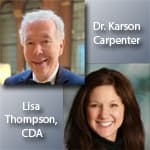
Karson L. Carpenter serves as President of Compliance Training Partners. He is an OSHA approved trainer who has for over 25 years designed educational programs to bring dental facilities into compliance with the governmental regulations that affect them in the areas of OSHA, HIPAA and infection control. His experience includes guiding numerous clients across the United States through OSHA and HIPAA inspections as well as the critical post-inspection process.
Lisa began her career in the dental industry 36 years ago as a Certified & Registered Dental Assistant. Along her career path, Lisa has worked as a Clinical Director for a multiple doctor facility, a clinical instructor of dental assisting, an educational trainer for multiple intraoral scanner systems, Territory Manager for dental implant sales and digital dentistry workflows and now enjoys working with Midmark Corporation as a member of the Clinical Affairs team.
Dental podcast: Welcome to DentalTalk. I'm Dr. Phil Klein. Every day your patients and staff trust you to protect them from healthcare associated infections. In this podcast we'll be hearing from two clinical experts about how to help keep your instrument processing compliant, efficient and safe for everyone who steps into your practice. Our guests are Dr. Karson Carpenter and Lisa Thompson.
Transcript
Read Full Transcript
This transcript was automatically generated and may contain errors or inaccuracies. It is provided for reference and accessibility purposes and may not represent the exact words spoken.
Thanks for joining us on The Dr. Phil Klein Dental Podcast. I'm Dr. Phil Klein. Today we'll be learning from two clinical
experts about how to help keep your instrument processing compliant, efficient, and safe for
everyone who steps into your practice. Our guests are Dr. Karson Carpenter and Lisa Thompson.
Dr. Carpenter serves as president of Compliance Training Partners. He is an OSHA-approved trainer
who has for over 25 years designed educational programs to bring dental facilities into compliance
in the areas of OSHA, HIPAA, and infection control. Lisa began her career in the dental industry 31
years ago as a certified and registered dental assistant. Since then, Lisa has worked as a clinical
director for a group practice facility, a clinical instructor of dental assisting, an educational
trainer for multiple intraoral scanner systems, and she was a territory manager for dental implant
sales and digital dentistry workflows. Lisa now enjoys working with Midmar Corporation as a member
of the clinical affairs team. Before we get started, I would like to mention that Dr. Carpenter and
Lisa's webinar titled Optimizing Safety, Compliance, and Efficiency in Your Sterilization Center is
now available as an on-demand webinar on VivaLearning.com. Simply visit VivaLearning.com,
type in the search field Carpenter, C-A-R-P-E-N-T-E-R, and you'll see the webinar.
I highly recommend it to everyone on the dental team. Dr. Carpenter, Lisa, it's a pleasure to have
you both on Dental Talk. Phil, it's great to be back. Yeah, thanks for the invite. Yeah, we're
really happy to have you both on. And it's so important, as we all know, to maintain good
instrument processing protocol. And it is a critical part of our daily routine in the dental
practice. So it's important to refresh ourselves with the nuances of handling instruments.
So let me begin with you, Lisa, with this question. What are your recommendations regarding opening
instruments ahead of time on a preset tray on the day of the appointment? You know,
Phil, as much as I love an efficient dental assistant, and I know we're utilizing every hour and
every minute of our day, what really needs to happen, what we know should happen, and what the CDC
recommends is that those instruments stay in their pouches or in their cassettes until ready to
use. And that means patients in the operatory and ready to go,
and then we can open our instrumentation. The other part of that is, you know, patients,
to your point about COVID, they really understand a lot more about infection prevention than they
ever have. And I think it's really nice to open their instruments for them in front of them.
That's a little bit of marketing and trust, right, that we can offer our patients.
When I go to a restaurant, I have had experiences where someone... A server will bring a bottle of
wine that's already open. And I'm thinking, you know, it takes about 15 seconds to open up a bottle
of wine, even when you're not good at it. And this person does it all day. So why not just open it
in front of us? So we know that we're getting the bottle of wine that we paid for. It's just peace
of mind. And I totally agree with you, Lisa, that the patients are more aware now and they're
looking at everything that's being done. I even look at the combs and the brushes and the blowers
and the hairstylist to see what they do with that. It's just the world we're living in. Let me ask
you this, Dr. Carpenter. What are the pros and cons of using in-office monitoring for spore
testing? Well, you know, first of all, I think they're both really good, Phil. I think there's a
place for both. My personal preference, most offices, I think you'd agree,
are really busy. We're all wearing three different hats. The hygienist or the head assistant is
also the OSHA coordinator. So I really like the mail-in program. I like it because it's fast,
it's easy, it's efficient. At the same time, at the same time,
I'm a real fan of having an in-office system available. And the reason for that is this.
From time to time, we're all going to get a bad result. In other words,
a spore that wasn't killed. So a positive test. What do you do? Well, you've got to shut that
machine down. You can't use it. If you have an in-office system, you can then get results back the
same day. And about 70% of the time, you'll find out that that test failed because the test maybe
was conducted the wrong way. So you reach under the counter, grab an in-office incubator, you're
back online the same day. Short answer, I like to have both. And what's the mail-in process?
How does that work and who does that? Well, the mail-in process is really the same in the sense
that you, of course, put the spore. in the autoclave, run the cycle, of course, doing it according
to the manufacturer's instructions. The only difference is, is with the mail-in program,
you drop it in the mail, send it to the lab for analysis, where if you, of course,
are doing the in-office, you have your own incubator, you run that test right there on site.
Offices, you think typically are doing both? You know, I find most offices are either doing one or
the other. But again, If you're a busy office, if you don't have time to do it, if it's going to
make you forget to do it, ah, I've got to go grab that incubator, just put it in the mail and be
done with it. The other thing I like about a mail-in, if an office is only doing in-office
incubation, isn't it nice to have a third-party verification once in a while? I like to send it
out at least from time to time and get the result from another lab. Right. Yeah,
it's always about peace of mind. It continues to be about verifying to make sure that there's
absolutely no room for error here. So, Lisa, I got to tell you, this one question I'm going to ask
you now seems like one of the most popular questions. I hear it all the time. I hear it in
lectures. People will raise their hand and say, you know, and ask this question to the speaker. So
you've heard it a million times, but I'm going to ask it anyway. When using an instrument pouch,
should we place the pouch in the autoclave paper side up or down? The age old question.
I knew you were going to throw that one at me. So I've worked in many offices and this has been a
debate sitting, you know, standing in the sterilization area forever. Two things that I'll mention
about this. One, every autoclave is a little bit different depending on age and style.
So the first thing I'm going to say is get out the users. manual. Make sure that you know what
you're dealing with. So every manufacturer will have a user manual that will tell you whether
you're loading paper up, paper down. That being said, the CDC recommends that we actually put them
on edge in a pouch rack. So many sterilizers come with at least one pouch rack.
And at first when I heard this and as a dental assistant for many years,
I thought, oh gosh, That's going to take up so much room. I'm never going to be able to do that.
That just makes no sense to me. But when you actually use your pouch racks,
not only are you following your CDC guidelines better, we're doing things better, but you can
actually, it's more efficient. You can get more in because you don't have to lay them flat on your
trays anymore. So you can actually rack them and rack multiples. So you're actually getting a
little bit more in your cycle, which for us, the difference between staying over at lunchtime or
not. Yeah, for sure. And let me ask you one more question, Lisa, about packaging of instruments.
Back in the day when I practiced endodontics, I was using pouches in the office, but I was under
the impression that the trend was cassettes and everybody was going to switch to cassettes. What
happened with that? I mean, I still hear that a lot of offices are still using pouches. Could you
give... quick insight on that. So, you know, it's kind of a preference. I see cassettes being used.
I like cassettes. I think they offer a little more sharps protection than a pouch as you're working
with the instrumentation, even clean instruments. We don't want to get a puncture. And so I think
cassettes are really nice. It's a very efficient, practical way to keep instruments into sets
throughout your day for your different treatment procedures. So I really like cassettes.
That being said, it takes some time to make sure that the instrumentation is dried properly,
and you still have to wrap those cassettes to keep them sterile. It doesn't make it any easier,
so to speak, in the sterilization process. You still have to wrap those cassettes. And by the way,
we have cassette racks, and we recommend that you also put those on edge. And I know you work with
Midmark. You're in the clinical affairs team. Tell us about, real quick, before I jump to Dr.
Carpenter about another question that he's probably heard many times before. Tell us about the
Midmark autoclave that satisfies many of the instrument processing protocol that we need to
implement in our practice. Yeah. So the nice thing about the Midmark autoclave,
it's got a very large chamber on that M11. So you're able to, again. put instruments in
appropriately. One thing that I like is you can purchase them with data loggers.
So when we talk about different types of compliance and monitoring, as Dr.
Carpenter was mentioning, spore testing is one of them. We also have physical monitoring that needs
to be done during our day. And so Midmark Autoclaves will help us with data loggers.
Everything from who the operator was, did the instruments reach temperature, pressure, did the dry
cycle, was it ran appropriately, and so on. Yeah, so that's really important. And it's really
important also that Midmark offers the continuing education that they do and the training after you
implement these various autoclaves into a practice. Dr. Carpenter, how critical is it for
instruments to be completely dry when placed into the sterilizer? We've heard this question many
times. You're right, Phil. We do get asked that question a lot, and it's extremely important that
those packages be dry, really for several reasons. First of all, a wet package,
of course, is weak. It tears easily. If a package tears, it's no longer sterile.
So to me, it's extremely important that your packages are coming out dry. Now,
you might wonder, well, why would they come out wet? Well, typically something's wrong. I find that
the offices that are getting wet packages, maybe they need more instruments because they're pulling
them out too quick. They're interrupting the drying cycle. Maybe they need another autoclave
because, again, they can't produce these instruments quick enough to keep the operatories full.
Most likely they need both. They probably need another autoclave and more instruments.
But a wet package. It's very dangerous. I mean, you stop and think all the time in an effort you
put into sterilizing it. Now you pull out a wet package. It's no longer sterile. So that's the main
reason. It's the integrity of the packaging that we're worried about. And that has to be very, very
secure in order for us to know that the instruments haven't been contaminated from the time they've
been removed from the sterilizer until they're used. No, you're right. It's all about integrity.
And when you stop and think about it, the CDC says that a package that's sealed remains sterile,
quote, indefinitely. Of course, they say we should use them first in, first out. But think about
that. If you do it the right way, if you have a dry package come out, if you allow that drying time
to come to full completion, now you've got a package that can last literally for months if need be.
So this is very important, and it's a problem in many offices. It's also one of the reasons I love
the new technology, the pre-vacuum, post-vacuum machines. At least the machine that we use,
the pre-vacuum, post-vacuum, those instruments come out bone dry. Is there anything that both of
you could chime in on before we wrap up this podcast to give a dental practice some insight into
things that are commonly done incorrectly that they should focus on? So something they can look at,
either a stress point, or a workflow obstacle in their sterilization process,
in their instrument processing. I'll start with you, Lisa. Sure. And I'm guilty of this myself over
the years. Trying to do things too quickly, not giving yourself time and space to do each separate.
protocol that needs to be done, whether that's pre-washing, making sure that we're getting gross
debris off, to rinsing and drying, to appropriate packaging, and running through the cycle.
The biggest thing I think I have seen as a dental assistant over the years and the things that I
teach too is the packing of the autoclave. Too much.
I call it the stack them pack and, you know, that you want to put too much in the autoclave at one
time, not allowing the steam or the chemicals to be able to efficiently and effectively get through
to the packaging. And that's a problem. That's when we run into our problems. Dr. Corbeter?
Well, you know, being involved in education and training in dentistry for years, OSHA compliance
infection control, to me, it's all about training. What I see. Too often is not enough training.
You stop and think about it. A sterilization center in a modern office, this is a high-tech area.
We've got high-tech, sophisticated equipment. We're trying to produce sterile instruments.
And to do that, we need to have protocols, we need to have standard operating procedures,
and we need to train our people. I think it's so important to go back in that office once in a
while, everybody gather in that sterilization lab, and go through the process. to make sure
everybody's on the same page. Now, in most cases, do practices have dedicated people in the stair
center where this is where they spend most of their time, or is that some role that everybody kind
of wears that hat when needed? Well, you know, I'm going to let Lisa comment right after me,
but Lisa, what I see, it's typically many people going in there. Several assistants are doing it
between patients. Several hygienists are doing it between patients. And that's how I see problems
can occur. There's a lot of moving parts. Do you agree with that, Lisa? I do.
I do see that. And to your point. you know, Dr. Carpenter, so many hands,
right? So many hands. It's so important that everyone knows where the last person left off or what
the last person did. And so you're right, you know, that training, the understanding,
and just that basic knowledge can be very easily overlooked in our busy days.
Right. But so it would really only apply to a very busy practice, though, to have a dedicated
employee staying in the SteriCenter, the sterilization center the whole day.
processing instruments. I mean, that would be a rough job. I certainly wouldn't want to do it. But
wouldn't they have to have a very busy practice to have a dedicated staff for that versus, in
reality, most practices, anybody who's looking to sterilize the instruments related to what
happened in their operatory goes into the sterilization center and starts the processing? I would
agree. It would have to be a pretty busy office. I don't see that very often. But I will tell you
one reason this is so important. At Compliance Training Partners, we receive a call like this at
least every two weeks we call it a sterilization disaster call and it's basically we just found out
we worked on X number of patients with instruments that were clean but they weren't sterile what do
we do by having training and following these protocols we can eliminate those sterilization
disasters and you can imagine Disaster is the word. What a disaster for that practice when that
happens. To have to contact all the patients, to have to contact your State Department of Public
Health, not a good thing for your business at all. So we really want to thank Dr. Carpenter and
Lisa for their insight. If you want more information on training, Dr. Carpenter is president of
Compliance Training Partners, so you can Google that. And, of course, Lisa is very involved with
Midmark and has a tremendous wealth of knowledge. And I guess you're accessible, right? From
Midmark to reach, if somebody wants to reach out to you with questions about autoclaves and setting
up their sterilization center. Absolutely. Either myself or one of our very talented reps will be
able to help. Thank you guys very much and enjoy the rest of your day. Thanks so much for your help
with this podcast. You're welcome. Great to talk to you again, Phil. Thanks, Lisa. Thank you, Dr.
Carpenter. Thanks, Phil.