Pathologist & Laboratory CEO · Omni Pathology Laboratory
Harbor UCLA Medical Center · UCLA · LabCorp Dianon Laboratory · PLUS Diagnostics · Omni Pathology Laboratory
Read full bio
Dr Kamal completed his Pathology training at Harbor UCLA Medical Center in California, serving as a chief resident. He completed subspecialty fellowship training in Gastrointestinal and Liver Pathology at UCLA and he is board certified in Anatomic Pathology. Dr. Kamal served as Medical Director of LabCorp's Dianon Laboratory and as Chief Medical Officer for PLUS Diagnostics.
Are you missing a critical screening opportunity that could save your patients' lives? Every time a patient opens their mouth in your chair, you have direct access to the oropharynx where HPV-related throat cancers are rapidly increasing.
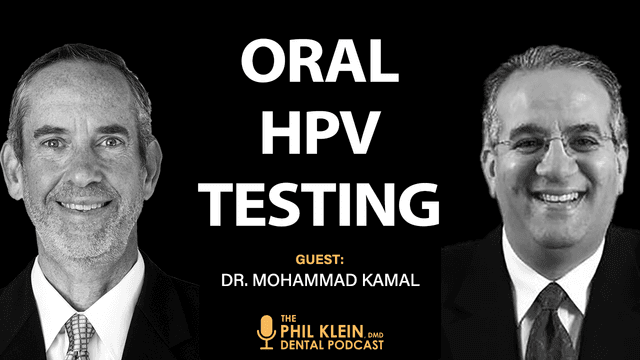
Dr. Mohammad Kamal, founder and CEO of Omni Pathology Laboratory, brings extensive expertise as a board-certified anatomic pathologist with subspecialty fellowship training in gastrointestinal and liver pathology at UCLA. Having served as Medical Director of LabCorp's Dianon Laboratory and Chief Medical Officer for PLUS Diagnostics, Dr. Kamal has managed large national pathology laboratories and now focuses on advancing collaborative healthcare between medical and dental professionals.
This conversation explores how dental professionals can integrate HPV screening into their wellness dentistry approach, potentially preventing oropharyngeal cancers through early detection of persistent HPV infections. Dr. Kamal explains why the oral cavity's connection to systemic health makes dentists uniquely positioned to screen for throat cancer, and how this screening aligns with the growing trend of wellness-focused dental practices.
Episode Highlights:
HPV screening in the dental office takes only 30 seconds using a simple oropharyngeal swab, with results available within 24 hours. The test targets the tonsils and base of tongue where over 80% of HPV-related oropharyngeal cancers develop, making dental professionals ideally positioned for early detection.
Persistent HPV infection, defined as positive results on retesting after 6-12 months, indicates increased cancer risk and warrants referral to ENT specialists. Unlike transient infections that resolve naturally, persistent cases require ongoing monitoring and potential intervention to prevent malignant transformation.
No known precursor lesions exist for throat cancer because systematic screening has been absent, similar to how breast and colon cancers would remain undetectable without mammograms and colonoscopies. Regular HPV screening could reveal early dysplastic changes before invasive cancer develops.
Patients who underwent childhood tonsillectomies show significantly lower rates of oropharyngeal cancer in research studies from 2015-2016. Combined HPV testing with targeted tonsillectomy for persistently positive patients could dramatically reduce throat cancer incidence in high-risk populations.
Wellness dentistry practices can integrate HPV screening as a practice differentiator and patient service expansion. This screening aligns with the oral-systemic health connection that many practices are already promoting, providing additional value while potentially preventing life-threatening cancers.
Perfect for: General dentists interested in wellness dentistry approaches, dental professionals seeking to expand screening protocols, and practitioners wanting to integrate oral-systemic health connections into patient care.
Discover how 30 seconds of screening could transform your practice's impact on patient health and cancer prevention.
Transcript
Read Full Transcript
This transcript was automatically generated and may contain errors or inaccuracies. It is provided for reference and accessibility purposes and may not represent the exact words spoken.
Somebody who has persistent HPV infection could benefit from a tonsillectomy. Then we're not
talking about a large segment of the population. It's a very small percentage of the population.
And that, in my opinion, could result in significant reduction in the incidence of throat cancer.
Welcome to the Phil Klein Dental Podcast. There's no question there's been an ongoing buzz and
growing interest among dental professionals in what is being referred to as wellness dentistry. So
what exactly is wellness dentistry? And why would a dentist consider positioning his or her
practice around it? To answer these questions and more is our guest, Dr. Mohammad Kamal, founder and
CEO of Omni Pathology Laboratory. Dr. Kamal completed his pathology training at Harbor UCLA Medical
Center in California, serving as a chief resident. He completed subspecialty fellowship training in
gastrointestinal and liver pathology at UCLA, and he is board certified in anatomic pathology.
Dr. Kamal has extensive experience in managing large national pathology laboratories, having served
as medical director of LabCorp's Dianon Laboratory and as chief medical officer for PLUS
Diagnostics. Dr. Kamal will be joining us in a moment, but first, if you're looking for a state-of
-the-art denture system, then you need to check out iVotion. from Ivaclar. The Ivotion denture
system is a fast and predictable process that delivers a finished denture out of a single disc for
increased efficiency with attractive aesthetics. Your impressions are quickly and easily digitized
in the lab, and the intuitive software allows the denture to be individually designed and
customized with high accuracy in only one uninterrupted milling cycle without bonding.
the Ivotion disc is transformed into a denture with both base and teeth material.
And when the milling process is done, all you need to do is polish. The Ivotion denture system is
truly a game changer in denture fabrication. The dream of finishing a denture out of one single
disc with unparalleled efficiency and quality is now a reality. To learn more,
visit ivachlor.com. Dr. Kamal, thanks for joining us. Phil, pleasure to be here.
Thank you. So as a medical pathologist, why is it important, in your opinion, for you to educate
dental professionals on the topic of wellness dentistry? I actually look at our relationship with
our colleagues in the dental industry as a collaborative relationship because a lot of the things
that happen in the body impact. the oral cavity and vice versa.
So we know that medically, the oral cavity is connected to the whole body.
I was pleasantly surprised when I started looking into promoting testing to dentistry to see that
there is this approach of dental health and the connection with oral health and connection with the
overall health. We know that it is really important for us to advocate for our patients' overall
health. It would not make any sense for a specialized practitioner to just focus on that area and
ignore everything else. I know that, for example, is that when I went for my dental implant,
there was a comment about the good bone density,
right? So that is a systemic issue, but it impacts a dental procedure.
Wellness dentistry is really on the upswing right now. There are dentists that are starting to
market their practice with the basis of wellness dentistry being the fundamental culture or
ideology of their practice. The significance of the oral health and systemic health link has been
talked about for a long time, but it's now becoming very well accepted in the community, in the
dental community. And as I said, a lot of these dentists are starting to market their practice
based on this. So how can the medical and dental communities collaborate more? on addressing this
tie-in between oral health and systemic health, specifically with throat cancer. When I started
practicing pathology, I had this idea, we were in a conversation about...
specimen and additional testing that we could do on the specimen. And I came up with this term.
I said, I want to maximize the diagnostic potential of the specimen. So you get a biopsy, you can
stain it and look morphologically at what you see and you make a diagnosis. But there are
additional molecular testing that you could do on that one sample. And you pursue that so you can
add to the diagnostic information. So that's maximizing the diagnostic potential of a specimen.
I feel that we also need to maximize the diagnostic and therapeutic potential of every encounter
with a healthcare provider. So it would be a missed opportunity for us to see patients going to
dentists, opening their mouths. And with dentists that have complete access to that throat,
and it would be a missed opportunity if we don't swap that to see if this patient has HPV,
especially if that patient has some risk factors, right? So that is my feeling,
is that we need to collaborate and work. And if it's something, if I wait for the patient to see an
ENT doctor, there are people that they live their whole life without seeing an ENT doctor once.
So I want that throat to be swabbed because there is an HPV-related cancer that is rising and we
really need to do something about it. And I think this fits in very well with the whole wellness
dentistry approach. It's something else the dentist can put in their menu of services that they
provide as they onboard the patients into their practice and they continue to service that patient.
with their oral health, but also keeping in consideration what you just said, which is so
important, which is that opportunity to get in there and do their thing with screening. It's so
important to do that screening. So related to the topic we're discussing today, what do you think
needs to be done in professional continuing education as well as patient education to further this
effort, not losing this opportunity? to be able to do this screening,
which can potentially save a patient's life with throat cancer. This is what we are doing today.
We are basically trying to spread the word about this test. When I was presenting to the California
Dental Association meeting in Anaheim last May, I met with a dentist who stopped by to discuss the
test, and he told me that his best friend was diagnosed with HPV-related oropharyngeal cancer and
passed away. And he was extremely touched by that because it hit him at a personal level.
And when I think about this, I say, well, people really know about it.
They just don't have – this test wasn't available two years ago,
three years ago. So what we are trying to do now is to say, okay, the test is available.
the approach. We know that HPV infection resolves on its own,
but that's exactly what happens in the cervical canal too. But what we know also is that persistent
HPV infection is linked to the development of cancer. And because of that,
the only way to identify the patient with persistent HPV infection is to test them and retest them
and make sure that if the patient has that persistence, which is positive for maybe a year and a
half or two years, that person should be referred to an ENT doctor. Now, having said that,
I know from my current conversations with dentists is that some of them do not want to further
follow up that patient. They want the patient once testing positive to be followed by an ENT
doctor. I actually think this is reasonable too, because a lot of, a lot of. Practitioners do worry
about the liability of missing cancer or being in knowledge of a virus that causes cancer and
sitting on it for a year or so. So it is also reasonable that somebody who tests positive gets
referred immediately and let the ENT doctor follow up that. Even the primary care doctor can do it.
So I think that this is really a collaborative effort, but we really want to work as a team.
We're all on one side as patient advocates. Now, what about the HPV vaccine?
Has that created some sort of herd immunity, even for those that didn't take the vaccine or haven't
taken the vaccine? I actually don't know about the vaccine causing herd immunity.
But one of the journals that I was reading mentioned that throat cancer is not an acceptable or
approved reason to get HPV vaccine. Because there hasn't been any link,
meaning that they couldn't really identify precursor lesions, right? The reason you don't see
precursor lesions for throat cancer is because nobody's looking at these patients. We want people
to start looking at these patients because they are positive for HPV infection. So that's why. But
yes, eventually, when the vaccine becomes more prevalent and when the vaccine is offered to boys
and girls and over time. you will see probably a decrease in the prevalence of HPV in the
community, which basically will eventually result in some kind of reduction in the infection
through the oral and the genital encounters. Right, and that should, because of the relation
between HPV and throat cancer, it should probably reduce throat cancer cases,
correct? Of course. Yeah, it should. It should. But I also don't think that this is how cervical
cancer incidence declined. It declined because of the testing and because of the follow-up and
well-defined guideline to follow up a patient who's positive for HPV. Let's specifically talk
about the dentist now and their role. Explain to me how you see the interaction with the patient
when a dentist... is onboarding a new patient into their practice. They're doing the typical cancer
screening protocol. How would you integrate this HPV test into this?
And do you think that almost every patient should be swabbed for this test? I think the beginning
of this interview is going to help me in answering that question, meaning that if we present our
practice as a practice focused on wellness, and we are focused on...
overall health, because this is linked to the oral health, and because this is a cancer that's
rising, and because that's exactly what we do when we palpate. Now we have an additional tool to
test for HPV. I think most patients will agree to it. Yeah, I think it's a practice builder,
in my opinion. You know, and on top of that too, it's a legacy. I think it's a legacy for any
practice to take part in fighting a rising cancer.
We'll be returning to Dr. Kamal in a moment, but first, are you looking for an air-driven
handpiece that rivals the power and torque of electric? Well, I have good news. It's finally here.
It's called the TMAC-Z, and it's from NSK, a company we all know and trust as a world leader in
dental handpieces. In addition to being lightweight and ergonomic, this revolutionary air-driven
handpiece delivers unprecedented 44 watts of power, allowing it to cut through tough zirconia
smoothly and quickly. In fact, the TMAX-Z reduces overall cutting time by 30%.
That means less chair time, reducing the burden on you and your patient. Take a test drive of the
TMAX-Z air-driven handpiece from NSK. For a free 10-day trial, go to nskdental.com and find
your local rep to inquire. Experience the power and excitement of the TMAX Z series.
Now, how long does it take to do the HPV test? Now, I know the tonsils are the most...
-related area, if the patient has tonsils, right? The crevices in the tonsils,
as you explained on another podcast, has the most potential to develop HPV activity,
persistent HPV, inside those crevices within the tonsils. Explain to us, I know you have a website,
which I do want to mention, if it's okay with you, Dr. Kamal. Sure, please. Omnipathology.com.
If you go there, you will see videos and other information about And you explain it.
You talk to this topic on a different podcast. What is exactly on that site, Dr. Kamal? So we have
educational videos on the site where a patient or a health care provider can go in and they would
read material. They would read frequently asked questions and answers. And then you can click on
videos and you could see how the swab, the swab itself, the process doesn't take more than 30
seconds. And that is well. displayed on the video and it has a diagram showing where to swab.
And then after that, the specimen is sent to us and within 24 hours, the doctor will get a result.
And I think it's so important that we hit this issue because as I said, a lot of dentists are
marketing their practice as a wellness practice and a lot of them are trying to specify their
treatment. to the patient based on their particular systemic health. Each patient is different and
unique in their own way, and it's important to customize treatment plans based on medical
conditions that some of these patients have, and certainly this fits into that. Now,
how would you respond to a dental professional who doesn't believe that the dental office is the
right place to screen for throat cancer? I would respond by saying,
first of all, we're talking about an oropharyngeal cancer. And that oral portion is oral.
And I always tell people, if not us, then whom? Then who?
And if it's not now, then when? This is an opportunity. Failing to take this opportunity and
swabbing the patient, I don't know how a practitioner can handle knowing that this patient down the
road could come with throat cancer. Yes. I mean, this is something that is preventable. And then
when you look at the literature that says there are no known precursor lesions, the key word here
is known because there is no way that there are no precursor lesions. And the reason there are no
known precursor lesions is because nobody's looking at these patients. Now, explain what you mean
by precursor lesions. Can you elaborate on that for our audience? Yes. The vast majority of cancer,
especially. carcinomas, like epithelial cancers, they do have a stage.
Before they become malignant, there is a stage called dysplasia. Dysplasia is basically cells are
becoming on their way to become malignant. So that is a stage where it has not been invasive.
It has not invaded any other adjacent organs. There is no chance for a dysplastic lesion to
metastasize and go anywhere, even a lymph node. So what we want to do,
and that's what we do in every organ system, is to catch that lesion either before it becomes
malignant, so it is still dysplastic, or before it enlarges and spreads somewhere else.
So you're saying there's no precursor lesion for throat cancer? No known precursor lesions.
And the reason they're not known, because no one is looking. So think about, for example, if I say
that a precursor lesion in breast is a small lump, right,
or an early lesion, a small lump. If nobody is doing exam or nobody is doing mammograms,
then, of course, nobody will know what's there. So it's the same thing with the colon cancer.
We do colonoscopies to see the polyps, and when we remove the polyps, they don't progress into
cancer. Right, so that's the precursor. Cursor lesion is the polyps. So in that case, right. So in
throat cancer, what's your explanation why no one's looking at it? Is that because dental
professionals who most often have, you know, the opportunity to look in the mouth and treat these
patients with their objective of good oral health, they're just not focusing on the oropharynx?
They're just not paying attention to it? And that area we're talking about is the area directly
behind the base of the tongue, the tonsils, etc. For simplification, it's basically the back of the
throat and you don't have to go down anywhere in the larynx or the pharynx.
But the thing about it is that they are looking for lymph nodes that have already become
metastatic. Right. The reason you don't see precursor lesion is, number one, nobody's going with a
scope. An ENT doctor can go with a scope and see a lot more than what a dentist would just see when
the patient opened their mouth. Right. I was going to ask you that. If no one's looking for it,
once the patient is referred to an ENT specialist, then through endoscopy, they'll be able to see
and identify a precursor lesion potentially of throat cancer. Yes. And the second. thing is because
when we describe the anatomy of the tonsils, sometimes the tumor starts underneath the surface,
right? So it becomes really difficult to visualize. However, If we do the testing,
then there is going to be much more thorough examination of the oropharynx, and that will give us a
chance to identify those dysplastic or precursor lesions. So it's up to the dentist,
once the HPV test is done, when they get the results back, if it's shown to be persistent HPV,
they have the opportunity then to say, you know what, I'm going to be really, really cautious here,
and I'm going to send this patient out to an ENT specialist. or they do another test in six months.
And if they get another persistent positive result on HPV, you're recommending,
you're saying it's really up to the dentist, whatever they feel comfortable, but some dentists are
sending it out right away to the specialist and some are holding onto it to evaluate it because it
could come and go, like you said, based on the health of the patient. If they're suffering from the
flu or they're just worn down with stress, that could be a positive persistent HPV result.
Is that right? Right. Right. And for clarifications, when somebody is testing positive once, we're
not going to call that persistent. But of course, if they get retested in six to 12 months and
they're positive, then we could consider that this is somebody that is likely to have a persistent
HPV infection. Right. And what happens if they have no tonsils? Where do you swab? Oh, that's a
great question. I think because, again, it's the tonsils on the back of the and the base of the
tongue. So maybe that would be an area to swab. But also, I think that those patients are going to
be at a much lower risk of developing throat cancer. And we know that because there's about I think
it's about 80, 70 to 80 percent, if not more. I don't recall the exact percentage of oropharyngeal
cancer happening on the tonsils, probably over 80 percent. So that's like a big. percentage of
those cases that are happening on the tonsils. So if somebody doesn't have tonsils, that person
could be presumed to have a lower risk or a lower chance of developing cancer.
But that doesn't mean that if they have high risk activity, they should be swapped. They should
definitely be swapped. It'd be interesting to see any... papers on the prevalence of throat cancer
in the population that was growing up where tonsillectomy was routine protocol.
And that's when I was a child, way back. I don't want to tell you how long ago that was. Yes, there
are studies from about 2015, 2015, 2016, that showed lower incidence of oropharyngeal throat
cancer. in patients that got their tonsillectomy prophylactically removed as children.
And then there are later papers that come to address the issue of oropharyngeal cancer and it's
linked to tonsillectomy. And of course, those later papers are saying that they don't really
believe that this would be the ideal way to combat throat cancer,
to go out and start removing people's tonsils. It's not practical and I don't think it's reasonable
and it's economically. so burdensome. But I believe that if you incorporate the oropharyngeal HPV
test in that approach and you say somebody who has persistent HPV infection.
could probably benefit from a tonsillectomy. Then we're not talking about a large segment of the
population. It's a very small percentage of the population. And that, in my opinion, could result
in significant reduction in the incidence of throat cancer. Okay, well, Dr. Kamal, we really
appreciate your time on this. Again, to our audience, Dr. Kamal has a website called omnipathology
.com. I highly recommend people visiting that. That's omnipathology.com. He has videos,
information, how-to videos. how to take a swab of the pharynx to identify whether the patient has
persistent or may have persistent HPV, which we just talked about is highly related to the
incidence of oral pharyngeal cancer. The throat is right there in front of us, and it takes seconds
to do this swab. And as we can imagine, it can be a massively significant benefit to intervene and
take that opportunity to prevent something that we know could be life-threatening. Dr. Kamal,
thank you so much for your time. We appreciate having you on the show. Thank you, Phil. If you've
been enjoying our podcast, we'd love to hear your thoughts and feedback by leaving a review on your
favorite podcast platform, whether it's Spotify, Apple, Google or any other platform you listen on.
Leaving a review is a fantastic way to support us and help others discover our show.
Thanks for listening. See you next time.
Clinical Keywords
Dr. Mohammad KamalHPV testingoropharyngeal cancerthroat cancer screeningwellness dentistryHPV infectionpersistent HPVoral-systemic healthoropharyngeal swabtonsillectomyENT referralprecursor lesionsdysplasiacancer preventiondental screeningoral cavity examinationOmni Pathology LaboratoryDr. Phil Kleindental podcastdental educationoral pathologysystemic health connection