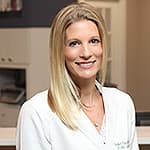
General Dentist & Orthodontic Provider · Brush and Floss Dental Center
University of Michigan School of Dentistry · Omicron Kappa Upsilon Dental Honor Society · US Navy Dental Corps
Read full bio
Dr. Julia Latham enjoys working with people of all ages and genuinely cares about improving the oral health of her patients. Dr. Latham grew up in New Zealand and moved across the Pacific in 2001 for her undergrad at Boston University, completing her DDS from the University of Michigan school of dentistry in 2011. While attending UMSoD, Dr Latham was the recipient of the William S. Kramer Award of Excellence, inducted into the Omicron Kappa Upsilon Dental Honor Society and served as co-chair for the Scholars Program in Dental leadership where she led a capstone project collaborating students, faculty and community dentists to increase the efficiency and efficacy of local children's clinic to help improve access to care. Additional honors include: the 2009 Periodontal Alumni Association Award for excellence in preventive periodontics and the 2011 American Academy of Oral Medicine Award.
Dr. Latham began her dental career as a general dentist for the US Navy serving in a military dental clinic in Rota, Spain and returned to the US to practice general dentistry with Tidewater Dental Group in Virginia Beach, VA. In 2014, Dr. Latham partnered with a successful muti-disciplined practice, Brush and Floss Dental Center in Stratford CT, where she now maintains a private practice focused in orthodontic and restorative care.
In her not so spare time, Dr. Latham is the proud mother of two young sons, and enjoys making rap videos with her husband, an emergency room physician at Bridgeport Hospital, including a recent video about dentistry they made during the Covid-19 shutdown.
Dr. Latham may be contacted at julialathamdds@gmail.com.
Are you still struggling with messy impressions, delayed lab returns, and frustrated patients who need to wait days for retainers or night guards? The integration of 3D printing technology could revolutionize your practice workflow and patient experience.
Dr. Julia Latham, a general dentist and partner in a five-doctor, 16-operatory practice in Stratford, Connecticut, brings extensive clinical expertise to this discussion. She earned her DDS from the University of Michigan School of Dentistry in 2011, where she received the William S. Kramer Award of Excellence and was inducted into the Omicron Kappa Upsilon Dental Honor Society. Dr. Latham has completed extensive postdoctoral training in orthodontics and maintains Invisalign Platinum provider status. After serving as a general dentist for the US Navy in Spain and practicing with Tidewater Dental Group in Virginia, she now focuses 50-60% of her practice on orthodontic and restorative care.
This conversation explores how 3D printing technology transforms dental practice efficiency, patient satisfaction, and clinical predictability. Dr. Latham shares her experience implementing digital workflows that eliminate traditional impression-taking while maintaining high-quality outcomes. The discussion covers practical considerations for selecting equipment, managing staff training, and integrating new technology into busy multi-doctor practices.
Episode Highlights:
Digital workflow efficiency allows scanning patients with braces on, digitally removing brackets using free software like MeshMixer, and pre-fabricating retainers so bracket removal and retainer delivery occur in a single appointment. This eliminates patient wait times and reduces the risk of orthodontic relapse from delayed retainer pickup.
DLP (Digital Light Processing) printers offer significant speed advantages over SLA (Stereolithography) systems because UV light cures entire layers simultaneously rather than point-by-point laser curing. Print times average 15-20 minutes for multiple models, making the technology suitable for high-volume practices.
Post-printing workflow requires three essential steps: printing the appliance, washing in specialized alcohol solutions to remove uncured resin that would distort accuracy, and final UV curing. Support removal and minimal polishing complete the process, typically within hours rather than days.
Temporary bridge fabrication uses eggshell-style printed shells created from pre-operative scans, which are then relined with traditional provisional materials during preparation appointments. This approach reduces chair time while maintaining proven material properties and clinical outcomes.
Staff delegation allows assistants to handle STL file processing, printer operation, and routine appliance fabrication, while doctors maintain control over treatment planning and complex restoration design. Multiple assistants can be trained on digital file processing, though specialized printer operation requires dedicated staff members.
Perfect for: General dentists and orthodontists considering 3D printing integration, practice managers evaluating digital workflow investments, and dental teams in multi-doctor practices seeking efficiency improvements.
Discover how this technology eliminates impression-taking stress while creating new opportunities for same-day appliance delivery and enhanced patient satisfaction.
Transcript
Read Full Transcript
This transcript was automatically generated and may contain errors or inaccuracies. It is provided for reference and accessibility purposes and may not represent the exact words spoken.
As we know, 3D printing is constantly improving, it's changing. So you don't want to have to
upgrade your printer and buy a new one every few years. So you want to choose a company that can
just upgrade the software to allow for different things to print. Welcome to the Phil Klein Dental
Podcast. Today we'll be discussing the benefits of 3D printing and how it simplifies office
workflow. increases efficiency, and allows dentists to provide the highest quality care to their
patients. We'll talk about different applications 3D printing can be used for, as well as what the
dentist can actually delegate out and what they do themselves. Our guest is Dr. Julia Latham,
a general dentist and partner in a five-doctor 16 operatory practice in Stratford,
Connecticut. She has completed many postdoctoral courses in orthodontics and is an Invisalign
Platinum provider. Dr. Latham, thanks for joining us. Hi, Phil. Thank you so much for having me
today. It's a pleasure to be here. Yeah, it's a pleasure to have you. And I noticed offline we
chatted briefly and I picked up what I thought was an Australian accent, but there's an overlap
between New Zealand and Australia, which has a very unique accent, different from South Africa,
different from London. Yes, yes. Very different from all of them, closest to Australia. Yeah,
closest to Australia. The reason why I know Australia accent so well is because I was a big tennis
fan back in the day when Australia ruled when it came to tennis. And you had John Newcomb and Rod
Laver. And there were so many great Australians. And I would always listen to the post-tournament
interviews, the press conferences. And I'd hear that very easily identifiable Australian accent.
So that's where that came from. We're not here to talk tennis. We're here to talk 3D printing.
So again, I appreciate your time. So to begin this podcast, tell us how long you've been 3D
printing in your practice. And I know you have a very large practice in Connecticut, like five
dentists and 16 operatories, something like that, which is huge.
And so how long have you been employing that there? And tell us the main reasons why you decided to
take that step to get into 3D printing. Great question, Phil. I would say our main reasons why we
started 3D printing and also why we have continued 3D printing, because we've just noticed the
predictability, profitability, we've been able to really increase our efficiency. And for,
you know, for patient comfort, I think all of us as dentists are really looking to create the best
possible experience for our patients, right? But at the same time, we are also trying to make this
as easy as possible for our staff and for ourselves. In 2018, I remember that's when we first got
our iTero scanner. And, you know, this was such a game changer for our practice. And from that
point on, I really never wanted to have to take another full archipelius impression. But the issue
with not taking impressions was... You know, we make a lot of retainers and we make nightguards in
-house to reduce our lab costs. It just didn't make sense to take a scan and then send that scan to
the lab for them to print a model and mail it back to us for us to then fabricate the appliance. I
mean, at that point, you might as well just take an impression because it would be quicker. So
really, as soon as we got our first scanner, that's when I realized that it really did make sense
to also be 3D printing. And actually in 2020, that's when we got our first 3D printer.
We got the DMG Dentimax printer, which we're very happy with. I would say it was partially the
COVID shutdown that was a catalyst to us taking that step. I'm not sure if you remember, but those
were the days when Amazon Prime shipping wasn't two days. It was like seven, 10 days. Everything
was taking so long. My trusty lab that could get my retainers or models back in two days prior to
COVID was now taking like a week. Everything was so long. I wasn't able to tell my patients when
they could come back to pick up with their retainers. So we really needed the 3D print. And
fortunately for us at the same time, we had this great opportunity with DMG to try out the new DMG
3D Max printer. And we were actually one of the first offices in the USA to use this printer.
So let me ask you this question. Change is always a little frightening, especially in a big
practice where you have a lot of dentists, a lot of staff, a lot of operatories. So you started
with a scanner and then you added this new printer. What was the ramp up time? How long did it take
for you to adjust to the new workflow where you were not sending these cases out to the lab and you
were printing it in-house? Well, we went from one iTero scanner to now having two iTero scanners
and two minute scanners. We've only needed to purchase one printer because you can print multiple
models at the same time with one printer. Luckily, we did have a very good assistant that was able
to learn the technology very quickly. And so actually, we got right into it.
It's one of those things, if you have it, you have to use it. It was so seamless for us bringing it
in. It just took some time. The assistants had to learn some of the software as far as getting the
STL file from the scanner and transfer it into a printable file.
For the printer, there was, you know, a little bit of software they had to learn, just push a few
buttons. But I would say it was a fairly simple transition. Which software are you using for your
3D printing? We use software that's called NetFab. And you can actually see the build plate.
And so you just import your file. You put it on the build plate. You have to add supports and a
base plate, perhaps, so that it's stable. You can use AI if you're going to be...
say changing the model in any way but for most of it it's you know pretty straightforward pretty
pretty straightforward yeah so if i was looking for a 3d printer for my office what are some of the
things i need to think about regarding compatibility and for one assume i have a scanner right
because nobody's going to buy a 3d printer if they don't have a scanner that's right so you have a
scanner and the data collected from that scan goes directly to the lab You're in the beginning of
the digital workflow world. And then you decide to make that leap into getting a 3D printer. And
when you make that decision, what should I be concerned about regarding compatibility with my
scanner, compatibility with the materials that I might choose based on the different oral
appliances and devices that I plan to print? Well, I would say you really want to choose a company
that's innovative and is keeping up with the latest technology. Because as we know,
3D printing is constantly improving. It's changing. So you don't want to have to upgrade your
printer and buy a new one every few years. So you want to choose a company that can just upgrade
the software to allow for different things to print. So that is super important. And with our DMG
printer, we've found, you know, every time there's a new resin that comes out, we can just upgrade
the software and it's compatible. As far as with scanners, I think there shouldn't be any
compatibility issue. Okay, what about materials? Am I locked into, if I buy a Dentimax,
for instance, and that's a DMG printer, am I locked into buying materials only from DMG for that
printer? No, you are not. We actually purchased a GC temp material for printing temporary bridges,
and that worked just fine with it. Okay, so it's important for a dentist to keep that in mind when
they buy a printer, whether or not they're locked into anything specific. Yes. Some other things to
keep in mind is you really want to think about the size. Now, firstly, the size of the build plate,
because the bigger the build plate, the more models you can print at one time. And then the more
time efficient you are. Now, if you're making in-house aligners, this is really key, is you have
to print a lot of models. But you have to think about the size of the whole unit as well. So the
footprint of the unit has to be small enough to fit in your lab space. And you have to think about
the size of the pixels because the smaller the size of the pixels, the higher the resolution and
the better accuracy of the print. So our Zentimax printer has a...
pixel size, 34 microns. And, you know, so far we've found our prints to be very accurate and also
very stable over time. And we found the build plate to be large enough for our needs, but it fits,
you know, fits easily in our lab space. One other point is it's not just a printer. You have to
wash and cure each print. So the Dentimax system has an integrated washing and curing unit.
So it makes for a smaller footprint. Does the wash and cure setup take up more room or how is that
organized? The wash and the cure, they can stack on top of each other. Okay. So what I wanted to
ask you about 3D printing, some dentists who have never done it before, they don't have experience
with it. they should be aware that there's more to do after the final product is fabricated,
right? I mean, there's post-fabrication work that has to be done. Yes. Yeah. Could you go over
that? And how much time are we talking about? And I'm not trying to discourage anybody from getting
a 3D printer, but I think it's important that they understand that what's printed in the office is
not the same thing they're going to get back from a lab as the final provisional or the final
occlusal guard, whatever they're trying to fabricate. Tell us about that a bit. So it depends on,
you know, whatever you're printing, you could print a model, you could print provisional
restorations, you could print a night guard, you could print a sports guard or, you know,
a bleaching tray. Whatever it is, there are really three main steps. So the first thing,
I'll just go over the DMG system with you. So first you just select the file you want to print.
You literally push the button on the touch screen. It will tell you how long it's going to print,
say about 20 minutes. Once it's printed, you have to remove that workpiece from the printer and you
place it in, it's called the 3 to wash unit. Now all prints need to be washed as they have uncured
resin on them, which has to be removed or it would distort the workpiece and it wouldn't be
accurate. So once it is washed, then it's placed in the 3 to cure unit for a final cure.
So it is those three main steps. And no matter what printer you get, you have to go through all the
three steps. After you take it out of the final cure, you just remove your supports and base plate,
and it's ready to go. So after the wash and cure, is there anything else to do as far as finishing,
polishing, et cetera? At that point, it's pretty good. You probably have to polish off where the
supports were. Right. So there's not much to do post-fabrication. The way that our system works is
because it is integrated, it automatically knows, say, how much alcohol to use to wash and it knows
how long it's going to take. So if you have to leave it overnight, you can do that. You don't risk
ruining it. So if you would, Dr. Latham, give us some specific examples of how 3D printing has
impacted your practice. I would say, you know, the patients have been impacted the most by using a
digital workflow. And that in turn impacts our practice due to a higher patient satisfaction.
Because, you know, no patient enjoys mouthful PVS or alginate impression material. And now,
you know, with the advances in digital scanning now, we can scan almost everyone instead of taking
an impression. And so the benefit of this is we have a permanent record of the patient's dentition.
And then once we 3D print a model. The material is so strong, it lasts for many years,
and we can use that same model over and over again to create occlusal guides, retainers,
if the patient loses them or breaks them, or the dog chews them. which actually happens all the
time. All the time. So versus a stone model, you know,
oftentimes, you know, a tooth will chip off on a stone model. So if a patient calls and they've
lost or broken their retainer, we can have a new one ready to be picked up in one or two days. And
if they've moved to another state, they can give us a call and we can ship a retainer to them. So I
feel like this all really ties into efficiency. And as dentists, you know, we're all about
efficiency. How can I plan this so the patient spends less time in the chair? And also,
how can I consolidate this treatment into fewer appointments? So it's less time for me and for
them. Just give you an example for my bracket and wire ortho patients. With 3D printing, I've been
able to change my process a little bit. So when they come in for a quick ortho check appointment
and I see they're ready for bracket removal, I will have my assistant scan them at that appointment
with their braces on. And I use this free software called MeshMixer that you can just download
online. And I remove their brackets digitally and then I can print and fabricate their retainers
ahead of time. So at their next appointment, it's brackets off and retainers on.
with really no waiting time in the chair. And the patient doesn't have to return a day or two later
to get their retainers. So I don't have to worry about them not picking them up and relapse and all
of that. That's amazing. So, and when someone loses a retainer, you could have it printed in the
office or you could even give them a backup. I mean, I don't know. Do you do that? Yeah, yeah,
I definitely do. The way we do it now, usually I print one model and we use the same model like
multiple times with a suck down to make retainers. It's very quick to make retainers that way.
The latest technology, I believe, is actually printing retainers directly. which I have not tried,
so I can't speak to the fit and the comfort of those. Right. So you use the suck-down technique
after the models are created. Yes, yes. Which is what we've been using. Yeah, we've been doing that
for a while, and that seems to be the most popular way currently. How much ortho do you do in your
practice? And I know you've completed a lot of additional training since graduating from dental
school in orthodontics. I'm a general dentist, but I have done a lot of training in bracket and
wire as well as Invisalign. So I'd say probably 50 to 60% of my practice is orthodontics.
So being an Invisalign dentist, do you see yourself at some point in the future printing your own
aligners or are you going to stick with Invisalign? Possibly. Say if I was doing a limited case,
it might make sense to design it, print the models, and then... I think with aligners,
you'd still probably have to do a suck down because those are pretty thin and they have to be very
flexible. Based on the discussions I've had with many KOLs on this show and outside of this show,
I think it's clear to me that even though more dentists are going to be buying 3D printers for
their office, I think they're going to continue to use services like Invisalign nevertheless. So
let me ask you this. What are some specific dental applications where 3D printing plays a key role
in your practice?
I just want to let you know the newest application we've been using 3D printing for is actually
printing temporary bridges. So I was very lucky to have been given the opportunity to trial the
iTero Design Suite. It's the new software from Align. And using the software,
I can create a temporary like eggshell style bridge even before the patient comes in for their prep
appointment. Now, these can print very thin. It was like 0.3 millimeters thin. So once you prep
the teeth, you just reline your printer temporary. We use Luxatemp, then cement it on,
and it saves you some time in that appointment. So you use it like a shell, right? Yes,
like it's like an eggshell, but you put your Pontic in there already. Okay, and then you just use
Luxatemp. That's a DMG product that's been around tried and true forever, and it's one of the best
temporary. provisional materials out there. What about straight out fabricating the provisional
itself using the 3D printer? Another option as well, say if you want to print your provisionals,
is you could prep the teeth first and then using the same scan that you send to the lab for your
final restoration, you could plan and print your provisional restorations. So you could do it that
way as well, but you would have to have staff there that are able to plan and print while the
patient is in the chair. So it doesn't work. for our office flow because we have a lot of patients
coming in and our days are pretty busy. So the patient would have to hang out for a while while you
print it. So it just doesn't work with our office flow. But in other offices, it might work that
well. And how much do you delegate to your staff to handle the 3D printing process? And it's
important to have some assistants trained to operate the 3D printer. We have a couple who are able
to operate the printer itself. meaning they know how to deal with all the resin material,
clean it, but not everyone does. But all of our assistants are able to do the digital aspect
regarding taking the STL file and changing it into a printable file.
That's pretty straightforward. Once you know the system, you just click a few buttons and it's
basically the same thing every time. So you have a pretty busy practice, Dr. Latham. You have 16
operatories, five doctors. So with that busy schedule, what are you using the 3D printer the most
for? We print models mostly just because we may make our occlusal guts. Just the style we make them
isn't so conducive to 3D printing, but we like to make the guide on the model that we're printed.
I can give you an example, say for my orthodontic restorative cases, what we do. Okay.
So for these, I really like using a digital workflow because I can plan the outcome ahead of time
and I like things to be predictable. So right now I'm actually using SmileFi software to create a
digital wax up with the ideal result before the appointment. I can then send the patient a digital
image of how their teeth would look like after the restorations are done and, you know, how their
smile would look so I can get their approval before we even prep the case. And so once I kind of
have the approval of how it looks, I then print a model of this digital wax up. So I create a stent
and I create retainers for the patient to wear while they're in their temporaries.
And the reason why I want retainers is because they've just finished ortho and I don't want their
teeth to shift before they get their final restorations. Also, say if they are a Bruxer,
it's going to protect their temporaries while they sleep in. And I also like to send this STL file
of the digital wax up that I made to the lab so they can copy the look and the shape of the teeth
and the permanent restorations. And because then I feel like I have more predictability over what
the lab is going to send back. So out of that workflow, how much do you delegate out to someone
else to do? Or do you do most of that? I like to plan my restorations. If I'm changing the model in
any way, I like to plan that. As far as printing occlusal guards,
bleaching trays, we have staff that can do that. Because that's pretty simple. It's just,
again, pushing a few buttons, going through the steps. So for you, it seems like 3D printing is all
about efficiency. Of course, it adds more control, immediacy as far as delivery. But I think the
efficiency factor for you is the most important element of 3D printing in your practice.
Yeah, I would say so. I used to have to have the patients come back multiple times. And so I think
it's less appointments because I can do, you know, some things I can do at home.
drinking a glass of wine, watching TV. You know, I can do this quickly. I don't mind doing it.
I'd rather work on my case there than when the patient is in the chair. In the end, it ends up
being less appointments for the patient because they don't have to come in, say, for their
impression and come back for their retainers. You know, it's less appointments,
especially with orthodontics. Yeah, I'm just wondering how you could even run your practice without
3D printing at this point. It's amazing. It would be. We'd be taking a lot more actual impressions.
Has it reduced your stress level associated with being a dentist? Yes. Yes. Yeah.
It's reduced the amount of patients gagging. Yeah. I mean, you're talking about having a glass of
wine and planning your workflow. Yeah. I don't mind doing it. How bad could that be? Yeah. Yeah.
I mean, it's amazing because I do a lot of podcasting and our show has taken off where we're
getting thousands of listens per episode. So it's very exciting to see that. on our program.
Yeah. It's really taken off. And, and I talked to a lot of KOLs and they are really enjoying their
profession to a whole nother level. Like they're just, these doctors like yourself are integrating
these digital tools and they're just, they still have the analog training behind them.
And I mentioned to one of the doctors that I've talked to on a recent. podcast is that the next
generation of dentists that come out will have no idea what it's like to do this without these
tools it's the same thing with my you know the kids that are growing up with cell phones they can't
imagine how society even functioned without a cell phone i mean everything is done on a cell phone
you can't go anywhere you can't put anything in your calendar you can't pay anybody like they look
at me these younger kids and they when i talk to them about it and say you know we didn't have a
cell phone back in 1980 and they they don't get it you know they just don't understand I'm thinking
the same thing is going to happen to dentists because it's already happening to you and you've
experienced both sides of it, right? Yes, yes. And we certainly used to do our own wax-ups by hand
and now transitioned over to digital wax-ups. Do you think the analog...
I don't have to go to the lab to do a wax-up. Like I said, I can sit at home and just do it on the
computer. Yeah, with some wine from New Zealand. I don't know if New Zealand has any wine of its
own. Oh, yeah, absolutely. Yeah, I do see it. Actually, I do see it in the grocery store. I see New
Zealand on the bottle. You'll see a lot of, you'll see Sauvignon Blancs. Yeah, right. Sauvignon
Blanc, yeah. And get a Pinot Noir from Otago. Okay, I'm going to try that because I like Pinot Noir
is good for you. It's a darker wine. There's a lot of stuff in there that's supposedly good for
you, good for your heart and so forth. I'm not sure your liver, but you know, you got to give up
something. Just to close out this podcast, it's been quite enlightening to talk to you because it
sounds like you're just enjoying things to another level. You've brought new efficiency in. You
certainly love the DMG. I think it's Dentimax you mentioned is the one you love. Dentimax,
yes. Yeah, to plug Dentimax. DMG is supporting this podcast. They're a great company. I know a lot
of people there. The owner, they just have a very... culture at DMG.
They care about the patients, they care about their products, and they always involve themselves
with really good clinicians that help them evaluate their products and make it better. So we're
happy to work with them. But in closing for this podcast, what key insights or advice would you
share with our audience who are considering integrating 3D printing technology into their practice?
I would say you need to have one or two assistants really dedicated to learning the technology and
operation of the printer. Once you learn it, it is very simple. But like with anything new, there
will be a learning curve. I mean, at this point in our office, I'm really not involved in any of
the printing anymore. My staff do it. But like I said, I still like to plan my own restorations.
But you can get to the point where your staff is able to take over all of it. One other point is,
you know, there are two main types of printers. I didn't go over this yet. There's DLP or digital
light processing and there's SLA or stereo lithography. So the printer we have is DLP.
So how that works is... When the build plate descends into the resin fill tank,
you have a UV light that cures each layer. So this is an advantage as it uses a light source.
So all points of a layer can be cured simultaneously. Whereas with the SLA printer, there's a laser
that has to cure each point. So it can take a little longer to cure each layer. So the DRP printer
does have a speed advantage. So it works for a busy office like ours.
That's another thing to think about is, you know, what are you going to be using it for, you know,
and how fast you need it to be. And the price of printers have really come down and you only really
need one, right? There's no need for to have a second printer. You'd have to have a pretty big
practice because these printers, they can print multiple work pieces at one time. It just depends
how you position them on the bill plate. So, and because the prints are fairly quick, you know,
15, 20 minutes. You can print one thing, put it in the wash unit, print something else if you need
to. So in your experience that you've had in your practice, if a dentist buys a printer, a 3D
printer, and starts using it, there's no turning back. There's no turning back.
We are in a new era right now in everything that we do. Everything's tied into digital,
and AI can play more of a role. in everything we do it's already playing a role in everything we do
yes um in fact we're using we just had a business call among ourselves our our own employees at
viva learning And we were looking at the AI that's installed in all of Windows, which is Copilot.
And you can say, recommend a podcast on bonding zirconia. Recommend a podcast on 3D printing.
We're very proud to say that we're showing up everywhere in those recommendations, which is a good
thing. Oh, that's great. Yeah, yeah. So AI could be your good friend, could also hurt you. But
regarding the technology and the AI that's... into dentistry, it's just evolving so quickly.
If we have a discussion five years from now, Dr. Latham, God willing, we will. We'll be talking
about something that we probably didn't even think could happen today. Absolutely. Absolutely.
Since 2020. There's been so many more developments in 3D printing. Now you're printing these long
-term provisionals that can last for years. It's amazing stuff. And retainers, all sorts of stuff
that we didn't have in 2020. And it makes dentistry more affordable for the patient. You can treat
more patients. Your lifestyle improves. As I said, technology could be a...
good friend to our society. It could be also dangerous, but from the standpoint of dentistry,
it looks like you're taking advantage of all this good stuff and power to you. Thanks again, Dr.
Latham, for your time. I know how busy you are. Thank you, DMG, and we really appreciate the
insight very much. Thank you. Thank you so much. It was great to be here.