April 22, 2026 · Digital Dentistry
Digital Workflow in Dentistry: A Practical Guide for Modern Practices
Last updated April 2026
Digital dentistry is no longer a niche interest for early adopters. It is becoming the standard of care for practices that want to deliver faster, more predictable, and more profitable outcomes. But the phrase "going digital" covers a wide range of technologies — and knowing where to start, and in what order, makes the difference between a practice that thrives with digital tools and one that struggles to justify the investment.
This article draws on four episodes of The Dr. Phil Klein Dental Podcast featuring some of the most respected voices in digital dentistry — covering intraoral scanning, mandibular jaw tracking, 3D printing, same-day zirconia, and injection-molded composite veneers — to give you a clear, practical picture of what the modern digital workflow looks like and how to build one.
Intraoral Scanning: The Entry Point for Every Digital Practice
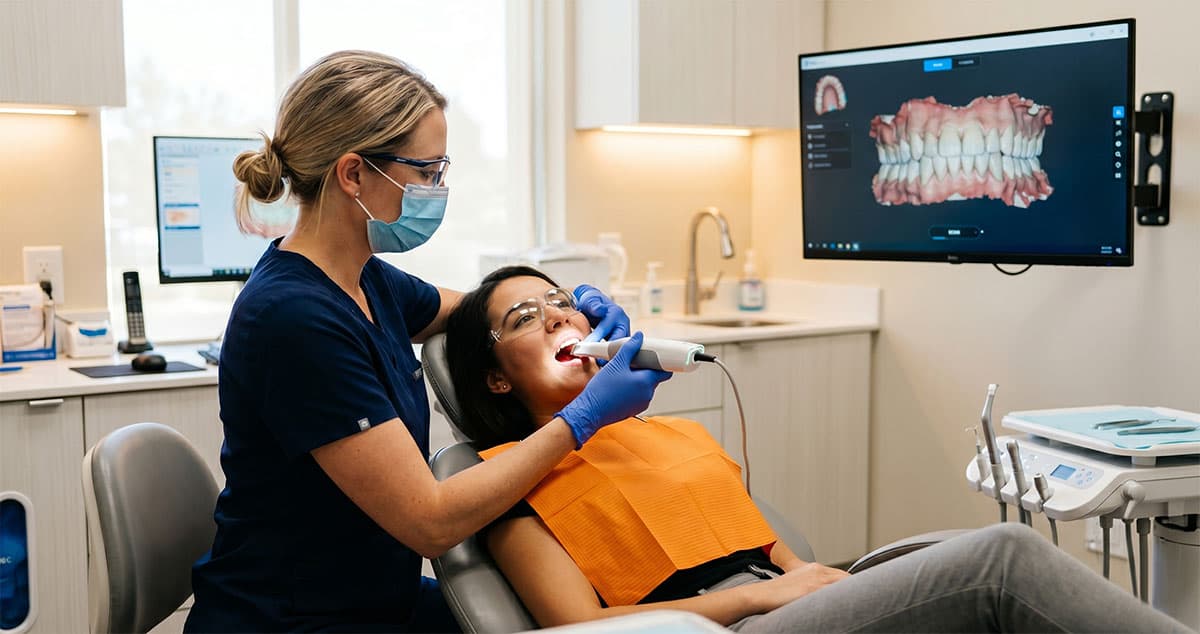
For most practices, digital workflow begins with the intraoral scanner. But not all scanners are created equal, and the differences matter more than most dentists realize.
Dr. Isaac Tawil — Diplomate of the International Academy of Dental Implantology, Pierre Fauchard Award recipient, board member of the Digital Dental USA Society, and Founder of Advanced Implant Education — draws a sharp distinction between single-camera and multi-camera scanner architecture on Episode 748 of The Dr. Phil Klein Dental Podcast. "I would really recommend only using a multi-camera scanner," he explained. "Single camera scanners only give you one perspective."
Beyond camera count, Dr. Tawil makes the case that scanner ergonomics directly determines clinical outcomes. The scanner head size determines whether a clinician can capture posterior margins accurately — and that no amount of software sophistication compensates for a device that is physically difficult to maneuver. "If I gave you a pen to hold and that pen was just a massive pen, it's hard to write with it. But if I give you a nice slim line pen, you have that nice grip... you could now become an artist. And I think scanning is very much like that."
The practical implication: when evaluating scanners, ergonomics and camera architecture should rank alongside price and brand recognition as primary selection criteria. A scanner your team can actually use in the posterior is worth more than a premium device that produces inconsistent results under clinical conditions.
Listen to the full episode: The Digital Stack: How Scanning, Jaw Tracking, and 3D Printing Power Modern Practices — Dr. Isaac Tawil, Episode 748
Jaw Tracking: Moving Beyond the Static Bite Record
The intraoral scanner is step one. Where the digital workflow becomes genuinely transformative is when scan data is merged with facial scan and CBCT data to create what Dr. Tawil calls a virtual patient — a dynamic, movement-capable reconstruction of the patient's dentition and skeletal anatomy.
Mandibular jaw tracking captures lateral excursive movements, protrusion, and open-close arcs in dynamic function rather than recording a single static bite position. The result is a dataset that allows clinicians and laboratories to evaluate occlusal schemes — group function versus canine guidance, full-arch wax-up contacts in movement — before any material has been milled or printed.
"You want to do a full arch. You want to do a wax up. You want to see how that's going to play. Are we going to be in group function, canine guidance? Where is that occlusion going to be at in movement? In movement, not just in plain static function, just in a bite." — Dr. Isaac Tawil, Episode 748
This capability has significant implications for full-arch implant planning, complex restorative cases, and TMD risk assessment. It also represents the clearest argument for why analog impressions — however well-executed — cannot compete with digital data in complex multi-unit cases: a physical impression cannot be merged with a CBCT file or a facial scan. The integration itself is what unlocks the clinical value.
3D Printing: The Revenue Generator Most Practices Are Missing
If the scanner is the entry point to digital dentistry, the 3D printer is where practices start seeing measurable practice growth — often faster than they expect.
Dr. Miles R. Cone — board-certified prosthodontist, Certified Dental Technician, Tufts University School of Dental Medicine graduate, former United States Army Major, and one of only two prosthodontists in all of New England holding both credentials — describes the impact of adding a 3D printer to his practice on Episode 728. After adopting digital workflow starting in 2023, he found his practice 36% ahead year-over-year. "The patient turnaround was quick. We were a lot more efficient. We were a lot happier. We had more free time. And the crazy thing was, yeah, we were making more money... the patient outcomes were better."
The applications that drove that growth were more varied than most dentists anticipate: same-day bleaching trays fabricated in 37 minutes while patients complete in-office whitening, in-house night guards at approximately $2-3 per unit versus $35-40 outsourced, models produced without alginate or lab delays, and provisional restorations delivered chairside. Dr. Cone's message to dentists on the fence is direct: "If you get a printer, you're definitely at the cutting edge of where the digital technology is. Most people don't have it. What I wish people would know is that it's really not as difficult as you think that it is."
Dr. Tawil adds a forward-looking dimension on Episode 748: DLP printing technology is returning with significant improvements in margin quality and color stability, and full-arch provisionals are now achievable in approximately 11 minutes. Nitrogen cure chambers extend provisional longevity to three months or more — and zirconia-infused printable materials capable of permanent restorations are on the near-term horizon.
Listen to the full episode: Inside the Digital Workflow: Dr. Miles Cone on 3D Printing Success — Dr. Miles Cone, Episode 728
Same-Day Zirconia: Strength, Fit, and Speed in One Appointment
For practices with a milling unit, same-day zirconia has crossed a threshold that many clinicians haven't fully recognized yet: it now delivers aesthetics approaching lithium disilicate, with superior marginal fit and the ability to be conventionally cemented in retentive preparations.
Dr. Mike Skramstad — resident faculty at Spear Education, alpha/beta tester for Dentsply Sirona since 2010, international lecturer, and 2000 graduate of the University of Minnesota School of Dentistry — has been evaluating zirconia materials longer than most practicing clinicians. His assessment on Episode 713 is grounded in 15 years of direct material testing: "Every dentist gets those situations where the fit is clinically acceptable, but there's areas that probably could fit better. And I immediately noticed zirconia is a little bit more forgiving with fit. The fit to me has a big role in longevity, and that was one of the things that zirconia satisfied for me."
Modern blocks like the Katana block and IPS e.max ZirCAD Prime can be sintered in approximately 15 minutes using advanced furnaces — making same-day delivery genuinely practical. The ZirCAD Prime features a gradient design with 3Y strength at the cervical, 4Y translucency in the body, and 5Y aesthetics at the incisal. As Dr. Skramstad describes it: "Now fast forward to 2025, we have the same predictability. But the sintering speed is rapidly sped up and the aesthetics is, I would say, almost to the point of lithium disilicate at this point. They're beautiful restorations."
For retentive preparations, conventional cementation with glass ionomer or resin-modified GI cement eliminates the isolation and bonding steps required for glass ceramics — a meaningful time and complexity reduction in busy operative sessions.
Listen to the full episode: From Blocks to Furnace: Unlocking Same-Day Zirconia Success — Dr. Mike Skramstad, Episode 713
Injection-Molded Composite Veneers: Same-Day Cosmetics Without the Reduction
The digital workflow has also transformed conservative cosmetic dentistry in a way that is reshaping patient conversations around veneers. Injection-molded composite veneers — delivered using 3D-printed templates designed from a digital wax-up — allow clinicians to achieve aesthetic outcomes that previously required ceramic laboratory work, in a single appointment, often with no anesthesia.
Dr. Stephen Shaw, a 2003 graduate of the University of Tennessee College of Dentistry with over 20 years in private practice, describes the workflow and patient response on Episode 733. Hygienists perform intraoral scans during routine appointments. Within 48 hours, a digital wax-up and 3D preview are generated. Patients receive video simulations before their appointment — and the response, as Dr. Shaw describes it, is consistent: "The overwhelming statement is always, wow, you can do that?"
The injection molding template handles approximately 85-90% of final contouring automatically, including line angles, incisal edge placement, and contact tightness. Total treatment time for a six-unit case averages 60-90 minutes. And because minimal or no tooth preparation is required in most cases, Dr. Shaw notes: "I've done it with no anesthesia... the vast majority of the cases I've done in the last 10 years with this system."
Listen to the full episode: The Clear Advantage: Injection Molding for Composite Veneers — Dr. Stephen Shaw, Episode 733
The Episodes Behind This Article
The clinical insights in this article are drawn from four episodes of The Dr. Phil Klein Dental Podcast — the #1 clinical dentistry podcast, with 750+ episodes and 250,000+ dental professionals reached globally.
- Episode 748: The Digital Stack: How Scanning, Jaw Tracking, and 3D Printing Power Modern Practices — Dr. Isaac Tawil, Diplomate of the International Academy of Dental Implantology, Pierre Fauchard Award recipient, Founder of Advanced Implant Education
- Episode 728: Inside the Digital Workflow: Dr. Miles Cone on 3D Printing Success — Dr. Miles Cone, Board-Certified Prosthodontist and Certified Dental Technician, Tufts University School of Dental Medicine, Editor in Chief of The Messenger, American College of Prosthodontists
- Episode 713: From Blocks to Furnace: Unlocking Same-Day Zirconia Success — Dr. Mike Skramstad, Resident Faculty at Spear Education, Dentsply Sirona alpha/beta tester, University of Minnesota School of Dentistry
- Episode 733: The Clear Advantage: Injection Molding for Composite Veneers — Dr. Stephen Shaw, University of Tennessee College of Dentistry, 20+ years in private practice
All episodes are available on Apple Podcasts, Spotify, YouTube, and iHeart Radio.
This article is intended for general informational and educational purposes only and does not constitute clinical advice. Content is based on podcast discussions with clinical experts. Dental professionals should consult current evidence-based guidelines and qualified professionals when making clinical decisions. The Dr. Phil Klein Dental Podcast assumes no liability for clinical decisions made based on the content of this article.